🇮🇳 The sarees of India
127 sarees from India, best known first, across 80 centres and states.
The sari is an unstitched length of woven cloth draped over the body, worn across India, Bangladesh, Sri Lanka, Nepal and Pakistan. Its history runs back to ancient drapery in the northwest of the subcontinent, and it shares roots with earlier pieces like the stanapatta, uttariya and antariya.
- A sari measures 4.5 to 9 yards long and 24 to 47 inches wide.
- Over 80 drapes are recorded; historian Rta Kapur Chishti found 108 across 14 states.
- Cotton was cultivated and woven in the subcontinent around the 5th millennium BCE.
- Indigo, lac, red madder and turmeric were ancient dyes, still in use today.
- Red is the most favoured colour for a Hindu wedding sari.
Sarees in India
The sari is a single piece of unstitched cloth. It can run from about four and a half to nine yards long and roughly two to four feet wide. One end is tucked at the waist and the other rests on a shoulder like a stole, often leaving the midriff bare. The word comes from shatika, a Sanskrit term for a strip of cloth. Older texts describe a set of three pieces: a chest band, a shoulder veil and a wrap for the lower body. These grew into the modern choli, dupatta and skirt. The garment is everyday and formal wear across the region, and it sits beside related draped cloth in Nepal, Bangladesh and Sri Lanka.
Weaves and fabrics
Cotton was grown and woven in the subcontinent from around the fifth millennium BCE, and silk from about 2450 to 2000 BCE. Handloom saris are made in silk and cotton. Named traditions include brocade silks such as Banarasi, Kanchipuram, Gadwal, Paithani, Mysore, Chanderi and Maheshwari, and lighter cloths like jamdani, tant, Mangalagiri, Ilkal and tussar. Ikat and tie-dye appear too. Polyester, georgette and charmeuse are now common as well.
How it is worn
More than eighty drapes have been recorded, and one scholar, Rta Kapur Chishti, documented a hundred and eight across fourteen states. The nivi style is the most seen today: cloth wrapped at the waist, pleats in front, the loose end, or pallu, over one shoulder. Related family styles include kaccha or nauvari, where pleats pass between the legs, and sidha pallu, worn by women in Bihar, Uttar Pradesh, Gujarat and Rajasthan, with the end brought forward. Bengali wear folds in a single box pleat. In Nepal, a Newari drape ties the pallu at the waist.
Dyeing, printing and embroidery
Dyeing is old here. Indigo, lac, red madder and turmeric were used in ancient times and are still worked with. Tie-dye and block-print saris include bandhani, leheria, bagru, ajrakh, sungudi, dabu, bagh and kalamkari. Embroidery covers gota patti for formal wear, plus mochi, pakko, kharak, suf, kathi, phulkari and gamthi. In the south the choli is called ravike and ties at the front; kasuti embroidery decorates it.
Weaving centres
Many saris are known by the place or style they come from. Silk brocades include Banarasi, Kanchipuram, Gadwal, Paithani, Mysore, Uppada, Chanderi, Maheshwari and Narayanpet. Ikat and cotton saris include Patola, Pochampally, Bomkai, Khandua, Sambalpuri, Berhampuri, Bargarh, Jamdani, Tant, Mangalagiri, Guntur, Tussar, Ilkal, Kotpad and Manipuri. Kerala keeps a two-piece mundum neryathum. Kashmir took the choli from the Deccan by royal order.
Weddings, festivals and daily wear
Red is the favourite colour for a wedding sari, and it is the traditional bridal choice at Hindu weddings. Handloom silks, brocades, tie-dye and block prints serve festive and formal days. Ikat and cotton saris are worn for both festival and everyday use, while tie-dyed and printed cloth was favoured in the monsoon. A married woman may draw the loose end over her head as a ghoonghat, still seen in Hindi-speaking areas.
The saree today
The sari stays fashionable in the subcontinent and counts as formal dress in several countries of the region. Newer fabrics such as polyester, georgette and charmeuse are widely used. Since 2017 a non-profit project, the Sari Series, has gathered short films showing more than eighty regional drapes, keeping that variety visible.
The facts in this overview come from the Wikipedia article "Sari", written by its contributors and used under the CC BY-SA 4.0 licence. EveryPallu rewrote the text in its own words, with AI assistance, and compares every page with the article to make sure no passage is copied. It may be reused under the same CC BY-SA 4.0 licence with a link back.
Weaving centres and states of India
 🇮🇳 IndiaLambada embroidery
Mirror-and-cowrie hand embroidery by Banjara women of Karnataka and TelanganaEmbroidery · Appliqué
🇮🇳 IndiaLambada embroidery
Mirror-and-cowrie hand embroidery by Banjara women of Karnataka and TelanganaEmbroidery · Appliqué
 🇮🇳 IndiaHimroo
A silk and cotton fabric from Aurangabad that reworks the royal kinkhwab brocadeSilk · Brocade
🇮🇳 IndiaHimroo
A silk and cotton fabric from Aurangabad that reworks the royal kinkhwab brocadeSilk · Brocade
 🇮🇳 IndiaKani shawl
A pashmina shawl woven on a handloom with small wooden spools, from Kanihama in Kashmir.Wool
🇮🇳 IndiaKani shawl
A pashmina shawl woven on a handloom with small wooden spools, from Kanihama in Kashmir.Wool
 🇮🇳 IndiaGota patti
Rajasthani applique embroidery that stitches down ribbons of gold and silverGeorgette · Appliqué · Embroidery
🇮🇳 IndiaSujini embroidery
A Bihar quilt craft where women stitch stories with a simple running stitchCotton · Embroidery
🇮🇳 IndiaGota patti
Rajasthani applique embroidery that stitches down ribbons of gold and silverGeorgette · Appliqué · Embroidery
🇮🇳 IndiaSujini embroidery
A Bihar quilt craft where women stitch stories with a simple running stitchCotton · Embroidery
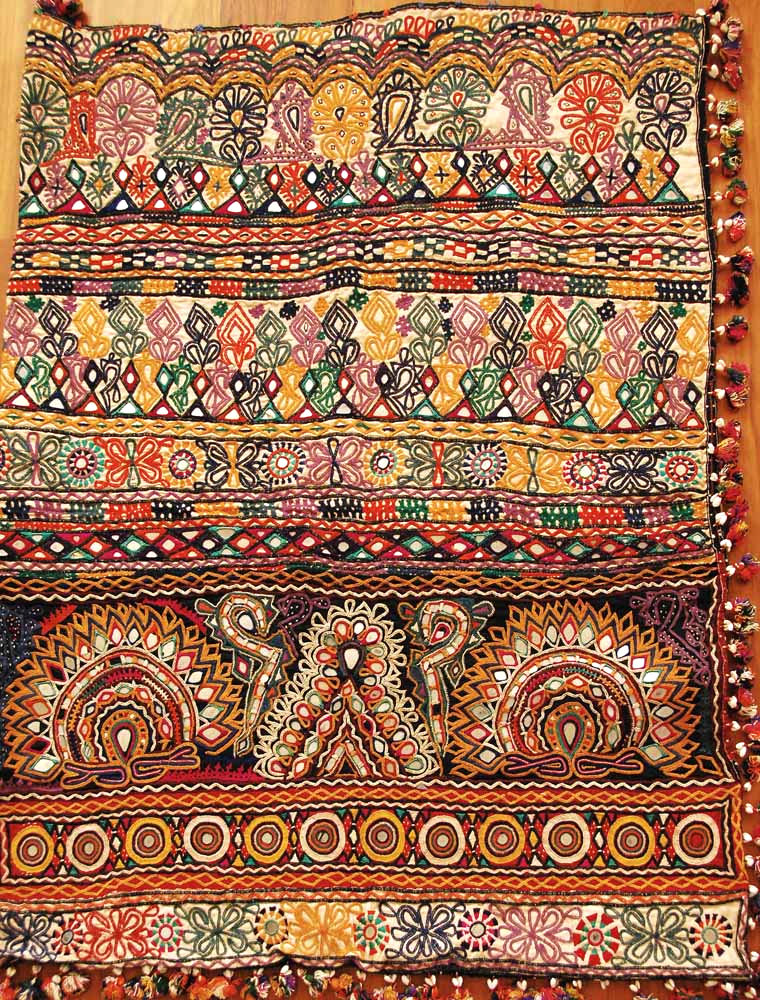 🇮🇳 IndiaKutch embroidery
Hand-stitched mirror work from Kutch, Gujarat, made by women of its tribal communitiesCotton · Embroidery · Mirror work
🇮🇳 India and 1 moreAgrun
A shawl-like festive wrap of the Hajong people, brocaded in silks with birds and flowers.Silk · Brocade · Zari work
🇮🇳 IndiaKutch embroidery
Hand-stitched mirror work from Kutch, Gujarat, made by women of its tribal communitiesCotton · Embroidery · Mirror work
🇮🇳 India and 1 moreAgrun
A shawl-like festive wrap of the Hajong people, brocaded in silks with birds and flowers.Silk · Brocade · Zari work
 🇮🇳 IndiaPedana Kalamkari
Hand block-printing with plant dyes, centred on Pedana town in Andhra PradeshBlock print
🇮🇳 IndiaDorea
A light, yarn-dyed striped cloth of Mughal-era India, woven in cotton and tussar.Cotton · Checks and stripes
🇮🇳 India and 1 moreMatka
A coarse silk spun from pierced cocoons, woven in the Bengal regionSilk
🇮🇳 India and 1 moreGazzi cloth
A coarse handloom cotton from Punjab, once sent in bulk to Afghan markets.Cotton
🇮🇳 IndiaBegampuri sareeবেগমপুরী শাড়ি
Cotton handloom saree from Begampur in West Bengal, woven with a contrasting borderCotton · Checks and stripes
🇮🇳 IndiaBafta
A plain-woven cotton calico from Gujarat, woven at Bharuch and traded far and wideCotton
🇮🇳 IndiaPedana Kalamkari
Hand block-printing with plant dyes, centred on Pedana town in Andhra PradeshBlock print
🇮🇳 IndiaDorea
A light, yarn-dyed striped cloth of Mughal-era India, woven in cotton and tussar.Cotton · Checks and stripes
🇮🇳 India and 1 moreMatka
A coarse silk spun from pierced cocoons, woven in the Bengal regionSilk
🇮🇳 India and 1 moreGazzi cloth
A coarse handloom cotton from Punjab, once sent in bulk to Afghan markets.Cotton
🇮🇳 IndiaBegampuri sareeবেগমপুরী শাড়ি
Cotton handloom saree from Begampur in West Bengal, woven with a contrasting borderCotton · Checks and stripes
🇮🇳 IndiaBafta
A plain-woven cotton calico from Gujarat, woven at Bharuch and traded far and wideCotton
 🇮🇳 India and 4 moreWoodblock printing on textiles
Patterns pressed onto cloth with hand-carved wooden blocks, the chhapa of South Asia.Linen · Block print
🇮🇳 India and 4 moreWoodblock printing on textiles
Patterns pressed onto cloth with hand-carved wooden blocks, the chhapa of South Asia.Linen · Block print
 🇮🇳 IndiaTripuri dress
A woven cotton wrap from Tripura, with its own pattern for each Tripuri clan.Cotton
🇮🇳 IndiaTripuri dress
A woven cotton wrap from Tripura, with its own pattern for each Tripuri clan.Cotton
 🇮🇳 India and 2 moreChintzछींट
A painted or woodblock-printed floral cotton cloth originating in GolcondaCotton · Block print · Hand painting
🇮🇳 IndiaShaphee Lanphee
A heavy black and red embroidered textile woven by Meitei craftswomen in ManipurCotton · Embroidery
🇮🇳 India and 2 moreChintzछींट
A painted or woodblock-printed floral cotton cloth originating in GolcondaCotton · Block print · Hand painting
🇮🇳 IndiaShaphee Lanphee
A heavy black and red embroidered textile woven by Meitei craftswomen in ManipurCotton · Embroidery
 🇧🇩 Bangladesh and 2 moreMuslin
A gossamer plain-weave cotton fabric historically spun and woven across BengalCotton · Jamdani
🇧🇩 Bangladesh and 2 moreMuslin
A gossamer plain-weave cotton fabric historically spun and woven across BengalCotton · Jamdani
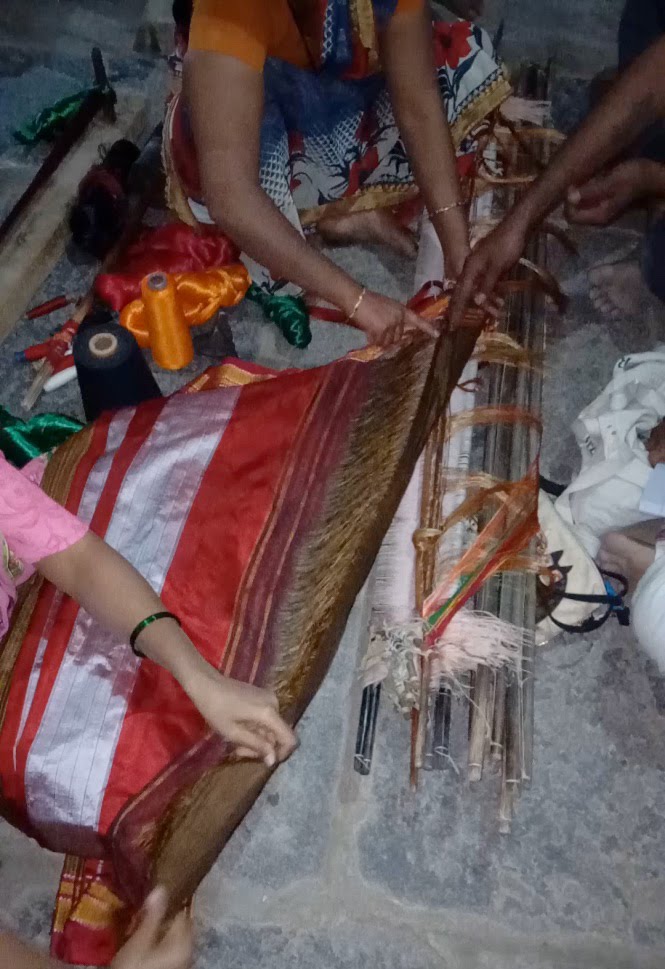 🇮🇳 IndiaIlkal sari
A cotton saree with a loop-joined silk pallu and broad red border, from Ilkal, KarnatakaCotton · Zari work · Embroidery
🇮🇳 IndiaIlkal sari
A cotton saree with a loop-joined silk pallu and broad red border, from Ilkal, KarnatakaCotton · Zari work · Embroidery
 🇮🇳 IndiaBomkai sari
An Odisha handloom saree with extra-weft threadwork, woven in cotton and silkCotton · Zari work
🇮🇳 IndiaKovai Cora cotton
A handwoven cotton-silk saree from Coimbatore with bright bordersCotton · Zari work · Brocade
🇮🇳 IndiaBomkai sari
An Odisha handloom saree with extra-weft threadwork, woven in cotton and silkCotton · Zari work
🇮🇳 IndiaKovai Cora cotton
A handwoven cotton-silk saree from Coimbatore with bright bordersCotton · Zari work · Brocade
 🇮🇳 India and 1 moreMashru
A heavy hand-woven satin with a silk face over cotton, woven in Punjab and SindhSilk
🇮🇳 India and 1 moreMashru
A heavy hand-woven satin with a silk face over cotton, woven in Punjab and SindhSilk
 🇮🇳 IndiaMurshidabad silkমুর্শিদাবাদী রেশম
Fine, light silk from Murshidabad in West Bengal, woven mostly into sarisSilk · Zari work · Jamdani
🇮🇳 IndiaMurshidabad silkমুর্শিদাবাদী রেশম
Fine, light silk from Murshidabad in West Bengal, woven mostly into sarisSilk · Zari work · Jamdani
 🇮🇳 IndiaDharmavaram silk sari
A handwoven Andhra silk sari in mulberry silk and zari, made only on pit loomsSilk · Zari work · Tie-dye
🇮🇳 IndiaDharmavaram silk sari
A handwoven Andhra silk sari in mulberry silk and zari, made only on pit loomsSilk · Zari work · Tie-dye
 🇮🇳 India and 1 moreKhes
A thick hand-woven cotton blanket cloth from Punjab, checked and worn as a winter wrap.Cotton · Checks and stripes · Zari work
🇮🇳 IndiaGarad sariগরদ শাড়ি
A fine silk sari woven on pit looms in Murshidabad and Birbhum, worn at Durga PujaSilk · Zari work · Brocade
🇮🇳 IndiaLeirum Pheeꯂꯩꯔꯨꯝ ꯐꯤ
A coarse cotton shawl from Manipur, black and red on white, given to Meitei bridesCotton
🇮🇳 India and 1 moreKhes
A thick hand-woven cotton blanket cloth from Punjab, checked and worn as a winter wrap.Cotton · Checks and stripes · Zari work
🇮🇳 IndiaGarad sariগরদ শাড়ি
A fine silk sari woven on pit looms in Murshidabad and Birbhum, worn at Durga PujaSilk · Zari work · Brocade
🇮🇳 IndiaLeirum Pheeꯂꯩꯔꯨꯝ ꯐꯤ
A coarse cotton shawl from Manipur, black and red on white, given to Meitei bridesCotton
 🇮🇳 India and 4 moreZardoziज़रदोज़ी
Heavy gold and silver metal embroidery on silk, satin or velvet, from Iran to IndiaSilk · Embroidery · Zari work
🇮🇳 IndiaBerhampur Patta
Odisha silk saree with a phoda kumbha temple border and zari edging, GI protectedSilk · Zari work · Temple border
🇮🇳 India and 4 moreZardoziज़रदोज़ी
Heavy gold and silver metal embroidery on silk, satin or velvet, from Iran to IndiaSilk · Embroidery · Zari work
🇮🇳 IndiaBerhampur Patta
Odisha silk saree with a phoda kumbha temple border and zari edging, GI protectedSilk · Zari work · Temple border
 🇮🇳 IndiaDokhonaदख'ना
A wrap-around cloth worn by Boro women of Assam, usually yellow, with woven Agor designsCotton
🇮🇳 IndiaDukula
An ancient Indian cloth of tree-bark fibre, fine like linen and likened to silkLinen
🇮🇳 IndiaDokhonaदख'ना
A wrap-around cloth worn by Boro women of Assam, usually yellow, with woven Agor designsCotton
🇮🇳 IndiaDukula
An ancient Indian cloth of tree-bark fibre, fine like linen and likened to silkLinen
 🇮🇳 India and 1 moreTussar silkkosa
Wild silk with a deep gold sheen, reeled from forest cocoons, woven into sarees in IndiaTussar · Kantha · Hand painting
🇮🇳 India and 1 moreTussar silkkosa
Wild silk with a deep gold sheen, reeled from forest cocoons, woven into sarees in IndiaTussar · Kantha · Hand painting
 🇮🇳 IndiaPat silkপাট ৰেচম
A glossy, naturally white mulberry silk from Assam, woven into mekhelas and chadarsSilk
🇮🇳 IndiaTelia Rumal
Oil-treated yarn, ikat dyeing and plant colours, from Andhra Pradesh and TelanganaIkat
🇮🇳 IndiaPhool Patti ka Kaam
Flowers and leaves cut from cloth and hemmed on, an appliqué craft of Aligarh and RampurCotton · Appliqué · Embroidery
🇮🇳 IndiaPat silkপাট ৰেচম
A glossy, naturally white mulberry silk from Assam, woven into mekhelas and chadarsSilk
🇮🇳 IndiaTelia Rumal
Oil-treated yarn, ikat dyeing and plant colours, from Andhra Pradesh and TelanganaIkat
🇮🇳 IndiaPhool Patti ka Kaam
Flowers and leaves cut from cloth and hemmed on, an appliqué craft of Aligarh and RampurCotton · Appliqué · Embroidery
 🇮🇳 IndiaPhanekꯐꯅꯦꯛ
A traditional Meitei wraparound skirt woven with striped borders in ManipurMuga · Embroidery · Checks and stripes
🇮🇳 IndiaToda embroiderypukhoor
Red and black thread embroidery on white cotton, worked by Toda women in the NilgirisCotton · Embroidery
🇮🇳 IndiaPhanekꯐꯅꯦꯛ
A traditional Meitei wraparound skirt woven with striped borders in ManipurMuga · Embroidery · Checks and stripes
🇮🇳 IndiaToda embroiderypukhoor
Red and black thread embroidery on white cotton, worked by Toda women in the NilgirisCotton · Embroidery
 🇮🇳 India and 1 moreDhoti
An unstitched cloth tied at the waist and worn to the ankle, the men's answer to the sariCotton
🇮🇳 India and 1 moreDhoti
An unstitched cloth tied at the waist and worn to the ankle, the men's answer to the sariCotton
 🇮🇳 IndiaAntariya
Ancient India's long strip of cloth for the lower body, pleated in frontCotton
🇮🇳 IndiaAntariya
Ancient India's long strip of cloth for the lower body, pleated in frontCotton
 🇮🇳 IndiaKasuti
Counted-thread folk embroidery from Karnataka, stitched on Ilkal and Mysore silk sareesCotton · Embroidery
🇮🇳 IndiaMadisarமடிசார்
A nine-yard Tamil drape tied close to a dhoti, worn by Brahmin women for ritesSilk
🇮🇳 IndiaGadwal sari
A handwoven Telangana sari with a cotton body, a silk border and a zari palluSilk · Zari work
🇮🇳 IndiaKasuti
Counted-thread folk embroidery from Karnataka, stitched on Ilkal and Mysore silk sareesCotton · Embroidery
🇮🇳 IndiaMadisarமடிசார்
A nine-yard Tamil drape tied close to a dhoti, worn by Brahmin women for ritesSilk
🇮🇳 IndiaGadwal sari
A handwoven Telangana sari with a cotton body, a silk border and a zari palluSilk · Zari work
 🇮🇳 IndiaUttariyaउत्तरीय
An unstitched upper-body cloth from ancient India, wrapped over the shoulder or armsCotton
🇮🇳 IndiaUttariyaउत्तरीय
An unstitched upper-body cloth from ancient India, wrapped over the shoulder or armsCotton
 🇮🇳 IndiaMekhela chador
Assam's two-piece dress: a pleated tube skirt, the mekhela, and a draped sadorSilk
🇮🇳 IndiaMekhela chador
Assam's two-piece dress: a pleated tube skirt, the mekhela, and a draped sadorSilk
 🇮🇳 IndiaSurat zari
Metal-wrapped thread made in Surat and woven into silk sarees across IndiaSilk · Zari work · Brocade
🇮🇳 IndiaThirubuvanam silk sari
Silk saree from a Thanjavur district town, its border and pallu dense with zariSilk · Zari work
🇮🇳 IndiaSurat zari
Metal-wrapped thread made in Surat and woven into silk sarees across IndiaSilk · Zari work · Brocade
🇮🇳 IndiaThirubuvanam silk sari
Silk saree from a Thanjavur district town, its border and pallu dense with zariSilk · Zari work
 🇮🇳 IndiaLeheriya
A Rajasthani tie-dye whose slanting stripes echo wind ripples on desert sandCotton · Tie-dye
🇮🇳 IndiaKotpad handloom fabric
Cotton and tussar sarees dyed with aul-root dye, handwoven in Koraput, OdishaCotton · Jamdani
🇮🇳 IndiaLeheriya
A Rajasthani tie-dye whose slanting stripes echo wind ripples on desert sandCotton · Tie-dye
🇮🇳 IndiaKotpad handloom fabric
Cotton and tussar sarees dyed with aul-root dye, handwoven in Koraput, OdishaCotton · Jamdani
Photo credits on this page
The small pictures above come from Wikimedia Commons under free licences. Some are cropped to fit.
- Garad sari: Bongan, CC BY-SA 3.0, source
- Assam silk: Hiranmoy Boruah, CC BY-SA 3.0, source
- Himroo: RubyGoes, CC BY 2.0, source
- Lambada embroidery: Daderot, CC0, source
- Kani shawl: Shahidkashmir, CC BY-SA 4.0, source
- Gota patti: User:आशीष भटनागर, Public domain, source
- Kutch embroidery: Jainamishra, CC BY 3.0, source
- Pedana Kalamkari: Sathishkagitha, CC BY-SA 4.0, source
- Woodblock printing on textiles: William Morris, Public domain, source
- Tripuri dress: Bijayan tripura, CC0, source
- Chintz: Karun Thakar Collection photo. Work by unknown Coromandel artisans. Ph, Public domain, source
- Muslin: Unknown author, Public domain, source
- Ilkal sari: T B Dinesh, CC0, source
- Zardozi: Zarood, CC BY-SA 3.0, source
- Dokhona: Bodoland Territorial Council, CC0, source
- Tussar silk: Biswarup Ganguly, CC BY 3.0, source
- Phanek: অজয় দাস, CC BY-SA 4.0, source
- Dhoti: Redaloes at English Wikipedia, Public domain, source
- Antariya: Raja Ravi Varma, Public domain, source
- Kasuti: Kannadiga, CC BY-SA 4.0, source
- Uttariya: Biswarup Ganguly, CC BY 3.0, source
- Mekhela chador: Deepraj, CC BY 2.5, source
- Surat zari: Hiart, CC0, source
- Leheriya: Daderot, CC0, source
- Mashru: Edwin Lord Weeks, Public domain, source
- Dharmavaram silk sari: Ch Maheswara Raju, CC BY-SA 4.0, source
- Khes: RAJIVVASUDEV, CC BY-SA 4.0, source
- Bomkai sari: Nayansatya, CC BY 3.0, source