Berhampur Patta
Odisha silk saree with a phoda kumbha temple border and zari edging, GI protected
A silk saree woven in Brahmapur, the Odisha city nicknamed India's silk city, in an Odissi style marked by a temple-shaped phoda kumbha design and a zari border said to differ from all others. Women wear the sari, men a cloth called the joda.
- GI listed, application no. 220, covering both the saree and the men's joda
- Brahmapur's silk has earned the city its popular name, the silk city of India
- The phoda kumbha motif is shaped like a temple and edged with zari
- In earlier trade, the finest pieces sailed from Gopalpur port to Southeast Asia
- The images at Puri's great temple are dressed in this silk
What is Berhampur Patta?
Berhampur Patta is a silk saree woven in Brahmapur, an Odisha city whose silk has earned it the name of India's silk city. The looms turn out a women's sari and a men's joda. The weave is Odissi in style, and its mark is the kumbha pattern in its phoda form, drawn as a temple, with a zari border described as unlike any other. Cooperatives of weavers handle both the work and the selling. One use stands apart from fashion: the images at Puri's great temple are dressed in this silk.
Where does Berhampur Patta come from?
The weave is said to reach back more than two hundred years. In earlier times, finely woven lengths left India by sea through Gopalpur port, bound for Southeast Asia and for markets further afield. The looms stayed in Brahmapur, and the city's name became tied to silk. It is tied by law now too: the saree stands on India's Geographical Indications register under application number 220, as Berhampur Patta or Brahmapuri Patta, so the title belongs to cloth from this place, made in this way.
How is Berhampur Patta made?
The work is done on hand looms, with pattern built into the weave rather than added on top. The kumbha motif, above all in its phoda form, takes the shape of a temple and sits within the fabric; along the edge runs zari, gold or silver thread. Selling is collective: three societies of weavers operate in Brahmapur town, with combined yearly sales of roughly one and a half to two crore rupees. Boyanika takes much of the output, and the societies keep a website of their own besides listing the cloth on large online stores.
Berhampur Patta, drawn
Colours, motifs and borders
One pattern carries the identity: kumbha, worked here in its phoda form and modelled on a temple. Zari runs along the border, and that border's design is held to differ from every other silk's. The record names no palette for the body of the cloth, so its look rests on the temple motif and the metal-thread edge rather than on set colours.
How Berhampur Patta is worn
Two garments leave these looms. The sari is the women's cloth; the joda is its counterpart for men. The record stays silent on pleats, pallu and drape, so this page keeps to what it knows: one weave serving two wearers, and a third role in which the same silk clothes temple images rather than people.
When Berhampur Patta is worn
Worship is the one occasion the record names. At the Puri shrine of Jagannath, the images of the god and of his brother and sister are clothed in this weave, which places Brahmapur's silk inside the ritual dressing of the shrine. No festival, wedding or season is tied to the saree in the sources; beyond the shrine, it belongs to whoever buys it, from the cooperatives or online.
Styles of Berhampur Patta
The main split is by wearer: the sari for women, the joda for men, both covered by one Geographical Indication that treats the pair as a single craft. The design has its own hierarchy: kumbha is the pattern family, and phoda kumbha, the temple form, is the variant Brahmapur is known for. Beyond this, the sources record no regional offshoots, no powerloom copies and no modern reworkings, so the range here is a pair of cloths and one signature border.
What Berhampur Patta means
The Geographical Indication is the cloth's legal shield: entered on India's register at number 220, it ties the names Berhampur Patta and Brahmapuri Patta to this one city and its looms. The craft is big enough to have given Brahmapur its popular title, the silk city of India. Three weavers' societies in the town carry the trade, with yearly sales of one and a half to two crore rupees, while Boyanika and online stores take the cloth to buyers the looms will never meet. Dressing the images at the Puri shrine gives the work a place in devotion as well as commerce.
Questions people ask about Berhampur Patta
Where does the Berhampur Patta saree come from?
From Brahmapur in Odisha, a city also spelled Berhampur and nicknamed the silk city of India because of this weave. The name is protected as a Geographical Indication, entered on India's register under application number 220, so the title belongs to cloth from this place.
How is it made?
On hand looms, in an Odissi style of weaving. The kumbha pattern, in its phoda, temple-shaped form, is built into the fabric, and the border is worked in zari. Sales run mostly through three weavers' societies in Brahmapur, with Boyanika and online stores taking much of the rest.
What is the joda?
The men's cloth. Alongside the sari for women, the joda for men forms part of the same Geographical Indication, listed as one craft from Brahmapur. The sources say little about how it is cut or wrapped, only that it comes from the same looms.
Why is it called phoda kumbha?
Kumbha is the pattern the saree is known for, and phoda is its particular form, drawn as a temple. The GI listing names the craft that way, phoda kumbha saree and joda, and the zari border is described as different from all others.
Is this silk used in worship?
Yes. The images worshipped at the temple of Jagannath at Puri, the god and his brother and sister, are clothed in sarees of this weave. The weaving itself is said to be more than two centuries old, and in earlier days the finest pieces were sent abroad through Gopalpur port.
Good reading and sources
The facts on this page come from the Wikipedia article "Berhampur Patta", written by its contributors and used under the CC BY-SA 4.0 licence, and from its Wikidata record (CC0). EveryPallu rewrote the text in its own words, with AI assistance, and compares every page with the article to make sure no passage is copied. It may be reused under the same CC BY-SA 4.0 licence with a link back.
It may contain mistakes. Traditions, weaves and prices differ from one weaver, town or shop to the next, and it is not buying advice. If something is wrong, tell us. Last refreshed 2026-10-03.
More from India
All the sarees of India 🇮🇳 IndiaGarad sariগরদ শাড়ি
A fine silk sari woven on pit looms in Murshidabad and Birbhum, worn at Durga PujaSilk · Zari work · Brocade
🇮🇳 IndiaGarad sariগরদ শাড়ি
A fine silk sari woven on pit looms in Murshidabad and Birbhum, worn at Durga PujaSilk · Zari work · Brocade
Its cousins elsewhere
All silk sarees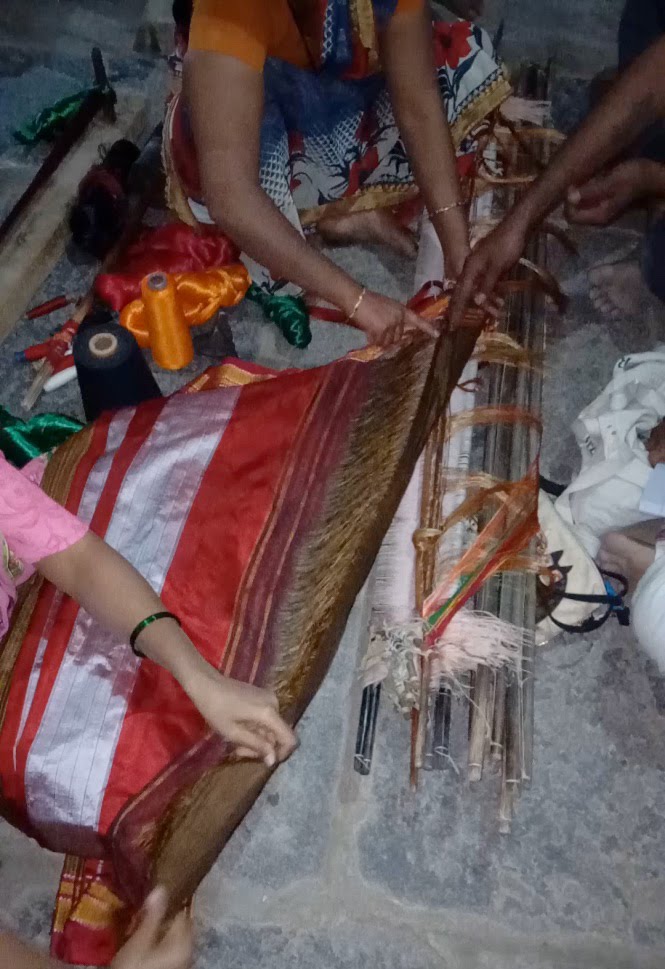 🇮🇳 IndiaIlkal sari
A cotton saree with a loop-joined silk pallu and broad red border, from Ilkal, KarnatakaCotton · Zari work · Embroidery
🇮🇳 IndiaIlkal sari
A cotton saree with a loop-joined silk pallu and broad red border, from Ilkal, KarnatakaCotton · Zari work · Embroidery
 🇮🇳 IndiaKanchipuram sari
A silk sari from Kanchipuram with a separate contrast border locked onto the bodySilk · Zari work · Brocade
🇮🇳 IndiaKanchipuram sari
A silk sari from Kanchipuram with a separate contrast border locked onto the bodySilk · Zari work · Brocade
 🇮🇳 IndiaChanderi sari
A silk sari woven in Chanderi, Madhya Pradesh, with gold and silver zariSilk · Brocade · Zari work
🇮🇳 IndiaKimkhwab
A heavy silk brocade woven with gold and silver yarns, famed in Mughal IndiaSilk · Brocade · Zari work
🇮🇳 IndiaChanderi sari
A silk sari woven in Chanderi, Madhya Pradesh, with gold and silver zariSilk · Brocade · Zari work
🇮🇳 IndiaKimkhwab
A heavy silk brocade woven with gold and silver yarns, famed in Mughal IndiaSilk · Brocade · Zari work