Ilkal sari
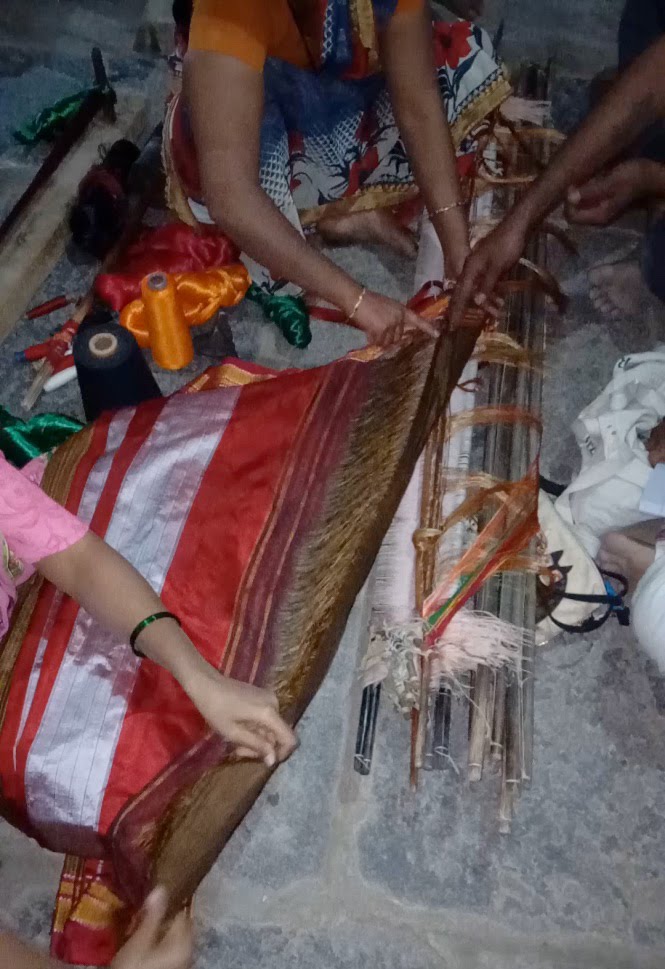
A cotton saree with a loop-joined silk pallu and broad red border, from Ilkal, Karnataka
A handloom saree from the town of Ilkal in Karnataka, woven at home by about 20,000 local weavers. Cotton body and art-silk or pure-silk pallu are joined by loop interlocks called Tope Teni, with a broad red or maroon border and Kasuti embroidery.
- Body and pallu warps are joined with loops, a method local weavers call Tope Teni
- Weaving has gone on at Ilkal since the 8th century AD
- About 20,000 people in Ilkal town work at weaving these saris
- Bridal saris come in Giri Kumukum, the red of priests' wives' sindhoor
- One handloom sari takes about seven days, with two helpers besides the weaver
What is Ilkal sari?
Ilkal is an everyday cotton saree from northern Karnataka with a border and pallu in art silk or pure silk. What sets it apart is the Tope Teni join: the body warp and the pallu warp are tied together in a series of loops, and the weft runs through three shuttles in the Kondi method. The border is broad, usually red or maroon, and the red silk pallu shows temple towers in white. Kasuti, a local embroidery, adds palanquins, elephants and lotuses. Women of weaving households in and around Ilkal make the saris at home. They are worn daily and, in a special red called Giri Kumukum, as bridal dress.
Where does Ilkal sari come from?
Ilkal, a town in Karnataka's Bagalkot district, has been a weaving centre since at least the 8th century AD. Chieftains in and around nearby Bellary patronised the craft, and raw materials close at hand helped it grow. The saree takes its name from the town. The trade is still large: about 20,000 people in Ilkal work at weaving, mostly as a household enterprise in which women do much of the work. Over time weavers added designs such as the Gayathri border alongside the older Chikki, Gomi, Jari and Gadidadi.
How is Ilkal sari made?
Every saree needs a warp of its own. The body threads, generally cotton, are prepared separately from the pallu and border threads, which are art silk or pure silk; border and pallu share a single colour. The weaver joins the two warps with loops, the Tope Teni technique, and inserts the weft through three shuttles carrying two colours by the Kondi method. Work happens indoors on pit looms in three yarn pairs: silk x silk, silk x cotton and art silk x cotton. One saree takes about seven days on the handloom, and a weaver needs two helpers for the preparatory work.
Ilkal sari, drawn
Colours, motifs and borders
Borders run from 2.5 to 6 inches wide and favour red or maroon, often with ochre patterns. Named styles include Gomi, better known as Ilkal dadi, Paraspet with its chikki and dodd paras variants, Gaadi, Jari, and the newer Gayathri. Bodies carry stripes, rectangles and squares. The Tope Teni seragu on the pallu sets three solid red portions against two white ones, and at times a Kyadgi design is woven into its middle. The pallu's end rows picture combs, fort ramparts, jowar heads and mountain ranges. Colours lean to pomegranate red, peacock green and parrot green.
How Ilkal sari is worn
Ilkal saris come in 6, 8 and 9 yard lengths, with 9 yards the usual cut. The pallu, the decorated end worn over the shoulder, is where the saree speaks: red silk, white patterns, temple towers, and the red-and-white seragu. Because body and pallu warps are joined by loops, the pallu reads as a separate panel in a different yarn from the cotton body. It is ordinary daily wear for women in Karnataka as much as festive dress.
When Ilkal sari is worn
These saris serve as common daily dress, and they also mark important days. The Tope Teni seragu was treated as a state symbol and honoured at festivals. Brides wear saris woven in Giri Kumukum, a red linked to the sindhoor that priests' wives in this region wear. Kasuti embroidery, with its palanquins, elephants and lotuses, is a hallmark of the saree.
Styles of Ilkal sari
Ilkal saris differ in yarn, length, colour pairing and border design. The three traditional yarn combinations are silk x silk, silk x cotton and art silk x cotton, and lengths come in 6, 8 and 9 yards with solid or contrast borders. Border designs fall into four traditional types, Chikki Paras, Gomi, Jari and the recently modified Gayathri, with Paraspet and Gaadi also named. Most traditional pieces come off pit looms, though powerloom weaving is done too. In place of art silk, pure silk can be used for a finer saree.
What Ilkal sari means
About 20,000 people in Ilkal earn from this weave, most working from home with women sharing the work at every stage. The Tope Teni seragu has been treated as a state symbol and was honoured during festivals. The saree holds a Geographical Indication in India, tying the name to its home town. What began under the patronage of chieftains around Bellary more than a thousand years ago still supports a whole town of weavers.
Questions people ask about Ilkal sari
Where does the Ilkal sari come from?
It is named for Ilkal, a town in the Bagalkot district of Karnataka. Weaving there goes back to the 8th century AD, when local chieftains around Bellary patronised the craft and ready access to raw materials helped it grow.
How is an Ilkal sari made?
Weavers dress the cotton body warp separately from the art-silk or pure-silk pallu and border warps, join them with loop interlocks in the Tope Teni technique, and pass weft through three shuttles using the Kondi method on pit looms. One sari takes about seven days.
What is Tope Teni seragu?
It is the design on the pallu made possible by the Tope Teni join. Three solid sections in red alternate with two white sections between them. The pattern has been treated as a state symbol and was honoured at festivals.
What does an Ilkal sari look like?
It has a broad border, 2.5 to 6 inches wide, mostly red or maroon with ochre patterns, and a red silk pallu with white temple-tower designs. Colours include pomegranate red, peacock green and parrot green, and Kasuti embroidery may add elephants and lotuses.
Is every Ilkal sari handwoven?
Traditional saris are woven at home on pit looms, one taking about seven days with a weaver and two helpers. Powerloom weaving is also done, and saris come in silk x silk, silk x cotton and art silk x cotton yarn pairs.
Good reading and sources
- Ilkal sari on WikipediaEncyclopedia
- More photos on Wikimedia CommonsPhotos and video
- Wikidata recordOpen data
The facts on this page come from the Wikipedia article "Ilkal sari", written by its contributors and used under the CC BY-SA 4.0 licence, and from its Wikidata record (CC0). EveryPallu rewrote the text in its own words, with AI assistance, and compares every page with the article to make sure no passage is copied. It may be reused under the same CC BY-SA 4.0 licence with a link back.
It may contain mistakes. Traditions, weaves and prices differ from one weaver, town or shop to the next, and it is not buying advice. If something is wrong, tell us. Last refreshed 2026-10-04.
More from India
All the sarees of India 🇮🇳 IndiaMundum neriyathumമുണ്ട് നേരിയത്
A two-piece white cotton cloth of Kerala, worn with a golden border called kasavuCotton · Zari work
🇮🇳 IndiaMundum neriyathumമുണ്ട് നേരിയത്
A two-piece white cotton cloth of Kerala, worn with a golden border called kasavuCotton · Zari work
Its cousins elsewhere
All cotton sarees 🇮🇳 IndiaGota patti
Rajasthani applique embroidery that stitches down ribbons of gold and silverGeorgette · Appliqué · Embroidery
🇮🇳 IndiaGota patti
Rajasthani applique embroidery that stitches down ribbons of gold and silverGeorgette · Appliqué · Embroidery
 🇮🇳 IndiaChanderi sari
A silk sari woven in Chanderi, Madhya Pradesh, with gold and silver zariSilk · Brocade · Zari work
🇮🇳 IndiaChanderi sari
A silk sari woven in Chanderi, Madhya Pradesh, with gold and silver zariSilk · Brocade · Zari work
 🇵🇰 PakistanSindhi embroideryسنڌي ٿرت
Needlework and mirror embroidery crafted across the desert communities of SindhEmbroidery · Mirror work
🇵🇰 PakistanSindhi embroideryسنڌي ٿرت
Needlework and mirror embroidery crafted across the desert communities of SindhEmbroidery · Mirror work
 🇮🇳 India and 4 moreZardoziज़रदोज़ी
Heavy gold and silver metal embroidery on silk, satin or velvet, from Iran to IndiaSilk · Embroidery · Zari work
🇮🇳 India and 4 moreZardoziज़रदोज़ी
Heavy gold and silver metal embroidery on silk, satin or velvet, from Iran to IndiaSilk · Embroidery · Zari work