
Dhoti
An unstitched cloth tied at the waist and worn to the ankle, the men's answer to the sari
The dhoti is an ankle-length unstitched cloth that men in the Indian subcontinent wrap at the waist and between the legs, so it sits like trousers. It is the men's version of the sari: usually about four yards of cotton, worn for ceremonies, rituals and formal occasions.
- The men's equivalent of the sari, wrapped from a rectangular piece of cloth of about four yards.
- Earliest depictions come from the Mauryan Empire; Sunga-period ties were named sakaccha and vikaccha.
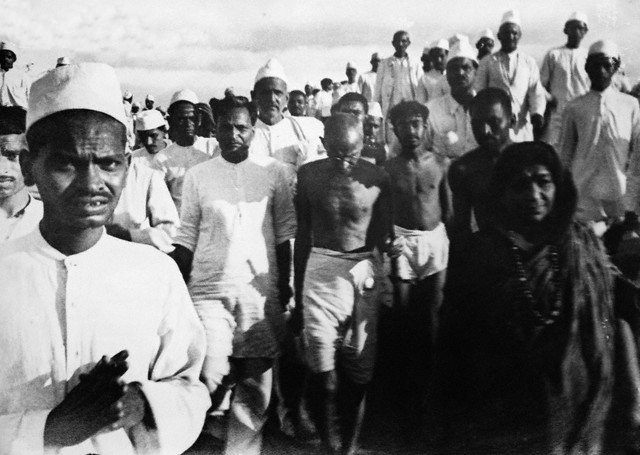
- Gandhi wore the dhoti, often without a shirt, to back home-spun khadi in 1921.
- Jain men wear the unstitched pancha for puja; ISKCON asks followers to wear saffron or white.
- Still daily wear in rural India, but displaced by English dress in cities.
What is Dhoti?
The dhoti is a length of unstitched cloth that men tie at the waist and carry between the legs, so it sits like loose trousers. It belongs to the Indian subcontinent, and it is broadly described as the sari's counterpart for men. Cotton is usual; silk appears for special days. A plain piece is about four yards long and reaches the ankle. It is read as formal rather than everyday, worn by politicians and at ceremonies and in temples. The same cloth can be tied short and loose, or pulled into firm folds. It is not the lungi, the relaxed wrap kept for home.
Where does Dhoti come from?
The dhoti grew out of the antriya, an older garment that went between the legs, was tucked behind and fell into pleats at the front. In Sanskrit the unstitched cloth was also called dhautra, a word meaning rope or cord. Its earliest pictures date to the Mauryan Empire, and in the Sunga period two ways of tying it had names: sakaccha, with the cloth drawn between the legs and tucked at the back, and vikaccha, worn more like a lungi. Stitched clothes arrived with Persians and Greeks, yet the dhoti held its ground. Under British rule it became a mark of resistance, and in 1921 Gandhi wore it, often without a shirt, to back home-spun khadi.
How is Dhoti made?
Nothing here is cut or sewn. The dhoti is one rectangular piece of cloth, generally around four yards long, taken off the loom and left whole. Cotton is the common fibre; silk turns up in the yellow pitambar and in white dhotis worn by some religious figures. The sources do not go into the weaving itself. What they record instead is the weight the loom carried: during the freedom movement, spinning and weaving khadi at home stood for swadeshi, and the plain dhoti was part of that message.
Dhoti, drawn
Colours, motifs and borders
There is not much pattern to describe. A dhoti is normally a plain field of cloth, and only a few colours are named for it: the yellow of the pitambar, a silk dhoti kept for auspicious days; saffron, which ISKCON asks its Western followers to wear, along with white; and the white silk favoured by Maharishi Mahesh Yogi. No motifs, borders or decorated end are mentioned for this garment. Any interest lies in how the cloth is folded and where the folds fall.
How Dhoti is worn
The piece runs about four yards and is tied at the waist, then taken down past the knees to the ankle. Left loose, it hangs like a lungi. Tied formally, it passes between the legs and is bunched and tucked at the back into a firm trouser-like shape, a style called panchakacham in South India, where men may even dance in it. Inside certain South Indian temples the upper body is left bare; in other places a shirt is usual.


When Dhoti is worn
Conservative Jain men put on the pancha for puja at the derasar or basadi, since unstitched cloth is thought to carry less pollution and suit ritual better. Some South Indian mandirs ask men to enter without stitched upper garments. A pitambar, the yellow silk dhoti, is tied for auspicious occasions. Sikh men in the Punjab wore the dhoti, and South Canarese Christian men wore it to pre-nuptial rites and church weddings until the 1960s, after which suits took over. Rural India still wears it daily.
Styles of Dhoti
Names and ties change from place to place, and so does the cloth. The short, firmly wrapped version is common among farmers and martial artists. Ready-made panchakachams and dhoti pants are recent ready-to-wear items, popular with women and common on children, and they are not the same garment. The lungi, worn at home, is a more relaxed wrap. Mundu and veshti are words often used for the dhoti, though the sources note that they name garments which differ from it.
What Dhoti means
Worn without a shirt, the dhoti became a national symbol of resistance and cultural identity in colonial India, when weaving khadi stood for swadeshi. Gandhi took it up in 1921 to align himself with the handicrafts of the rural poor. Its use has since declined; few men now know how to tie one or wear it every day, and English dress, described as caste neutral, displaced it in cities such as Bombay. Wrapping styles once marked caste, as with Bombay's Sonars and the Peshva Brahmins. Men in dhotis are sometimes read as poor, and face discrimination in places like shopping malls.
Questions people ask about Dhoti
Where does the dhoti come from?
It belongs to the Indian subcontinent, where it is the men's counterpart to the sari. Old texts and early sculptures trace it to the antriya, a cloth passed between the legs. Its first depictions are dated to the Mauryan Empire, and it survived the arrival of stitched clothing.
How is a dhoti made?
It is not stitched at all. One rectangular length, usually about four yards and most often of cotton, comes off the loom and is left whole. Silk is used for special pieces such as the yellow pitambar. There is no cutting and no sewing involved.
How is it worn?
It is tied at the waist and taken down to the ankle. Left loose it hangs like a lungi; pulled between the legs, bunched and tucked at the back, it becomes firm and trouser-like. That formal tie is called panchakacham in South India.
Is a dhoti the same as a lungi?
No. The lungi is the casual cloth worn at home, while the dhoti is treated as formal wear and is still seen on politicians. Mundu and veshti are words often used for the dhoti, though the sources say the garments they name are not identical.
Who wears it now?
More men in rural India than in cities, and especially in religious settings. Jain men wear it for puja, some South Indian temples ask for unstitched cloth, and auspicious days call for the yellow silk pitambar. Urban wearers may face discrimination.
Good reading and sources
- Encyclopaedia BritannicaArticle
- Sartorial quirkinessDeccan Herald, Article
- Gandhi Jayanti: When Mahatma Gandhi turned ‘half-naked fakir’ in Tamil NaduHindustan Times, Article
- Dhoti dynamicsThe Hindu, Article
- Dhoti on WikipediaEncyclopedia
- More photos on Wikimedia CommonsPhotos and video
- Wikidata recordOpen data
The facts on this page come from the Wikipedia article "Dhoti", written by its contributors and used under the CC BY-SA 4.0 licence, and from its Wikidata record (CC0). EveryPallu rewrote the text in its own words, with AI assistance, and compares every page with the article to make sure no passage is copied. It may be reused under the same CC BY-SA 4.0 licence with a link back.
It may contain mistakes. Traditions, weaves and prices differ from one weaver, town or shop to the next, and it is not buying advice. If something is wrong, tell us. Last refreshed 2026-10-03.
More from India
All the sarees of India 🇮🇳 India and 4 moreSariसाड़ी
A single unstitched length of cloth, tucked at the waist and slung over one shoulderSilk · Brocade · Ikat
🇮🇳 India and 4 moreSariसाड़ी
A single unstitched length of cloth, tucked at the waist and slung over one shoulderSilk · Brocade · Ikat
Its cousins elsewhere
All cotton sarees 🇮🇳 India and 1 moreBandhani
Tie-dyed cloth dotted with small tied knots, made in Gujarat and RajasthanSilk · Tie-dye
🇮🇳 India and 1 moreBandhani
Tie-dyed cloth dotted with small tied knots, made in Gujarat and RajasthanSilk · Tie-dye
 🇮🇳 IndiaMundum neriyathumമുണ്ട് നേരിയത്
A two-piece white cotton cloth of Kerala, worn with a golden border called kasavuCotton · Zari work
🇮🇳 IndiaMundum neriyathumമുണ്ട് നേരിയത്
A two-piece white cotton cloth of Kerala, worn with a golden border called kasavuCotton · Zari work
 🇮🇳 IndiaGarad sariগরদ শাড়ি
A fine silk sari woven on pit looms in Murshidabad and Birbhum, worn at Durga PujaSilk · Zari work · Brocade
🇮🇳 IndiaGarad sariগরদ শাড়ি
A fine silk sari woven on pit looms in Murshidabad and Birbhum, worn at Durga PujaSilk · Zari work · Brocade