
Khes
A thick hand-woven cotton blanket cloth from Punjab, checked and worn as a winter wrap.
Khes is a thick, hand-woven cotton cloth from the Punjab region of India and Pakistan, used as a blanket, a winter wrap and a loose covering for the upper body. Village women wove it on handlooms in checks and diamonds, and it was a staple of a bride's trousseau.
- A thick hand-woven damask cotton cloth of Punjab, used as blanket and winter wrap
- Village women wove khes for a bride's wedding trousseau
- Rampur khes came up to 6 by 9 feet, with gold thread and coloured borders
- Khes patpatti has white and red checks; khes tukridaar has white and blue
- Woven in paired spans, stitched together on the handloom
What is Khes?
Khes is a thick cotton cloth woven on handlooms in the Punjab region, which straddles India and Pakistan. Woven from coarse yarns in a damask structure, it works as a blanket, a bed cover and a winter wrap. Men in Pakistan and north-west India also fling it loosely around the upper body in cold weather. Most khes are plain or patterned with checks and diamonds, the chequered ones so common that the cloth is sometimes likened to tartan. Much of the weaving was done by village women, for household bedding and for a bride's trousseau. Production is tied to the Malwa belt of southern Indian Punjab, to Panipat in Haryana and Rampur in Uttar Pradesh, and to towns across Pakistani Punjab and Sindh. It feels heavy and warm, a cloth of the home rather than the shop window.
Where does Khes come from?
The cloth belongs to the northern Indian subcontinent, above all Punjab, and to neighbouring Sindh, Haryana and western Uttar Pradesh, all long known for coarse cotton weaving through the 19th and 20th centuries. In rural Punjab, khes weaving was a household craft with cultural weight: women wove it for the home and for wedding trousseaus, a practice kept up over generations of brides. Particular towns built reputations around their khes. Rampur, in Uttar Pradesh, was prized for its cotton and its unusual interwoven patterns, sometimes carrying gold thread. Panipat in Haryana and the Malwa region of southern Indian Punjab wove it too, as did Bahawalpur, Faisalabad, Multan, Okara and Sargodha in Pakistani Punjab, and Naserpur, Sehwan Sharif and Thatta in Sindh.
How is Khes made?
Khes is a damask cloth, which means the pattern comes from the weave itself rather than from printing or needlework. Weavers used coarse cotton yarns, with a few cotton-and-silk versions among them. Cloth was made on hand-operated looms, traditionally as spans that were produced in pairs and then joined by stitching to give the blanket its width. Rampur pieces ran larger, up to about six by nine feet. Patterns were built in different ways: squares of dyed yarn for the dabba style, diagonal effects from a method called khesbaf, and plain checks for the commonest cloths. Village women did much of this weaving at home, alongside the rest of their work.
Khes, drawn
Colours, motifs and borders
Geometric patterns dominate. Charkhana is the chequered style, so typical that khes is sometimes described as a tartan-like cloth. Diamond motifs appear as well. Dabba khes sets squares in dyed yarns; khes patpatti pairs white with red checks, and khes tukridaar white with blue. Khesbaf weaving produces diagonal designs. The Rampur khes stood apart, using good cotton, distinctive interwoven patterns, gold thread and borders worked in coloured yarns. Otherwise the palette is simple and strong: white grounds carrying red or blue checks.
How Khes is worn
Khes is not tailored. As bedding it lies over a bed as a blanket or spread, and serves as a comfort object for cold nights. As clothing, men in Pakistan and north-west India wear it as a loose wrap thrown over the upper body against winter. The khes a bride brought with her, woven by the women of her family, went into the household stock of bedding and covers.
When Khes is worn
Its main season is winter, when it is used as a blanket and a wrap. In rural Punjab it was everyday bedding, a thick cover for the household. Its other great occasion is the wedding: for years, village women wove khes for a bride's trousseau, so a new household began with cloth made by the women of the family itself.
Styles of Khes
Varieties are named by pattern and by place. Khesi is a wider version, used for sheets. Dabba khes has squares in dyed yarns, khes patpatti white-and-red checks, khes tukridaar white-and-blue, and khesbaf refers to diagonal weaving. Rampur State khes was known for superior cotton, interwoven patterns and gold thread. Production centres differ too: Malwa, Panipat and Rampur in India; Bahawalpur, Faisalabad, Multan, Okara, Sargodha and the villages of Cholistan in Pakistani Punjab; Naserpur, Sehwan Sharif and Thatta in Sindh.
What Khes means
In village Punjab the khes loom was women's work, and the cloth carried meaning beyond warmth: weaving it for a daughter's trousseau was part of the rhythm of rural life, and the craft held cultural weight in its own right. The wider region, through the 19th and 20th centuries, was known for many coarse cotton textiles, with khes among them. Towns such as Rampur built name and trade on their khes.
Questions people ask about Khes
Where does khes come from?
It belongs to the Punjab region of India and Pakistan, with weaving also in Sindh, Haryana and western Uttar Pradesh. Known centres include Malwa, Panipat and Rampur in India, and Bahawalpur, Faisalabad, Multan, Okara, Sargodha, Naserpur, Sehwan Sharif and Thatta in Pakistan.
How is khes made?
It is a damask cloth hand-woven on handlooms from coarse cotton yarns, with some cotton-and-silk varieties. Spans were traditionally made as pairs and joined by stitching, and patterns such as checks, squares and diagonals come from the weave itself.
What is khes used for?
Mainly as a thick blanket, a bed cover and a winter wrap. Men in Pakistan and north-west India also wear it as a simple loose covering for the upper body. A wider variant, khesi, is used for making sheets.
What patterns does khes have?
Most are plain or geometric: charkhana checks, diamonds, dabba squares in dyed yarns and khesbaf diagonals. Two named check styles are patpatti in white and red, and tukridaar in white and blue. Rampur khes often added gold thread and coloured borders.
Who weaves khes?
In rural Punjab, weaving was traditionally women's work, done at home; women wove khes over the years as part of wedding trousseaus. Towns such as Rampur and Panipat, and districts across Pakistani Punjab and Sindh, also produced it.
Good reading and sources
- Sangrur | How this entrepreneur is helping empower rural women through handicraftHindustan Times, Article
- Of lost weavesDeccan Herald, Article
The facts on this page come from the Wikipedia article "Khes", written by its contributors and used under the CC BY-SA 4.0 licence, and from its Wikidata record (CC0). EveryPallu rewrote the text in its own words, with AI assistance, and compares every page with the article to make sure no passage is copied. It may be reused under the same CC BY-SA 4.0 licence with a link back.
It may contain mistakes. Traditions, weaves and prices differ from one weaver, town or shop to the next, and it is not buying advice. If something is wrong, tell us. Last refreshed 2026-10-04.
More from India
All the sarees of IndiaIts cousins elsewhere
All cotton sarees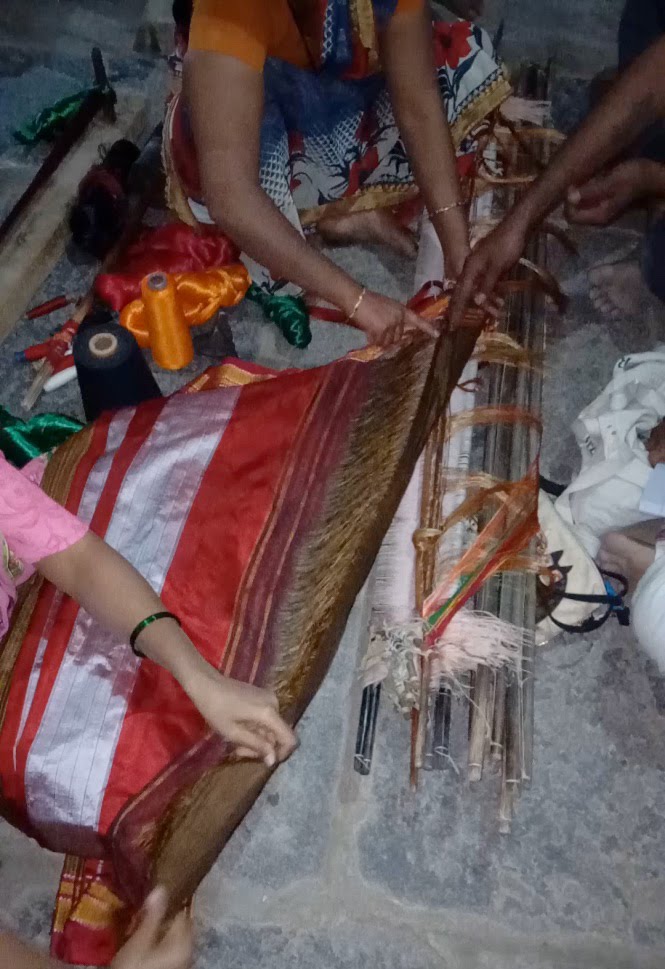 🇮🇳 IndiaIlkal sari
A cotton saree with a loop-joined silk pallu and broad red border, from Ilkal, KarnatakaCotton · Zari work · Embroidery
🇮🇳 IndiaIlkal sari
A cotton saree with a loop-joined silk pallu and broad red border, from Ilkal, KarnatakaCotton · Zari work · Embroidery
 🇮🇳 IndiaKanchipuram sari
A silk sari from Kanchipuram with a separate contrast border locked onto the bodySilk · Zari work · Brocade
🇮🇳 IndiaKanchipuram sari
A silk sari from Kanchipuram with a separate contrast border locked onto the bodySilk · Zari work · Brocade
 🇮🇳 IndiaMundum neriyathumമുണ്ട് നേരിയത്
A two-piece white cotton cloth of Kerala, worn with a golden border called kasavuCotton · Zari work
🇮🇳 IndiaMundum neriyathumമുണ്ട് നേരിയത്
A two-piece white cotton cloth of Kerala, worn with a golden border called kasavuCotton · Zari work
 🇮🇳 IndiaPasapali sari
A handloom ikat saree from Odisha with chess-board checks in contrasting colours.Ikat · Checks and stripes
🇮🇳 IndiaPasapali sari
A handloom ikat saree from Odisha with chess-board checks in contrasting colours.Ikat · Checks and stripes