
Phanek
In its own language: ꯐꯅꯦꯛ
A traditional Meitei wraparound skirt woven with striped borders in Manipur
A phanek is a traditional wraparound lower garment worn by Meitei women in Manipur. Woven from fibres including muga silk, it carries nature motifs and striped, embroidered borders. Women wear it for daily routines, sacred rites, weddings, and political protests.
- Woven by Meitei women in Manipur with sacred symbols from nature and regional folklore.
- The Phanek Mayek Naibi variation features lower stripes and dense decorative embroidery.
- Ritual versions woven from muga silk are worn for child ear-piercing rites and feasts.
- Used as a historic symbol of resistance in the Nupi Lan uprisings and modern protests.
What is Phanek?
A phanek is a traditional wraparound garment worn by Meitei women in Manipur and across the diaspora. It covers the lower body like a skirt and forms an essential part of local dress. Weavers embellish the cloth with distinct patterns that reflect community identity, regional history, and folklore. The fabric ranges from simple daily work cloths to finely decorated versions with striped bases and dense needlework. While practical in its wraparound style, the cloth carries deep social meaning, functioning as an emblem of feminine identity, maternal authority, and creative heritage.
Where does Phanek come from?
Rooted in the ancient civilisation of Manipur, also known as Kangleipak, the garment features in historical chronicles and royal lore. In one notable account, the queen of Sugnu used her phanek to grant life to individuals facing execution. During the twentieth century, the garment became a potent badge of political resistance. Women draped in phaneks organized the Nupi Lan uprisings of 1904 and 1939 to oppose forced colonial labour and unfair food export rules. Later, the Meira Paibi collective and activists at Kangla Fort used the cloth in public demonstrations against violence.
How is Phanek made?
Weaving this skirt has historically been a female craft passed down from mother to daughter. Young girls learned the skill early to secure personal income and achieve financial independence. Today, men also take part in the weaving process. Weavers construct the cloth on domestic looms, adjusting the layout to accommodate bottom borders and distinctive striping. The cloth is patterned with symbolic figures drawn from folklore and nature. Ritual garments for special celebrations and religious ceremonies are frequently crafted from lustrous muga silk.
Phanek, drawn
Colours, motifs and borders
The motifs woven into the garment draw inspiration from Meitei folklore, myth, and the natural world. One early design pairs lotus blooms with bees along the border of the cloth. In popular varieties, horizontal stripes run across the bottom section. Embroiderers finish the lower edge with heavy needlework in various decorative patterns, giving the skirt a structured base.
How Phanek is worn
Women wear the phanek wrapped securely around the body as a skirt. It is worn for everyday tasks, professional office work, and ceremonial gatherings. The cloth is folded snugly around the waist or chest, allowing free movement while showing off the patterned or embroidered lower border at the ankles.


When Phanek is worn
Meitei women wear different types of phanek depending on the setting. Everyday styles serve for domestic chores and office work. Auspicious events call for ceremonial pieces, including weddings, festive feasts, and formal community gatherings. Garments woven from muga silk are reserved for religious ceremonies, traditional dances, and child ear-piercing rituals.
Styles of Phanek
The Phanek Mayek Naibi is a well known variety featuring bottom stripes and heavy lower embroidery. Other ethnic groups across Manipur wear related wraparound skirts: the Kukis call their version ponve, the Kabui or Rongmei people wear the pheisoi, the Tangkhul community uses the kashan, and the Anal tribe weaves the lungvin. Related Northeast garments include Assam's mekhla and Mizoram's puan.
What Phanek means
The phanek occupies a sacred yet complex position in Meitei society. It represents life, care, and female agency. At the same time, traditional taboos forbid men from touching it or washing it alongside male garments. The cloth holds immense political weight in Manipur, serving as a banner in historic women's wars, peace patrols, and contemporary protests against state violence and moral policing.
Questions people ask about Phanek
Where does the phanek come from?
The phanek originates in Manipur, historically known as Kangleipak, in Northeast India. It is the traditional lower garment of the Meitei community and is also worn across the Meitei diaspora.
How is a phanek made?
The cloth is traditionally handwoven by women, though men also weave it today. Girls learn the craft from a young age. Ritual versions use muga silk, and formal pieces are finished with heavy embroidery at the bottom edge.
What is Phanek Mayek Naibi?
Phanek Mayek Naibi is a popular type of phanek featuring stripes along the bottom edge and heavy decorative embroidery. Meitei women wear it for marriage ceremonies and office work.
How has the phanek been used in political protests?
Meitei women wore phaneks during the 1904 and 1939 Nupi Lan uprisings against British colonial policies. In modern times, grassroots activists like the Meira Paibis and protesters at Kangla Fort have used the garment as a symbol of resistance.
Good reading and sources
- Phanek on WikipediaEncyclopedia
- More photos on Wikimedia CommonsPhotos and video
- Wikidata recordOpen data
The facts on this page come from the Wikipedia article "Phanek", written by its contributors and used under the CC BY-SA 4.0 licence, and from its Wikidata record (CC0). EveryPallu rewrote the text in its own words, with AI assistance, and compares every page with the article to make sure no passage is copied. It may be reused under the same CC BY-SA 4.0 licence with a link back.
It may contain mistakes. Traditions, weaves and prices differ from one weaver, town or shop to the next, and it is not buying advice. If something is wrong, tell us. Last refreshed 2026-10-04.
More from India
All the sarees of India 🇮🇳 IndiaAssam silk
Golden muga, white pat and warm eri silks, reared and hand-woven in AssamMuga
🇮🇳 IndiaAssam silk
Golden muga, white pat and warm eri silks, reared and hand-woven in AssamMuga
Its cousins elsewhere
All muga sarees 🇲🇲 Myanmar and 1 moreLongyiလုံချည်
A cloth tube worn at the waist in Myanmar, about two metres longCotton · Checks and stripes · Embroidery
🇲🇲 Myanmar and 1 moreLongyiလုံချည်
A cloth tube worn at the waist in Myanmar, about two metres longCotton · Checks and stripes · Embroidery
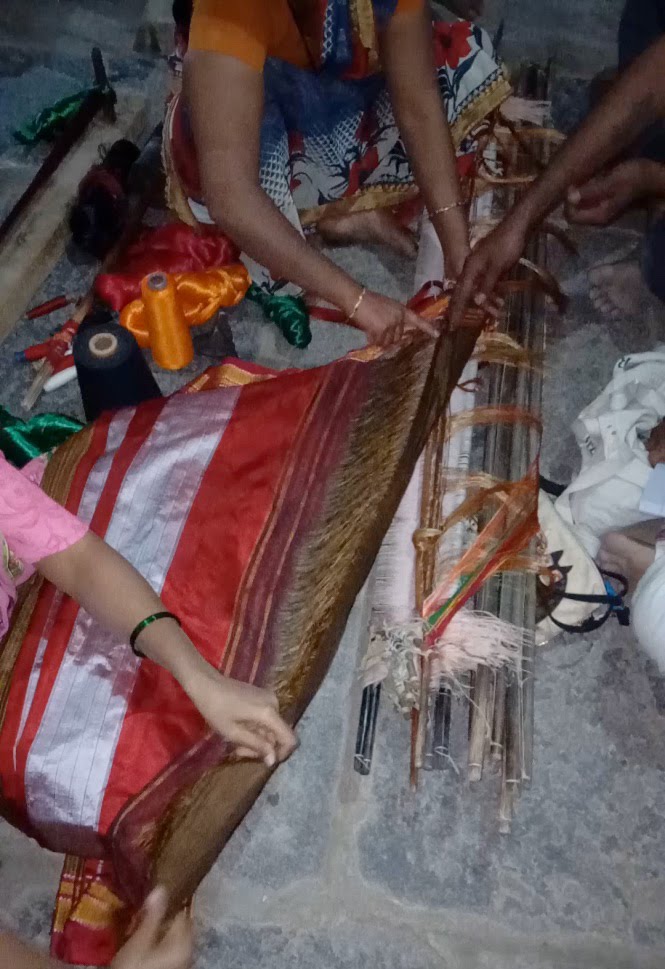 🇮🇳 IndiaIlkal sari
A cotton saree with a loop-joined silk pallu and broad red border, from Ilkal, KarnatakaCotton · Zari work · Embroidery
🇮🇳 IndiaIlkal sari
A cotton saree with a loop-joined silk pallu and broad red border, from Ilkal, KarnatakaCotton · Zari work · Embroidery
 🇮🇳 India and 2 moreMadras
A light handwoven cotton cloth of bright checks, named after the city of ChennaiCotton · Checks and stripes · Embroidery
🇮🇳 India and 2 moreMadras
A light handwoven cotton cloth of bright checks, named after the city of ChennaiCotton · Checks and stripes · Embroidery
 🇰🇭 Cambodia and 4 moreSbaiស្បៃ
A shawl-like breast cloth derived from the sari, worn over one shoulder in Southeast AsiaSilk · Embroidery · Brocade
🇰🇭 Cambodia and 4 moreSbaiស្បៃ
A shawl-like breast cloth derived from the sari, worn over one shoulder in Southeast AsiaSilk · Embroidery · Brocade