
Tripuri dress
A woven cotton wrap from Tripura, with its own pattern for each Tripuri clan.
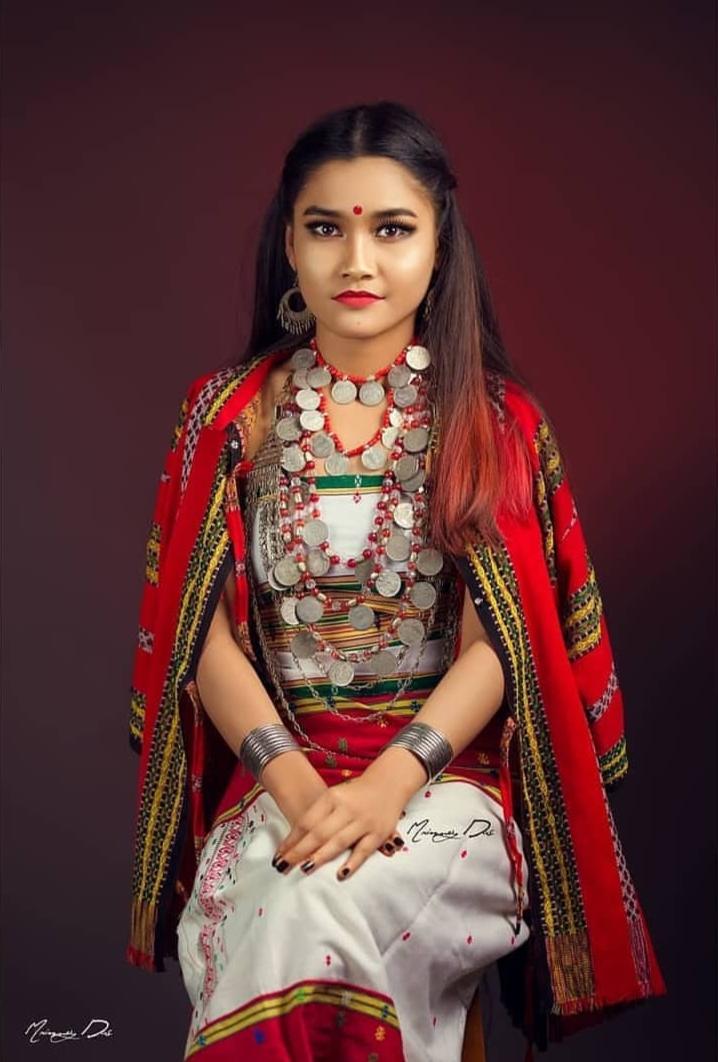
The traditional dress of the Tripuri people of Tripura in north-east India. Women wrap a woven rignai around the lower body with a risa or rikutu above; each clan's rignai carries its own pattern, and Tripuri women weave the cloth themselves.
- Each Tripuri clan has its own rignai pattern, distinct enough to identify the wearer's clan.
- Rignai chamathwibar is called the mother of all rignais, from which the others evolved.
- Legend credits the 250 wives of King Subrai Raja with inventing 250 rignai designs.
- The dress was once woven at home from hand-spun cotton; today the thread is bought.
- Most women now wear a blouse instead of the risa; girls pair the rignai with tops.
What is Tripuri dress?
The traditional dress of the Tripuri people sits close to that of other North-East Indian communities, yet its patterns set it apart. A woman wraps the rignai around the lower half of her body. Above it come two cloths: the risa, which covers the chest, and the rikutu, a plain cloth in a different colour and shade that covers the whole upper half. In earlier generations women spun cotton at home and wove each piece themselves; today the thread is bought from the market, though Tripuri women still weave. Most women now wear a blouse with the rignai instead of the risa, for convenience, and young girls team the rignai with tops. Men wore a rikutu at the waist with the kamchwlwi borok above, rather like kurta and dhoti.
Where does Tripuri dress come from?
No date is recorded for the dress's beginnings. Legend places its golden age under Subrai Raja, remembered as the greatest king of Tripura. It is said that his 250 wives invented 250 different rignai designs, and that he married each woman who created a new one. Nearly all of those designs were lost over time; only a few remain, and an effort to rediscover them is under way. The dress itself endures, though changed. Clan patterns that once marked a woman's family now mingle across clans, and weavers keep adding new designs. The risa has largely given way to the blouse, while the rignai stays on.
How is Tripuri dress made?
Cotton is the fibre of record: in the past, Tripuri women spun the thread at home and wove the rignai, risa and rikutu themselves. Thread is now bought from the market, but the weaving remains women's work, with the rikutu woven by Tripuri women today. The sources give no loom details, dye methods or hours needed at the loom. What they record instead is the design labour: the rignai's patterns are woven so distinctly that each clan's cloth can be named on sight, and weavers keep producing new designs alongside the old. Rignai chamathwibar, the most significant pattern, is honoured as the mother of all rignais, from which the rest evolved.
Tripuri dress, drawn
Colours, motifs and borders
The design story of the rignai is one of patterns rather than pictures. Every clan of the Tripuri wove its own rignai pattern, distinct enough that a woman's clan could be told at a glance from the cloth. The oldest and most significant of these is Rignai chamathwibar, called the mother of all rignais, from which all the others are said to have evolved. Legend adds that King Subrai Raja's 250 wives created 250 designs between them, though nearly all are lost. The rikutu is deliberately plain, in a colour and shade different from the rest of the dress, so the woven rignai carries all the pattern.
How Tripuri dress is worn
A Tripuri woman wraps the rignai around the lower half of her body, the way women across the North-East wear a wrapped skirt. The upper body is dressed with the risa, which covers the chest, or with the rikutu, which covers the whole upper half. Today most women find the risa inconvenient and wear a blouse instead, and young girls team the rignai with tops. Men's dress was a rikutu for the loin with the kamchwlwi borok above, somewhat like kurta and dhoti; now few men wear it outside rural Tripura and the working class.


When Tripuri dress is worn
No festivals or rites are named for this dress in the sources; what they describe is how it lives on in daily use. Women wear the rignai, now usually with a blouse in place of the risa, and young girls wear it with tops. The full outfit of risa and rikutu is slipping away for the sake of convenience. Among men, the traditional dress survives mainly in rural Tripura and among the working class, while most have adopted the international style the sources call gaffa.
Styles of Tripuri dress
The great variation is between clans: each of the Tripuri clans keeps its own rignai pattern, though nowadays the designs mingle, with women freely wearing another clan's rignai and weavers producing fresh designs. Rignai chamathwibar stands at the head of the family, the pattern from which all others evolved. Modern versions are appearing too: young girls wear the rignai with tops, women pair it with a blouse instead of the risa, and men have largely moved to international styles. The sources mention no powerloom copies; what they note is an effort to recover the many old designs that have been lost.
What Tripuri dress means
The rignai works as a clan badge. Its patterns were once so distinct that a woman's clan could be identified from the cloth she wore, which made the weave a marker of family identity. That strict mapping has loosened: clans now wear one another's rignai and new designs are woven freely. The legend of Subrai Raja ties the cloth to Tripura's royal past, crediting his 250 wives with 250 designs, most now lost. Rediscovering those lost patterns is an active effort, and the weaving itself remains in the hands of Tripuri women, keeping the craft and the identity together.
Questions people ask about Tripuri dress
Where does the Tripuri dress come from?
It belongs to the Tripuri people of Tripura in north-east India. The style is close to that of other North-East Indian communities, but its patterns and designs differ significantly from theirs.
How is the rignai made?
It is woven by Tripuri women. In earlier days they spun cotton thread at home and wove the garments themselves; nowadays the thread is bought from the market, and women still weave the rikutu.
What is rignai chamathwibar?
The most significant of the Tripuri rignais. It is called the mother of all rignais, the design from which every other rignai pattern is said to have evolved.
What do women wear with the rignai?
Traditionally the risa, a cloth that covers the chest, and the rikutu, which covers the whole upper half in a plain, different shade. Most women now prefer a blouse for convenience, and young girls wear the rignai with tops.
Do men wear the Tripuri dress too?
Men traditionally wore the rikutu for the loin area with the kamchwlwi borok above, somewhat like kurta and dhoti. Very few wear it now, apart from men in rural Tripura and the working class; most have taken up international styles.
Good reading and sources
The facts on this page come from the Wikipedia article "Tripuri dress", written by its contributors and used under the CC BY-SA 4.0 licence, and from its Wikidata record (CC0). EveryPallu rewrote the text in its own words, with AI assistance, and compares every page with the article to make sure no passage is copied. It may be reused under the same CC BY-SA 4.0 licence with a link back.
It may contain mistakes. Traditions, weaves and prices differ from one weaver, town or shop to the next, and it is not buying advice. If something is wrong, tell us. Last refreshed 2026-10-04.
More from India
All the sarees of IndiaIts cousins elsewhere
All cotton sarees 🇮🇳 India and 4 moreSariसाड़ी
A single unstitched length of cloth, tucked at the waist and slung over one shoulderSilk · Brocade · Ikat
🇮🇳 India and 4 moreSariसाड़ी
A single unstitched length of cloth, tucked at the waist and slung over one shoulderSilk · Brocade · Ikat
 🇮🇳 IndiaChanderi sari
A silk sari woven in Chanderi, Madhya Pradesh, with gold and silver zariSilk · Brocade · Zari work
🇮🇳 IndiaChanderi sari
A silk sari woven in Chanderi, Madhya Pradesh, with gold and silver zariSilk · Brocade · Zari work
 🇮🇳 India and 1 moreMundumuṇṭŭ
A cotton cloth wrapped at the waist, edged with the thicker woven line called the karaCotton · Embroidery
🇮🇳 India and 1 moreMundumuṇṭŭ
A cotton cloth wrapped at the waist, edged with the thicker woven line called the karaCotton · Embroidery
 🇮🇳 IndiaMundum neriyathumമുണ്ട് നേരിയത്
A two-piece white cotton cloth of Kerala, worn with a golden border called kasavuCotton · Zari work
🇮🇳 IndiaMundum neriyathumമുണ്ട് നേരിയത്
A two-piece white cotton cloth of Kerala, worn with a golden border called kasavuCotton · Zari work