
Garad sari
In its own language: গরদ শাড়ি
A fine silk sari woven on pit looms in Murshidabad and Birbhum, worn at Durga Puja
Garad is a fine silk sari woven by hand in Murshidabad and Birbhum districts of West Bengal, known for its smooth ground, small buttis and a sparingly worked anchal. Weavers at Mirzapur, Raghunathganj and Murarai keep the looms busy, and Bengali Hindu women wear it on puja days, above all at Durga Puja.
- First woven in the late 19th century at Mirzapur in Murshidabad
- Registered as a Geographical Indication in 2024
- Over 600 looms were weaving garad as of 2024
- The sari of Ashtami and Sindur khela during Durga Puja
- Finished with a khai treatment and folded into a shape called pat
What is Garad sari?
Garad is a silk sari from rural Bengal, woven by hand on pit looms in Murshidabad and Birbhum districts. The cloth is worked entirely in silk at a fine yarn count, which gives it a smooth, light fall. Its known flourishes are small woven dots called buttis and quietly finished detailing on the anchal, the loose end piece of the sari; the earliest garads carried no pattern at all and were prized as emblems of purity and shine. Weavers at Mirzapur, Raghunathganj and Murarai produce it today. Bengali Hindu women reach for it at pujas and ritual days, when a plain, unshowy silk is the garment of choice. Each piece measures roughly five and a half to six and a half metres long and about 1.2 metres wide.
Where does Garad sari come from?
Murshidabad's silk trade goes back at least three centuries, and the district was a silk centre even before British rule. Cossimbazar served as Bengal's principal silk market; a trading company set up a factory there around 1658, and the town's silk went out to buyers across much of Asia. Garad weaving is younger, beginning in the late 1800s at Mirzapur, where a weaver named Mrityunjay Sarkar is credited as its inventor. The plain cloth once marked high social rank, and Mirzapur's weavers collected prizes for their garad work at exhibitions and contests. Governor Padmaja Naidu, in office in West Bengal from 1956 to 1967, wore garad and little else, and the sari picked up her name as a result. In 2024 it was registered as a Geographical Indication.
How is Garad sari made?
Weavers work on pit looms fitted with a flying shuttle, using silk yarn counted at 90s to 92s, and gold-coloured zari thread for the detailing. Most pieces keep a plain ground and border; others take extra-warp jala patterning across the body or edges, a method of building figures into the weave itself. Once off the loom, the cloth receives a traditional finishing treatment known locally as kha'i mara, or khai finish, and is then folded into a distinctive shape called a pat. The scale is real: more than 600 looms across the two districts were weaving garad as of 2024, and in 2018-19 saris worth about ₹149.6 million changed hands in the trade.
Garad sari, drawn
Colours, motifs and borders
The classic garad keeps its ground and border bare, letting the sheen of the silk do the talking. Two touches define the sari now: tiny woven dots, called buttis, on the body, and fine work on the anchal. Borders run four to seven inches wide and may carry extra-warp jala figures; jala is a loom method that weaves patterns into the cloth as it is made. The details are picked out in gold-toned zari thread. Older saris had none of this decoration, and the bareness was the point, a look tied to worship rather than show.
How Garad sari is worn
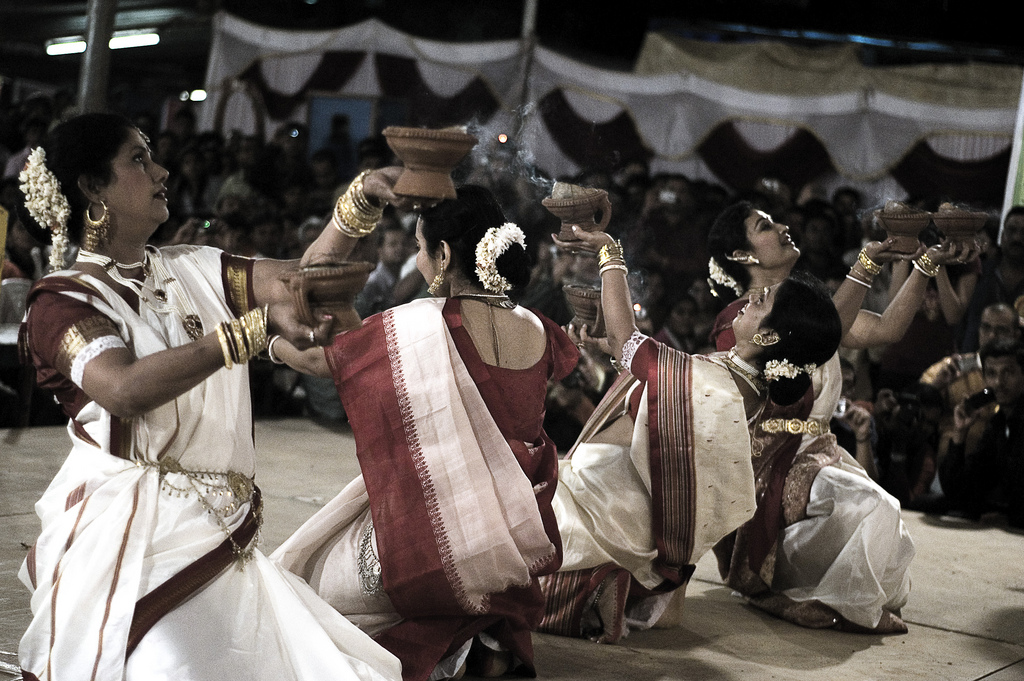
Each sari runs five and a half to six and a half metres long and about 1.2 metres wide, so it drapes as a full-length sari normally does. Bengali Hindu women choose it for puja days: above all on Ashtami during Durga Puja, and again at Sindur khela on Bishorjan, the festival's farewell day, when married women mark one another with vermilion. On those days the unadorned silk is the point; the garment itself signals the holiness of the occasion.


When Garad sari is worn
Garad belongs to the festival calendar of Bengal. It is the sari Bengali Hindu women put on for pujas, above all Ashtami during Durga Puja and the Sindur khela on Bishorjan. In earlier generations the plain cloth also read as a badge of rank, and aristocratic households set store by it. Its present standing rests on ritual fitness: a silk felt to be clean and bright, right for worship, and quiet enough for sacred days.
Styles of Garad sari
Two broad kinds exist side by side. The old style is bare throughout, with no motif on body, border or anchal. The newer style adds extra-warp jala figures to border or ground, along with buttis and a worked anchal. A later chapter gave the sari a second name: after Padmaja Naidu made it her regular wear as Governor, garad saris were also spoken of as 'Padmaja'. Its Geographical Indication now ties the name to the West Bengal weave.
What Garad sari means
The garad keeps a working craft economy alive. More than 600 looms across Murshidabad and Birbhum wove it as of 2024, and in 2018-19 sari sales worth about ₹149.6 million passed through the trade. In 2024 the weave also became a registered Geographical Indication, putting its name under official protection. The cloth carries meaning beyond the loom. Once a marker of aristocracy, it remains what many Bengali Hindu households consider proper for worship, and its link with Indira Gandhi, who ordered saris from Mirzapur, kept it in public view.
Days Garad sari is worn for
Questions people ask about Garad sari
Where does the garad sari come from?
It is a handloom sari of West Bengal, made in Murshidabad and Birbhum districts. Weaving began in the late 19th century at Mirzapur in Murshidabad, where weaver Mrityunjay Sarkar is credited as its inventor; weavers in Raghunathganj and Murarai also make it.
How is a garad sari made?
Weavers use pit looms with a flying shuttle, silk yarn counted at 90s to 92s, and gold-toned zari thread for the details. The finished cloth is given a traditional khai finish and folded into a distinctive shape called a pat.
When is a garad sari worn?
Bengali Hindu women wear it for pujas, especially on Ashtami during Durga Puja and at the Sindur khela on Bishorjan. Once a sign of aristocracy, it is still the silk many households consider right for worship.
What does a garad sari look like?
The ground and border are usually plain, with fine buttis and delicate anchal work; some saris carry extra-warp jala patterns. Borders measure four to seven inches, and older garads had no ornament at all.
Does it have any official status?
Yes. It was registered as a Geographical Indication in 2024. The weave is tied to Murshidabad and Birbhum districts, where more than 600 looms were making garad saris as of that year.
Good reading and sources
- Garad sari on WikipediaEncyclopedia
- More photos on Wikimedia CommonsPhotos and video
- Wikidata recordOpen data
The facts on this page come from the Wikipedia article "Garad sari", written by its contributors and used under the CC BY-SA 4.0 licence, and from its Wikidata record (CC0). EveryPallu rewrote the text in its own words, with AI assistance, and compares every page with the article to make sure no passage is copied. It may be reused under the same CC BY-SA 4.0 licence with a link back.
It may contain mistakes. Traditions, weaves and prices differ from one weaver, town or shop to the next, and it is not buying advice. If something is wrong, tell us. Last refreshed 2026-10-03.
More from India
All the sarees of IndiaIts cousins elsewhere
All silk sarees 🇮🇳 IndiaKanchipuram sari
A silk sari from Kanchipuram with a separate contrast border locked onto the bodySilk · Zari work · Brocade
🇮🇳 IndiaKanchipuram sari
A silk sari from Kanchipuram with a separate contrast border locked onto the bodySilk · Zari work · Brocade
 🇮🇳 IndiaChanderi sari
A silk sari woven in Chanderi, Madhya Pradesh, with gold and silver zariSilk · Brocade · Zari work
🇮🇳 IndiaKimkhwab
A heavy silk brocade woven with gold and silver yarns, famed in Mughal IndiaSilk · Brocade · Zari work
🇮🇳 IndiaChanderi sari
A silk sari woven in Chanderi, Madhya Pradesh, with gold and silver zariSilk · Brocade · Zari work
🇮🇳 IndiaKimkhwab
A heavy silk brocade woven with gold and silver yarns, famed in Mughal IndiaSilk · Brocade · Zari work
 🇮🇳 IndiaPaithani
A Maharashtrian handwoven silk sari with interlocking tapestry borders and peacock motifsSilk · Zari work · Brocade
🇮🇳 IndiaPaithani
A Maharashtrian handwoven silk sari with interlocking tapestry borders and peacock motifsSilk · Zari work · Brocade