The sarees of Varanasi
The city on the Ganga whose silk brocades, woven with gold and silver thread, are the best known sarees of northern India.
Motifs of Varanasi
Woven here
Best time: October to March, when the weather is cool; the weddings season is busiest then.
GI: Banaras brocades and sarees are registered as a Geographical Indication.
Varanasi has woven silk for centuries, and its brocade sarees, called Banarasi, are worn at weddings across India. The cloth is dense with metallic thread in floral and leaf patterns. The weaving is done mostly in homes in the old lanes and in the villages around the city, and it still depends on hand-set looms and on families who have done the work for generations.

What is woven here
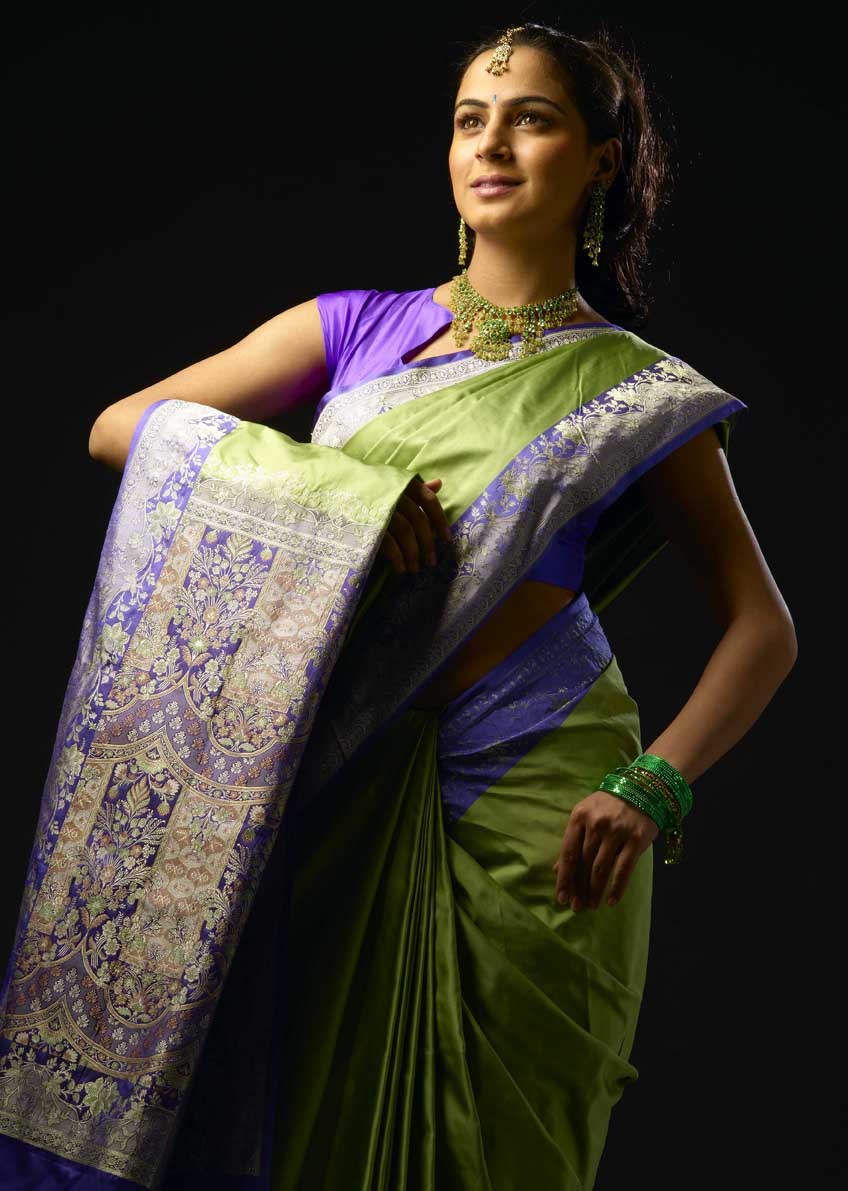
Banarasi sarees are woven in silk, with patterns made of zari, which is thread wrapped in gold or silver coloured metal. The main kinds are katan, a plain tightly twisted silk, and the lighter organza and georgette versions. Fine small motifs called buta are scattered over the body, and a broad pallu carries the heaviest design. Older Mughal-influenced patterns of flowers, creepers and leaves are still the base of most designs. The city also weaves tanchoi, a closely patterned silk with fine extra-weft pattern.
The craft and its people
Much of the weaving is done by Muslim weaver families, many of the Ansari community, together with Hindu weavers, and the work is divided. One person draws or designs the pattern, another punches it onto cards for the jacquard loom, and the weaver sets up the warp and weaves. A heavy saree can take weeks on one loom, sometimes two weavers working together. Banaras brocades and sarees are protected as a Geographical Indication, so the name is meant for cloth made in the region.
Seeing it
Weaving is spread across the old city and its edges, and lanes such as those of Madanpura are known for silk and brocade trade. Visitors can ask to see a loom in a weaver's house or workshop, and can walk the lanes of the old market to see how finished sarees are shown and folded. Do the Ganga ghats at dawn first, then the lanes. Buy from a seller who can show the weave and tell you whether it is handloom or power loom.
A trail idea for Varanasi
- Dawn on the ghats Start by the river to see the city that the cloth comes from, and where many wedding sarees are first worn.
- The weavers' lanes of Madanpura Walk the narrow streets of the old city where the click of looms is heard from open doorways.
- A silk showroom or weaver's workshop Ask to see the same design as handloom and as power loom, and look at the back of the cloth.
- A village loom outside the city On a second day, drive to a weaving village near Varanasi, to see work in the home.
Written by the EveryPallu desk with AI assistance. Background: "Varanasi" on Wikipedia. Opening hours, markets and workshops change; check locally before travelling. If something is wrong, tell us.
 🇮🇳 IndiaShalu sari
A Banaras sari made with silk from two weaving traditions, worn by brides in MaharashtraSilk · Zari work
🇮🇳 IndiaShalu sari
A Banaras sari made with silk from two weaving traditions, worn by brides in MaharashtraSilk · Zari work
 🇮🇳 IndiaBanarasi sari
Fine silk sari of Varanasi, hand-woven at home with zari work for weddingsSilk · Brocade · Zari work
🇮🇳 IndiaKimkhwab
A heavy silk brocade woven with gold and silver yarns, famed in Mughal IndiaSilk · Brocade · Zari work
🇮🇳 IndiaBanarasi sari
Fine silk sari of Varanasi, hand-woven at home with zari work for weddingsSilk · Brocade · Zari work
🇮🇳 IndiaKimkhwab
A heavy silk brocade woven with gold and silver yarns, famed in Mughal IndiaSilk · Brocade · Zari work
 🇮🇳 India and 3 moreDupattaदुपट्टा, دوپٹہ
A versatile long scarf and veil draped with traditional ensembles across South AsiaSilk · Brocade · Tie-dye
🇮🇳 IndiaBanarasi sari
A heavy silk brocade saree woven with gold and silver zari in VaranasiSilk · Brocade · Zari work
🇮🇳 India and 3 moreDupattaदुपट्टा, دوپٹہ
A versatile long scarf and veil draped with traditional ensembles across South AsiaSilk · Brocade · Tie-dye
🇮🇳 IndiaBanarasi sari
A heavy silk brocade saree woven with gold and silver zari in VaranasiSilk · Brocade · Zari work