🇧🇩 The sarees of Bangladesh
21 sarees from Bangladesh, best known first, across 28 centres and states.
Jamdani is a fine cotton muslin woven in Bangladesh, mostly around Dhaka and Narayanganj, with motifs worked into the cloth as it is made. It is a fabric rather than a garment, and sari lengths are its main use, with scarves and handkerchiefs alongside. UNESCO listed the weaving in 2013; Bangladesh won geographical indication status for the Jamdani sari in 2016.
- UNESCO added jamdani weaving to its Intangible Cultural Heritage list in 2013.
- The Jamdani sari won geographical indication status in 2016, a first for Bangladesh.
- Jamdani is a supplementary-weft cotton muslin, usually in grey and white.
- Weavers set each motif by hand with bamboo sticks, following a pattern under the warp.
- The cloth was once called Dhakai, after the city of Dhaka.
Sarees in Bangladesh
Bengal has a long record on the loom. Muslin from this region reached Arab, Chinese and Italian traders, and the Periplus of the Erythraean Sea mentions Indian muslin. Jamdani grew out of that tradition: a figured muslin whose motifs sit inside the weave. Under the Mughals, court workshops supported it, and the Persian word jamdani replaced the older name Dhakai, taken from the city of Dhaka. The cloth was priced for emperors and nobles, well beyond ordinary households. British rule brought cheaper mill yarn and imported cloth from Europe, and the loss of Mughal patronage, and the trade shrank through the nineteenth century. Jamdani is now described as the most artistic textile Bangladeshi weavers make, and as an old cottage industry being rebuilt.
Weaves and fabrics
Jamdani is hand-loom woven cotton, as a rule in grey and white, sometimes with gold thread mixed in. The base weft makes a sheer, fine ground. Patterns come from a second, thicker weft that is no part of the structure: each motif is worked in by hand, thread by thread, with small bamboo sticks and separate spools. Nothing is printed or drawn on the cloth. The design is plotted on graph paper and slipped under the warp for the weaver to follow, and the shapes read as though they float on the surface. Geometric, plant and floral forms are the usual ones, and the cloth is held to be a fusion of Bengal techniques that may be two thousand years old.
Weaving centres
Production centred on Dhaka and the country around it. South Rupshi in Narayanganj district, beside the Shitalakshya river, is named as a historic weaving place. Dhaka itself was one of the region's old textile towns, and the cloth carried its name. Madhurapur and Jangalbari, both in Kishoreganj district, were once known for jamdani and later faded. A Jamdani Palli has been set up near Dhaka to gather weavers in one place. Craftspeople in West Bengal and Odisha also work the craft, and are reached by labels selling to newer buyers.
The weavers and their communities
The weavers are called taanti in Bangla, and a senior one, an ostad, is the master of a loom. Pay is low, so many families steer their children into garment factory work instead. In West Bengal, Biren Kumar Basak, a master weaver of jamdani saris, received the Padma Shri, India's fourth highest civilian honour, and welcomed it as a good sign for the jamdani community in Bengal.
The saree today
Jamdani has moved from a dying trade to a listed one. UNESCO added jamdani weaving to its Intangible Cultural Heritage list in 2013, and in 2016 the Jamdani sari became the first Bangladeshi product to receive geographical indication status. Government bodies and design schools work on new patterns, and organizers try to put weavers in direct contact with buyers, cutting out middlemen. Exhibitions and labels in Bangladesh and West Bengal build contemporary clothing around the cloth. Demand for good jamdani saris has grown, though weavers' earnings stay thin.
The facts in this overview come from the Wikipedia article "Jamdani", written by its contributors and used under the CC BY-SA 4.0 licence. EveryPallu rewrote the text in its own words, with AI assistance, and compares every page with the article to make sure no passage is copied. It may be reused under the same CC BY-SA 4.0 licence with a link back.
Weaving centres and states of Bangladesh
 🇮🇳 India and 4 moreSariसाड़ी
A single unstitched length of cloth, tucked at the waist and slung over one shoulderSilk · Brocade · Ikat
🇮🇳 India and 4 moreSariसाड़ी
A single unstitched length of cloth, tucked at the waist and slung over one shoulderSilk · Brocade · Ikat
 🇮🇳 India and 1 moreTant sari
A light, near-transparent cotton sari woven in Bengal, suited to hot, humid weatherCotton · Jamdani · Embroidery
🇮🇳 India and 1 moreTant sari
A light, near-transparent cotton sari woven in Bengal, suited to hot, humid weatherCotton · Jamdani · Embroidery
 🇮🇳 India and 2 moreKhadi
Hand-spun and hand-woven cloth from the subcontinent, tied to the swadeshi movementCotton
🇮🇳 India and 2 moreKhadi
Hand-spun and hand-woven cloth from the subcontinent, tied to the swadeshi movementCotton
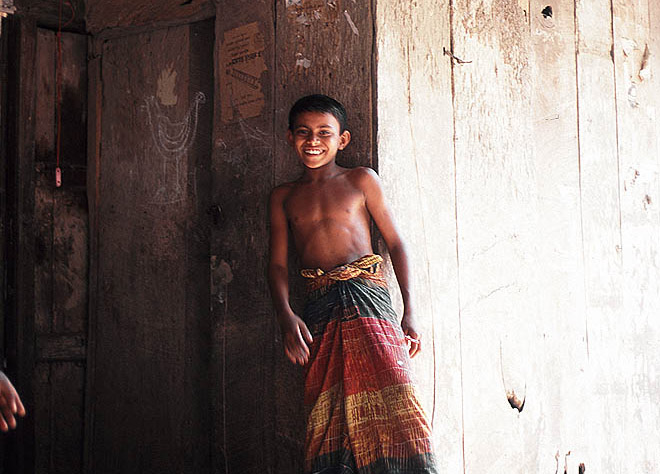 🇮🇳 India and 5 moreLungiলুঙ্গি
A cloth tube or sheet tied at the waist, worn across South and Southeast AsiaCotton · Batik · Checks and stripes
🇮🇳 India and 5 moreLungiলুঙ্গি
A cloth tube or sheet tied at the waist, worn across South and Southeast AsiaCotton · Batik · Checks and stripes
 🇮🇳 India and 1 moreDhoti
An unstitched cloth tied at the waist and worn to the ankle, the men's answer to the sariCotton
🇮🇳 India and 1 morePathin
A striped wrap skirt of the Hajong people, worn from bust to calf in Northeast IndiaSilk · Checks and stripes
🇮🇳 India and 1 moreAgrun
A shawl-like festive wrap of the Hajong people, brocaded in silks with birds and flowers.Silk · Brocade · Zari work
🇮🇳 India and 1 moreMatka
A coarse silk spun from pierced cocoons, woven in the Bengal regionSilk
🇮🇳 India and 1 moreDhoti
An unstitched cloth tied at the waist and worn to the ankle, the men's answer to the sariCotton
🇮🇳 India and 1 morePathin
A striped wrap skirt of the Hajong people, worn from bust to calf in Northeast IndiaSilk · Checks and stripes
🇮🇳 India and 1 moreAgrun
A shawl-like festive wrap of the Hajong people, brocaded in silks with birds and flowers.Silk · Brocade · Zari work
🇮🇳 India and 1 moreMatka
A coarse silk spun from pierced cocoons, woven in the Bengal regionSilk
 🇧🇩 BangladeshDhakai
A cotton saree woven in Dhaka, Bangladesh, its patterns drawn from nature and alpanaCotton · Jamdani
🇧🇩 BangladeshDhakai
A cotton saree woven in Dhaka, Bangladesh, its patterns drawn from nature and alpanaCotton · Jamdani
 🇧🇩 Bangladesh and 1 moreNakshi kanthaনকশি কাঁথা
An embroidered quilt from Bengal, stitched from old sarees with a simple running stitch.Cotton · Kantha · Embroidery
🇧🇩 Bangladesh and 1 moreNakshi kanthaনকশি কাঁথা
An embroidered quilt from Bengal, stitched from old sarees with a simple running stitch.Cotton · Kantha · Embroidery
 🇮🇳 India and 4 moreWoodblock printing on textiles
Patterns pressed onto cloth with hand-carved wooden blocks, the chhapa of South Asia.Linen · Block print
🇧🇩 BangladeshGrameen checkগ্রামীণ চেক
Bright checked cotton from Bangladesh, woven by village weavers in traditional waysCotton · Checks and stripes
🇮🇳 India and 4 moreWoodblock printing on textiles
Patterns pressed onto cloth with hand-carved wooden blocks, the chhapa of South Asia.Linen · Block print
🇧🇩 BangladeshGrameen checkগ্রামীণ চেক
Bright checked cotton from Bangladesh, woven by village weavers in traditional waysCotton · Checks and stripes
 🇮🇳 India and 3 moreDupattaदुपट्टा, دوپٹہ
A versatile long scarf and veil draped with traditional ensembles across South AsiaSilk · Brocade · Tie-dye
🇮🇳 India and 3 moreDupattaदुपट्टा, دوپٹہ
A versatile long scarf and veil draped with traditional ensembles across South AsiaSilk · Brocade · Tie-dye
 🇧🇩 Bangladesh and 2 moreMuslin
A gossamer plain-weave cotton fabric historically spun and woven across BengalCotton · Jamdani
🇧🇩 Bangladesh and 1 moreAbrawan
A legendary, sheer muslin from Dacca named after flowing waterCotton · Zari work
🇧🇩 Bangladesh and 2 moreMuslin
A gossamer plain-weave cotton fabric historically spun and woven across BengalCotton · Jamdani
🇧🇩 Bangladesh and 1 moreAbrawan
A legendary, sheer muslin from Dacca named after flowing waterCotton · Zari work
 🇮🇳 India and 1 moreHandloom sari
Saris woven by hand on pit looms in India and BangladeshSilk · Zari work · Jamdani
🇮🇳 India and 1 moreHandloom sari
Saris woven by hand on pit looms in India and BangladeshSilk · Zari work · Jamdani
 🇧🇩 Bangladesh and 1 moreTangail saree
A Bengal handloom saree in cotton or silk, known for stepped extra-weft patterns.Cotton · Jamdani
🇮🇳 India and 1 moreUppada Jamdani sari
A light handwoven silk sari from Uppada, Andhra Pradesh, patterned in the jamdani waySilk · Jamdani · Zari work
🇧🇩 Bangladesh and 1 moreTangail saree
A Bengal handloom saree in cotton or silk, known for stepped extra-weft patterns.Cotton · Jamdani
🇮🇳 India and 1 moreUppada Jamdani sari
A light handwoven silk sari from Uppada, Andhra Pradesh, patterned in the jamdani waySilk · Jamdani · Zari work
 🇧🇩 Bangladesh and 1 moreJamdaniজামদানি
A sheer cotton muslin saree decorated with hand-woven supplementary weft motifsCotton · Jamdani · Brocade
🇧🇩 Bangladesh and 1 moreTangail saree
A Bengal handloom saree with stepped extra-weft patterns, woven in cotton and silkCotton · Jamdani · Brocade
🇧🇩 BangladeshComilla khadi
Hand-spun, hand-woven cloth from Comilla, Bangladesh, once woven on pit loomsCotton
🇧🇩 Bangladesh and 1 moreJamdaniজামদানি
A sheer cotton muslin saree decorated with hand-woven supplementary weft motifsCotton · Jamdani · Brocade
🇧🇩 Bangladesh and 1 moreTangail saree
A Bengal handloom saree with stepped extra-weft patterns, woven in cotton and silkCotton · Jamdani · Brocade
🇧🇩 BangladeshComilla khadi
Hand-spun, hand-woven cloth from Comilla, Bangladesh, once woven on pit loomsCotton
Photo credits on this page
The small pictures above come from Wikimedia Commons under free licences. Some are cropped to fit.
- Handloom sari: P.K.Niyogi, Public domain, source
- Tant sari: Billjones94, CC BY-SA 4.0, source
- Sari: Suyash.dwivedi, CC BY-SA 4.0, source
- Khadi: Unknown author, Public domain, source
- Lungi: Laportechicago at English Wikipedia (Paul La Porte)., CC BY 2.5, source
- Dhakai: Amit Sen, CC BY-SA 4.0, source
- Woodblock printing on textiles: William Morris, Public domain, source
- Muslin: Unknown author, Public domain, source
- Tangail saree: P.K.Niyogi, Public domain, source
- Dhoti: Redaloes at English Wikipedia, Public domain, source
- Dupatta: Kinshuk Sunil, CC BY 2.0, source
- Nakshi kantha: A junaid alam khan ( talk ), Public domain, source