
Khadi
Hand-spun and hand-woven cloth from the subcontinent, tied to the swadeshi movement
Khadi is cloth spun by hand on a charkha and woven on a handloom, made mostly from cotton but also from silk or wool. It is used across the Indian subcontinent, and Mahatma Gandhi turned it into a symbol of swadeshi, or home-made goods, during India's freedom struggle.
- Spun on a charkha and woven by hand, mostly from cotton, sometimes silk or wool.
- Sabarmati Ashram was where the first hand-woven piece was made, in 1917 to 1918.
- The khadi movement began in 1918 and became part of the freedom struggle.
- The Khadi and Village Industries Commission holds the khadi trademark.
- Muslin, the soft fine khadi, was registered as a GI in Bangladesh in 2020.
What is Khadi?
Khadi is cloth spun by hand and woven by hand, mostly from cotton, though silk and wool can be mixed in. The yarn is drawn out on a charkha, a small spinning wheel, and it is the coarseness of the finished cloth that led Gandhi to call it khadi. He promoted it as swadeshi, meaning goods made at home, and the word is understood right across the Indian subcontinent. It is worn as everyday clothing, and it is also bought by people who want to support hand spinning. The cloth does not trap heat in hot weather and holds warmth when it is cold, and it is often starched for a stiffer feel.
Where does Khadi come from?
Cotton cloth from India travelled widely long before the word khadi was in use. Traders from Greece and Rome bought fine cotton in large amounts, and in medieval times it reached Rome along the sea route known as the maritime Silk Road. Merchants from Arabia and Surat carried Gujarat and Coromandel textiles to Basra and Baghdad, and the trade went east towards China by way of Java. Ibn Battuta, travelling in the 14th century, wrote that the sultan of Delhi sent five kinds of cloth as gifts to China's Yuan emperor. Indian mill and hand textile production fell to its lowest point after the uprising of 1857. Khadi then grew into a quiet economic revolution, and the movement that carried its name began in 1918.
How is Khadi made?
The fibre is cleaned and spun into yarn on a charkha. Gandhi used a double-wheel design he called the Patti Charkha, built to spin faster and take up less room, and in 1946 he recommended the simpler takli over the charkha when money was being poured into more productive wheels. Spinning by hand is slow, and the yarn comes out less even than mill yarn, which is stronger and more consistent. That unevenness shows in the woven cloth. Weavers once preferred mill-spun yarn for this reason, and some used it to make finer khadi for wealthier buyers, a practice Gandhi objected to.
Khadi, drawn
How Khadi is worn
Khadi is cloth rather than a single garment, so it is cut and stitched into whatever the wearer needs. In the museum collections the sources mention, it appears as muslin sarees from a 1710 group of 350 pieces held by the Victoria and Albert Museum in London. Gandhi himself dressed in a dhoti, a length of cloth wrapped at the waist and drawn between the legs, and added wool shawls when the weather turned cold. The sources do not describe any particular way of draping khadi as a saree.

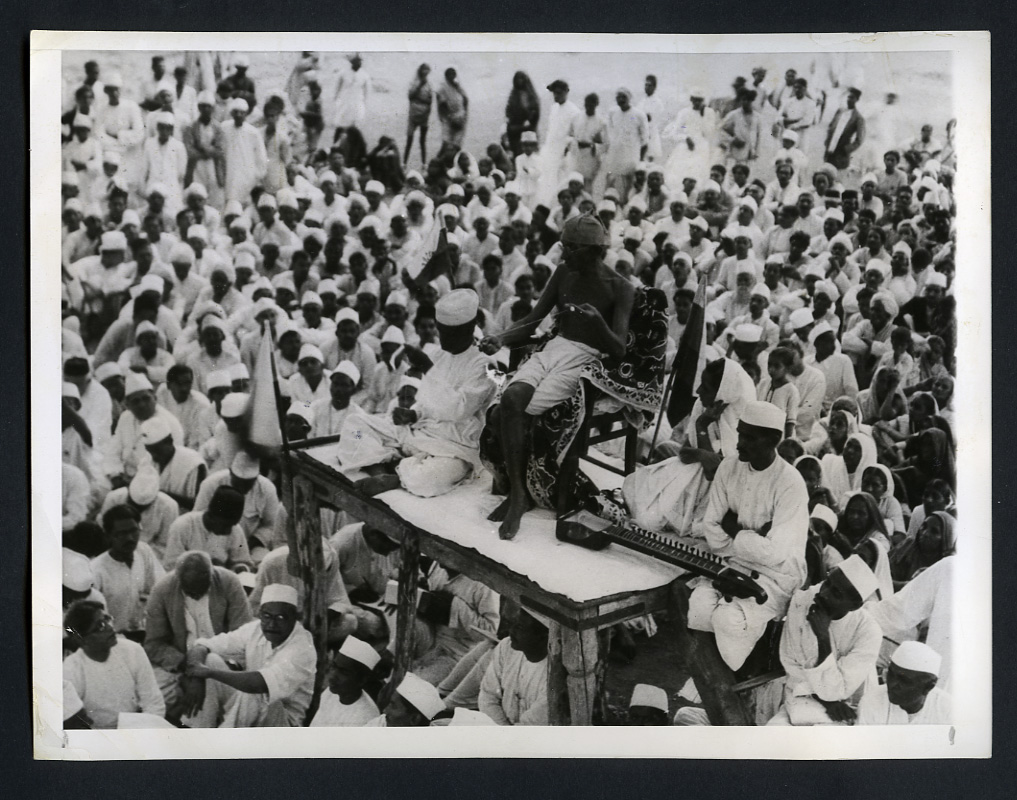

When Khadi is worn
From 1934 the cloth became something villagers could use for themselves, and it stayed in everyday use alongside its political role. Members of the Indian National Congress were required to spin cotton and pay their dues in yarn, so spinning became part of party life. The first Swadeshi Exhibition, held at the Belgaum Congress session in December 1924, showed khadi, spinning wheels and village crafts together. Prime Minister Narendra Modi spoke at Khadi Utsav in August 2022, calling khadi a movement to help people who are poor.
Styles of Khadi
Khadi ranges from coarse cloth to a fine, soft kind known as muslin khadi, which researchers have tried to recreate. They identified phuti carpas as the cotton variety behind muslin, working from the DNA of the plant and from motifs on muslin sarees in a 1710 collection at the Victoria and Albert Museum. Handspun and mill-spun yarn give different cloth, and weavers long argued over which to use. After independence the government reserved some production, such as towel making, for handlooms, which weakened traditional weaving skills while power looms grew.
What Khadi means
Khadi carries the memory of the freedom struggle. Gandhi made swadeshi, the boycott of foreign cloth, central to the campaign against colonial rule, and he asked Congress members to spin their own yarn. The Khadi and Village Industries Commission, a statutory body created after independence, holds the trademarks khadi and Khadi India, and has defended them in India and abroad, registering them in places including Bhutan, the UAE and Mexico. The oldest khadi organisations still running are in Uttar Pradesh, Uttarakhand, Bihar, Jharkhand and Tamil Nadu, and the weaving they support remains a livelihood for rural families.
Questions people ask about Khadi
Where does khadi come from?
It is made across the Indian subcontinent. Cotton cloth from India was traded to Rome, Arabia and China for centuries, and khadi took shape as a movement in India in 1918. Weaving centres also grew in the Comilla region of Bangladesh after Gandhi's visit in 1921.
How is khadi made?
The fibre, usually cotton but sometimes silk or wool, is spun into yarn on a charkha, a hand spinning wheel. The yarn is then woven on a handloom. Hand spinning is slow and the yarn is less even than mill yarn, which gives the finished cloth its particular feel.
What is muslin khadi?
Muslin khadi is the soft, fine version of the cloth, as against the coarser kind. Muslin was registered as a geographical indication in Bangladesh in 2020. Researchers have tried to reproduce it, tracing the phuti carpas cotton variety through plant DNA and studying old muslin sarees in London collections.
Who wears khadi?
It is everyday clothing for many people in India and Bangladesh, and from 1934 villagers used it for their own needs. It also has a political history: Congress members spun cotton and paid their dues in yarn, and Gandhi wore a dhoti of it.
Is the name khadi protected?
The Khadi and Village Industries Commission, a statutory body created after independence, holds the exclusive rights to the khadi and Khadi India trademarks. It has defended them before an Indian tribunal and abroad, and registered them in countries including Bhutan, the UAE and Mexico.
Good reading and sources
- ‘Khadi’, ‘Khadi India’ not generic names, rules tribunalThe Hindu, Article
- Search ResultsV&A, Article
- LifeStyleThe Daily Star, Article
- Khadi on WikipediaEncyclopedia
- More photos on Wikimedia CommonsPhotos and video
- Wikidata recordOpen data
The facts on this page come from the Wikipedia article "Khadi", written by its contributors and used under the CC BY-SA 4.0 licence, and from its Wikidata record (CC0). EveryPallu rewrote the text in its own words, with AI assistance, and compares every page with the article to make sure no passage is copied. It may be reused under the same CC BY-SA 4.0 licence with a link back.
It may contain mistakes. Traditions, weaves and prices differ from one weaver, town or shop to the next, and it is not buying advice. If something is wrong, tell us. Last refreshed 2026-10-03.
More from India
All the sarees of India 🇮🇳 India and 4 moreSariसाड़ी
A single unstitched length of cloth, tucked at the waist and slung over one shoulderSilk · Brocade · Ikat
🇮🇳 India and 4 moreSariसाड़ी
A single unstitched length of cloth, tucked at the waist and slung over one shoulderSilk · Brocade · Ikat
Its cousins elsewhere
All cotton sarees 🇮🇳 India and 1 moreBandhani
Tie-dyed cloth dotted with small tied knots, made in Gujarat and RajasthanSilk · Tie-dye
🇮🇳 India and 1 moreBandhani
Tie-dyed cloth dotted with small tied knots, made in Gujarat and RajasthanSilk · Tie-dye
 🇮🇳 IndiaMundum neriyathumമുണ്ട് നേരിയത്
A two-piece white cotton cloth of Kerala, worn with a golden border called kasavuCotton · Zari work
🇮🇳 IndiaMundum neriyathumമുണ്ട് നേരിയത്
A two-piece white cotton cloth of Kerala, worn with a golden border called kasavuCotton · Zari work
 🇮🇳 IndiaGarad sariগরদ শাড়ি
A fine silk sari woven on pit looms in Murshidabad and Birbhum, worn at Durga PujaSilk · Zari work · Brocade
🇮🇳 IndiaGarad sariগরদ শাড়ি
A fine silk sari woven on pit looms in Murshidabad and Birbhum, worn at Durga PujaSilk · Zari work · Brocade