Abrawan
A legendary, sheer muslin from Dacca named after flowing water
Abrawan was an ultra-fine, sheer muslin woven in Dacca from cotton or silk yarns. Famous for its flowing translucence, it was crafted during the monsoon to preserve delicate threads and survives in related forms like the Tarbana sari.
- Named after flowing water to reflect its translucent and fluid nature.
- Crafted in Dacca from fine cotton and silk using a delicate plain weave.
- Woven during the monsoon so humid air would prevent delicate threads from snapping.
- Connected to the Tarbana sari, which pairs a silk warp with a zari weft.
What is Abrawan?
Abrawan was a remarkably delicate muslin woven in the Indian subcontinent. The Persian phrase translates to flowing water, capturing the sheer and liquid quality of the textile. It was constructed with a basic plain weave, predominantly using fine cotton yarns, though some versions incorporated silk. The cloth was so clear and light that contemporaries celebrated it alongside other historic muslins under names such as woven air. While the earliest historical forms have vanished, related styles like the Tarbana sari continue to use this heritage by pairing silk warps with metallic zari wefts.
Where does Abrawan come from?
The fabric originated in Dacca as one of its most prized muslins. Historical accounts celebrate its extraordinary lightness through royal court tales. In one episode, the Mughal emperor Aurangzeb questioned his daughter about dressing modestly because her multi-layered garment remained sheer. Another legend recounts that Nawab Alivardi Khan banished an artisan after a cow grazed on a piece of Abrawan drying unnoticed on grass. Over the centuries, the original craft lost its authentic qualities, leaving behind modern descendants.
How is Abrawan made?
Weavers made Abrawan using a simple plain weave structure. Cotton was the primary raw material, while silk threads were also woven into distinct varieties. The fine threads were exceedingly prone to snapping in dry weather. To counter this, weavers carefully timed their production for the humid monsoon season. The surrounding moisture kept the delicate strands supple on the loom. A later related derivative, the Tarbana sari, weaves a warp made of silk together with a weft of gold zari thread.
Abrawan, drawn
Colours, motifs and borders
Abrawan is characterized by its utter transparency and fine plain weave rather than dense surface ornamentation. Its aesthetic centers on its sheer, fluid appearance that mimics rippling water. In the related Tarbana sari format, the textile achieves a glittering tissue finish through the direct combination of fine silk warp yarns and shining gold-toned zari in the weft.
Styles of Abrawan
Historical varieties of Abrawan were woven in both pure cotton and silk iterations. In later times, the style evolved into the Tarbana sari. This tissue-like garment reimagines the flowing aesthetic by crossing a silk warp with a metallic zari weft, yielding a shimmering, sheer drape.
What Abrawan means
Abrawan holds a mythic place in South Asian textile history, symbolising the peak of handweaving skill in Dacca. The fabric inspired court legends regarding its extreme invisibility and modesty debates in the Mughal court. Royal karkhanas produced such cloth for elite patrons, and its lore remains tied to the vanished art of ultra-fine subcontinental muslins.
Questions people ask about Abrawan
Where does Abrawan originate?
Abrawan originated in the Indian subcontinent and was counted among the finest muslins woven in Dacca. It was produced in historic weaving centers, often associated with royal workshops.
How was Abrawan made?
Artisans created Abrawan using a plain weave technique, primarily working with cotton and occasionally silk. Weavers operated during the rainy monsoon season to keep delicate yarns from breaking in dry air.
What does the name Abrawan mean?
The name translates to running water, a poetic description of the fabric's sheer, lightweight texture. Contemporaries also referred to similar high-grade muslins as woven air.
What is the Tarbana sari?
A Tarbana sari is a related form of Abrawan. It is a tissue-style saree made with a warp of silk yarns and a weft of gold metallic zari threads.
Good reading and sources
The facts on this page come from the Wikipedia article "Abrawan", written by its contributors and used under the CC BY-SA 4.0 licence, and from its Wikidata record (CC0). EveryPallu rewrote the text in its own words, with AI assistance, and compares every page with the article to make sure no passage is copied. It may be reused under the same CC BY-SA 4.0 licence with a link back.
It may contain mistakes. Traditions, weaves and prices differ from one weaver, town or shop to the next, and it is not buying advice. If something is wrong, tell us. Last refreshed 2026-10-04.
More from Bangladesh
All the sarees of Bangladesh 🇮🇳 India and 4 moreSariसाड़ी
A single unstitched length of cloth, tucked at the waist and slung over one shoulderSilk · Brocade · Ikat
🇮🇳 India and 4 moreSariसाड़ी
A single unstitched length of cloth, tucked at the waist and slung over one shoulderSilk · Brocade · Ikat
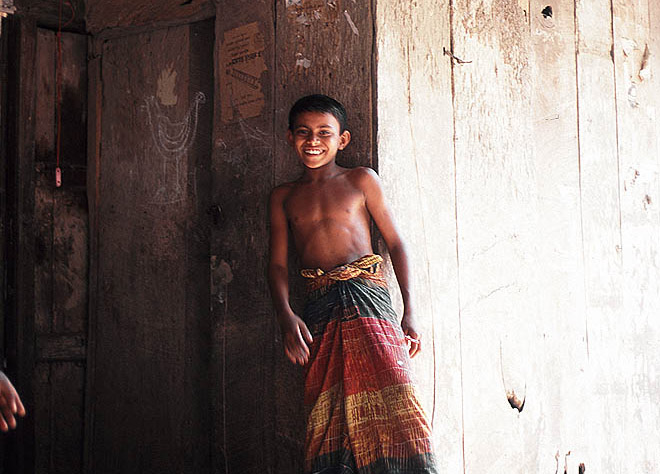 🇮🇳 India and 5 moreLungiলুঙ্গি
A cloth tube or sheet tied at the waist, worn across South and Southeast AsiaCotton · Batik · Checks and stripes
🇮🇳 India and 5 moreLungiলুঙ্গি
A cloth tube or sheet tied at the waist, worn across South and Southeast AsiaCotton · Batik · Checks and stripes
 🇮🇳 India and 2 moreKhadi
Hand-spun and hand-woven cloth from the subcontinent, tied to the swadeshi movementCotton
🇮🇳 India and 2 moreKhadi
Hand-spun and hand-woven cloth from the subcontinent, tied to the swadeshi movementCotton
 🇮🇳 India and 1 moreDhoti
An unstitched cloth tied at the waist and worn to the ankle, the men's answer to the sariCotton
🇮🇳 India and 1 moreDhoti
An unstitched cloth tied at the waist and worn to the ankle, the men's answer to the sariCotton
Its cousins elsewhere
All cotton sarees 🇮🇳 IndiaGarad sariগরদ শাড়ি
A fine silk sari woven on pit looms in Murshidabad and Birbhum, worn at Durga PujaSilk · Zari work · Brocade
🇮🇳 IndiaGarad sariগরদ শাড়ি
A fine silk sari woven on pit looms in Murshidabad and Birbhum, worn at Durga PujaSilk · Zari work · Brocade
 🇮🇳 IndiaChanderi sari
A silk sari woven in Chanderi, Madhya Pradesh, with gold and silver zariSilk · Brocade · Zari work
🇮🇳 IndiaChanderi sari
A silk sari woven in Chanderi, Madhya Pradesh, with gold and silver zariSilk · Brocade · Zari work
 🇮🇳 IndiaMundum neriyathumമുണ്ട് നേരിയത്
A two-piece white cotton cloth of Kerala, worn with a golden border called kasavuCotton · Zari work
🇮🇳 IndiaKimkhwab
A heavy silk brocade woven with gold and silver yarns, famed in Mughal IndiaSilk · Brocade · Zari work
🇮🇳 IndiaMundum neriyathumമുണ്ട് നേരിയത്
A two-piece white cotton cloth of Kerala, worn with a golden border called kasavuCotton · Zari work
🇮🇳 IndiaKimkhwab
A heavy silk brocade woven with gold and silver yarns, famed in Mughal IndiaSilk · Brocade · Zari work