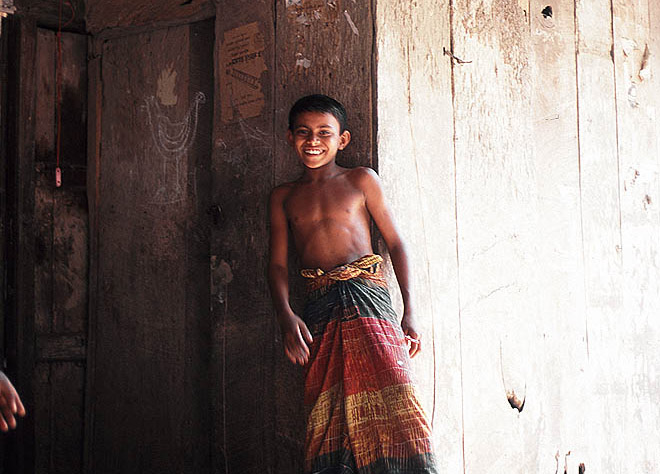
Lungi
In its own language: লুঙ্গি
A cloth tube or sheet tied at the waist, worn across South and Southeast Asia
The lungi is a wrap of cloth for the lower waist, worn mainly by men and tied below the navel. It comes from the Indian subcontinent, is woven mostly in cotton with silk for ceremonies, and is made either as an open sheet or sewn into a tube. Bangladesh's weaving clusters supply much of it.
- Standard open lungis measure about 200 cm by 115 cm; children's sizes are two thirds.
- Bangladeshi lungis are sewn into a tube, unlike the open sheet used elsewhere.
- Silk lungis are kept for ceremonies such as weddings.
- A reinforced black and white stripe along both edges keeps the cloth from fraying.
- In 2013 a Dhaka housing society banned the lungi and a protest march followed.
What is Lungi?
The lungi is a wrap of cloth tied round the lower waist, just below the navel. It sits in the sarong family and is worn mostly by men, though a few regions let women wear it as well. Cotton is the usual fibre, with silk kept for ceremonies. In hot, humid climates the open cloth lets air move, and wearers find it comfortable for that reason. It serves as everyday dress and as nightwear. The garment is common across South Asia and parts of Southeast Asia.
Where does Lungi come from?
The lungi belongs to the Indian subcontinent. In Bangladesh its story is traced to the Bengal Sultanate, when men wore cotton sarongs in many colours along with turbans, dhutis, belts and leather shoes. Two word histories are offered: one says the Bengali word arrived through Burmese, from longyi; another treats the lungi as a form of dhoti, a word said to come from a Bengali term meaning to wash. In the Punjab region, wearing it has fallen away in recent years.
How is Lungi made?
Most lungis are woven from cotton. An open lungi, the cheapest sort, is simply a flat sheet; a standard adult one measures about 200 cm long and 115 cm high, and children's versions are roughly two thirds of that. Bangladeshi makers sew theirs into a seamless tube instead. Solid colours and plaids are the commonest patterns, because a power loom turns them out easily and cheaply. Silk is kept for weddings and similar rites. A black and white reinforced stripe along the top and bottom edges stops the cloth fraying.
Lungi, drawn
Colours, motifs and borders
Colour is part of the point. Blue is especially popular, because it fades into pleasant tones, unlike other colours. Plaid and solid grounds are the everyday look, and the simplest of these come off power looms. Better pieces carry tartan, batik or silk work. A black and white band runs along the top and bottom edges. Kerala's plain white mundus, by contrast, often carry golden kasavu embroidery at the border.
How Lungi is worn
Lungis sit at the waist, below the navel, and are knotted rather than buttoned. The usual everyday fastening is a double twist: the wearer brings two points of the top edge together, twists them twice and tucks the ends in. A double pretzel knot, made from two points on the upper border, holds more securely. Length can be shortened by tucking cloth into the waist, so the garment covers only from waist to knee, which labourers working long hours in the sun often do. Some wear a kaupinam or langot underneath.


When Lungi is worn
Daily life and sleep are its main uses, and in several places it is not considered proper for the street. Kerala treats the plain white mundu as formal dress for weddings and festivals, while Odisha, West Bengal, Bihar and Haryana keep the lungi for home and night. In Bangladesh, tartan, batik or silk lungis are given to a groom at his wedding. Punjab's Bhangra dancers wear it, and rural households there wear it indoors.
Styles of Lungi
Names and cuts change with the map. Bangladesh favours a sewn tube, while elsewhere a single open sheet is the norm. Myanmar spells the word longyi, with a paso for men and a htamein for women. The Maldives calls it mundu, and there mostly elderly men wear it now. Thailand knows a pa kao mah for men and a pa toong for women. Afghanistan shortens the name to lung for use in public steam baths, where the colour is cream and occasionally red. Iran has its own Farsi term.
What Lungi means
Bangladesh's lungi industry is clustered in Sirajganj, Kushtia, Pabna and Khulna. In 2013 a housing society in Dhaka barred the lungi and refused entry to wearers; people objected on social media and a march followed on 13 April. For the Nawayath of Bhatkal, on Karnataka's Konkan coast, the sewn cylindrical lungi is daily dress and a mark of tradition. Tribal communities in Jharkhand, Chhattisgarh and Madhya Pradesh wear it too.
Questions people ask about Lungi
Where does the lungi come from?
It belongs to the Indian subcontinent and to the wider family of sarongs. Bangladesh traces its own lungi tradition back to the Bengal Sultanate. The garment is also established in India, Myanmar, the Maldives, Thailand, Afghanistan and Iran.
How is a lungi made?
It is normally woven from cotton, with silk reserved for ceremonial pieces. A maker can leave it as a flat open sheet or sew it into a seamless tube. Solid colours and plaids dominate, because power looms produce those patterns cheaply.
How is a lungi tied?
The everyday method is a double twist: two points of the upper edge are brought together and twisted twice, with the ends tucked into the waist. A double pretzel knot made from two points holds more securely. Tucking cloth in shortens the garment.
Do women wear lungis?
Rarely, and it depends on local tradition. In Kerala both men and women wear it, and in Punjab women wear a version called laacha. Bangladeshi women do not wear lungis, though non-Bengali tribal women in the Chittagong Hill Tracts wear similar cloth.
Is a lungi the same as a dhoti?
They are close relatives. The mundu and dhoti are treated as variations of the lungi, usually plain white, sometimes with golden kasavu embroidery at the border, and worn formally. The lungi itself is casual dress, often colourful or checked.
Good reading and sources
- Lungi on WikipediaEncyclopedia
- More photos on Wikimedia CommonsPhotos and video
- Wikidata recordOpen data
The facts on this page come from the Wikipedia article "Lungi", written by its contributors and used under the CC BY-SA 4.0 licence, and from its Wikidata record (CC0). EveryPallu rewrote the text in its own words, with AI assistance, and compares every page with the article to make sure no passage is copied. It may be reused under the same CC BY-SA 4.0 licence with a link back.
It may contain mistakes. Traditions, weaves and prices differ from one weaver, town or shop to the next, and it is not buying advice. If something is wrong, tell us. Last refreshed 2026-10-03.
More from India
All the sarees of India 🇮🇳 India and 4 moreSariसाड़ी
A single unstitched length of cloth, tucked at the waist and slung over one shoulderSilk · Brocade · Ikat
🇮🇳 India and 4 moreSariसाड़ी
A single unstitched length of cloth, tucked at the waist and slung over one shoulderSilk · Brocade · Ikat
Its cousins elsewhere
All cotton sarees 🇮🇩 Indonesia and 5 moreSarongꦱꦫꦸꦁ
A wrapped tube of cloth worn at the waist, from the Malay world to Kerala and SomaliaCotton · Batik · Ikat
🇮🇳 IndiaTsüngkotepsü
A black and red Ao Naga warrior shawl with a white band of animal and star motifsChecks and stripes
🇮🇩 Indonesia and 5 moreSarongꦱꦫꦸꦁ
A wrapped tube of cloth worn at the waist, from the Malay world to Kerala and SomaliaCotton · Batik · Ikat
🇮🇳 IndiaTsüngkotepsü
A black and red Ao Naga warrior shawl with a white band of animal and star motifsChecks and stripes
 🇮🇳 IndiaPasapali sari
A handloom ikat saree from Odisha with chess-board checks in contrasting colours.Ikat · Checks and stripes
🇮🇳 India and 1 morePathin
A striped wrap skirt of the Hajong people, worn from bust to calf in Northeast IndiaSilk · Checks and stripes
🇮🇳 IndiaPasapali sari
A handloom ikat saree from Odisha with chess-board checks in contrasting colours.Ikat · Checks and stripes
🇮🇳 India and 1 morePathin
A striped wrap skirt of the Hajong people, worn from bust to calf in Northeast IndiaSilk · Checks and stripes