
Longyi
In its own language: လုံချည်
A cloth tube worn at the waist in Myanmar, about two metres long
The longyi is a sheet of cloth, roughly two metres long and eighty centimetres wide, worn in Myanmar and often sewn into a tube. Men call their version a paso and women a htamein; the cloth is wrapped at the waist, folded over with no knot, and usually worn with a fitted blouse or jacket.
- About 2 metres long and 80 cm wide, often sewn into a tube.
- Men's versions are called paso; women's are htamein.
- Held up by folding the cloth over, with no knot.
- Acheik, the finest silk cloth, is woven in Amarapura and worn at weddings.
- Lethwei fighters once hitched it up like shorts to kick.
What is Longyi?
The longyi is a piece of cloth worn in Myanmar. Most are about two metres long and eighty centimetres wide, and many are stitched into a tube. It sits at the waist and falls to the feet, held by folding the fabric over itself, with no knot. Men's versions are called paso and women's htamein; they differ in pattern and in the way they are tied. Cotton is the everyday cloth, though silk, crepe, satin and georgette are also used. It is ordinary dress in towns and villages alike, not something kept only for special days.
Where does Longyi come from?
The tube-shaped cloth is a fairly recent arrival in Myanmar. It became common under British rule, taking the place of two older garments: the paso worn by men and the htamein worn by women. Before that, men's taungshay paso was a long, unsewn length of about thirty feet. Women's htamein was shorter, open at the front and finished with a train. The word longyi once described the sarong worn by Malay men, and the looser Malay and Indian style was adopted more quickly in Lower Burma and in the towns.
How is Longyi made?
There is no single recipe. Cotton is the basic cloth, but imported and home-grown fabric alike is cut into longyis, and weavers also work in silk. Before colonial times much of the silk came from China. The most elaborate ceremonial cloth is acheik, the hooked wave and houndstooth silk of the Amarapura weavers, worked in a range of colour combinations, mostly for weddings. Royal pasos and htameins of the past were richly embroidered with pearls, gold, silver and precious stones.
Longyi, drawn
Colours, motifs and borders
Men's pasos are usually plain, striped or checked, and can be worn inside out or upside down with no difference. Women's htameins carry more colour and more floral patterns, and have a black calico waistband called a htet sint. For ceremonial wear people bring out their best silks. The most elaborate is acheik, an intricate wave or houndstooth design. Silk was once the cloth of royalty and courtiers, whose garments were worked with metal thread and gems.
How Longyi is worn
A longyi is wrapped around the waist and folded over at the front, so it stays up without a knot. Men make a fold on each side and tie the two together just below the navel. Women use one broad fold at the front, tucking the end at the hip or folding it back into the opposite side of the waist, and usually wear a fitted blouse that ends at the waistband. Hemlines move with fashion but rarely rise above the knee. Men sometimes hitch the cloth up between the legs and tuck it at the back, the way a dhoti is worn, for climbing or sport.


When Longyi is worn
A longyi is everyday dress in Myanmar, worn by men and women of all ages. For ceremonies people keep their best silk. Acheik is worn especially at weddings, where bride and groom often appear in matching colours, and poorer families may set aside a traditional silk for such days. In the past silk belonged to royalty and courtiers, and reproductions of their embroidered pasos and htameins still appear on stage at zat pwès, the theatrical performances.
Styles of Longyi
Regional and ethnic weaves are many: Rakhine, Mon, Kachin, Inle, Yaw, Seikkhun, Dawei, and Zin Mè from Chiang Mai. Men wear a silk paso called Bangauk, or Bangkok, paso on special days, while Kala or Indian pasos tend to be longer and suit taller wearers; kaka zin is a broad black, brown and white check associated with Indian teashop owners. Longyis are usually sold unsewn, though ready-to-wear and skirt-style htameins exist, and durable mercerised cloth from India is popular.
Care and buying
Care is simple because the garment is a tube of cloth: it hangs, presses, folds and stacks without fuss, and takes up very little wardrobe space. Changing is easy too. A person steps into the new longyi and pulls it up while the old one loosens and drops, or draws the new one down over the head. Women change without undressing fully, wearing one htamein while they put on the next.
What Longyi means
Henry Yule, travelling through Amarapura, called pasos and htameins the most important local product and noted how many people the trade employed. Today the longyi is ordinary dress and a marker of identity, with ethnic and regional patterns worn proudly. Its history is bound up with colonial change: the tube replaced older unsewn cloth in the towns first. The old habit of hitching it up for fighting survives in lethwei, and in the folding used by players of chinlone.
Questions people ask about Longyi
Where does the longyi come from?
It is worn in Myanmar, formerly Burma. The modern tube-shaped version became common there under British rule, replacing the older paso and htamein. The word itself first described the sarong worn by Malay men.
How is a longyi made?
Cotton is the everyday cloth, though silk, crepe, satin and georgette are also used, and the fabric may be imported or woven at home. It is cut to about two metres by eighty centimetres and usually sewn into a cylinder, then sold unsewn or ready to wear.
How is it worn?
It is wrapped at the waist and folded over without a knot, falling to the feet. Men fold and tie each side below the navel; women use one broad front fold and tuck the end at the hip, usually with a fitted blouse that stops at the waistband.
What is acheik?
Acheik is the most elaborate ceremonial longyi cloth, an intricate wave or houndstooth pattern woven in several colours by the weavers of Amarapura. It is worn especially at weddings, often by bride and groom in matching colours.
Do men and women wear it the same way?
No. The longyi is not unisex: men's pasos and women's htameins differ in pattern and in the way they are tied. Men's are usually plain, striped or checked, while women's carry more colour and floral patterns and a black calico waistband.
Good reading and sources
- Longyi on WikipediaEncyclopedia
- More photos on Wikimedia CommonsPhotos and video
- Wikidata recordOpen data
The facts on this page come from the Wikipedia article "Longyi", written by its contributors and used under the CC BY-SA 4.0 licence, and from its Wikidata record (CC0). EveryPallu rewrote the text in its own words, with AI assistance, and compares every page with the article to make sure no passage is copied. It may be reused under the same CC BY-SA 4.0 licence with a link back.
It may contain mistakes. Traditions, weaves and prices differ from one weaver, town or shop to the next, and it is not buying advice. If something is wrong, tell us. Last refreshed 2026-10-03.
More from Myanmar
All the sarees of Myanmar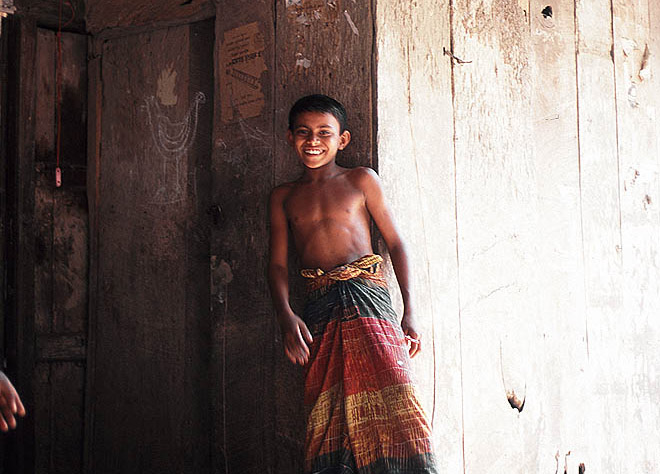 🇮🇳 India and 5 moreLungiলুঙ্গি
A cloth tube or sheet tied at the waist, worn across South and Southeast AsiaCotton · Batik · Checks and stripes
🇮🇳 India and 5 moreLungiলুঙ্গি
A cloth tube or sheet tied at the waist, worn across South and Southeast AsiaCotton · Batik · Checks and stripes
 🇲🇲 MyanmarAcheikအချိတ်
Myanmar's multi-shuttle silk weave of waves and stripes, made into paso and htameinSilk · Brocade
🇲🇲 MyanmarAcheikအချိတ်
Myanmar's multi-shuttle silk weave of waves and stripes, made into paso and htameinSilk · Brocade
 🇮🇳 India and 4 moreWoodblock printing on textiles
Patterns pressed onto cloth with hand-carved wooden blocks, the chhapa of South Asia.Linen · Block print
🇮🇳 India and 4 moreWoodblock printing on textiles
Patterns pressed onto cloth with hand-carved wooden blocks, the chhapa of South Asia.Linen · Block print
Its cousins elsewhere
All cotton sarees 🇮🇳 India and 2 moreMadras
A light handwoven cotton cloth of bright checks, named after the city of ChennaiCotton · Checks and stripes · Embroidery
🇮🇳 India and 2 moreMadras
A light handwoven cotton cloth of bright checks, named after the city of ChennaiCotton · Checks and stripes · Embroidery
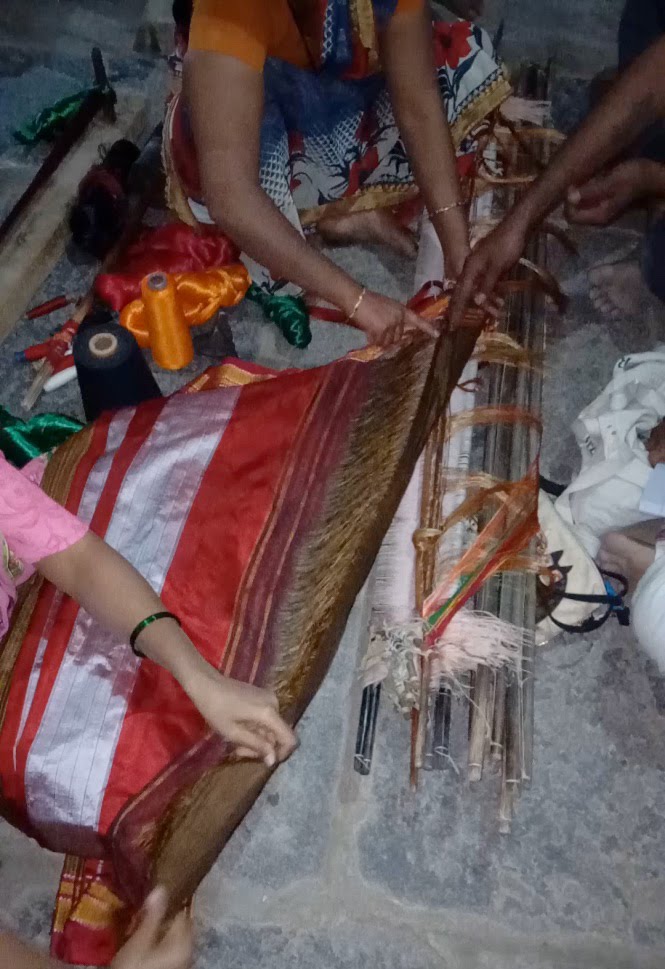 🇮🇳 IndiaIlkal sari
A cotton saree with a loop-joined silk pallu and broad red border, from Ilkal, KarnatakaCotton · Zari work · Embroidery
🇮🇳 IndiaIlkal sari
A cotton saree with a loop-joined silk pallu and broad red border, from Ilkal, KarnatakaCotton · Zari work · Embroidery
 🇮🇩 Indonesia and 5 moreSarongꦱꦫꦸꦁ
A wrapped tube of cloth worn at the waist, from the Malay world to Kerala and SomaliaCotton · Batik · Ikat
🇮🇩 Indonesia and 5 moreSarongꦱꦫꦸꦁ
A wrapped tube of cloth worn at the waist, from the Malay world to Kerala and SomaliaCotton · Batik · Ikat
 🇮🇳 IndiaPhanekꯐꯅꯦꯛ
A traditional Meitei wraparound skirt woven with striped borders in ManipurMuga · Embroidery · Checks and stripes
🇮🇳 IndiaPhanekꯐꯅꯦꯛ
A traditional Meitei wraparound skirt woven with striped borders in ManipurMuga · Embroidery · Checks and stripes