Batik
Wax-resist patterns, dyed layer on layer.
Batik is wax-resist dyeing: wax is applied to cloth, the cloth is dyed, and the wax is removed to leave a pattern. In India it is practised in Bengal, Madhya Pradesh, Tamil Nadu and Gujarat. Indonesian batik is the most famous, but Indian and Sri Lankan makers have their own traditions.
What it is
Batik is a resist technique in which molten wax is applied to cloth, so the waxed parts do not take dye. Once the cloth is dyed and the wax removed, the pattern appears as undyed lines or shapes. Applying more wax and dyeing again lets the artist build layers of colour. The wax is usually a mix of beeswax and paraffin, and cracks in the wax allow thin veins of dye to seep in, creating the crackle effect that many people link to batik. The craft is best known from Java in Indonesia, and in India it has been taken up by studios and cooperatives, often on cotton and silk sarees.
How it is made, step by step
The cloth is washed and stretched on a frame. The artist draws a pencil design, then applies hot wax with a tool called a canting, a small copper cup with a spout, for fine lines, or with a brush for larger areas. Alternatively a copper stamp called a cap is dipped in wax and pressed on the cloth. The cloth is dipped in the lightest dye, dried, and more wax is applied to protect the colour. This repeats towards darker shades. When finished, the wax is removed by boiling the cloth in water or ironing it between sheets of absorbent paper. In India, makers use cold-water-soluble dyes, often reactive, and silk is common.
The motifs and looks it is known for
Indian batik sarees often feature florals, leaves, paisleys, abstract brushwork, birds and landscapes, and many are painterly and contemporary rather than rigidly traditional. In Bengal, studios around Santiniketan blend batik with Tagore-era art influences, and the motifs may reflect rural scenes and nature. The telltale look is a soft line and a network of fine cracks where dye entered the wax, in contrast with the crisp edges of print. Colours are layered and often rich, with deep indigo and wine tones. Sri Lankan batik tends to be bold and bright with large figures, while Javanese designs are formal with set patterns such as parang and kawung.
Where it is made
In India, batik on sarees is made in West Bengal at Santiniketan and surrounding areas, and in Madhya Pradesh at Bagh and Ujjain, where Bagh batik is a recognised style. Tamil Nadu has batik workshops in Chennai and at Cholamandal artists village, which took part in the revival of the craft in the twentieth century. Gujarat, Odisha and Kerala also have batik studios. In Sri Lanka, the craft is centred on Colombo, Kandy and the south, where it is popular among tourists and exports. In Indonesia, Java, including Yogyakarta, Surakarta and Pekalongan, is the heartland, and UNESCO lists Indonesian batik as intangible heritage.
History in brief
Wax-resist dyeing is old and appears in many cultures, including in Africa, East Asia and Indonesia. Evidence of resist-dyed cloth in India exists from early periods, though the exact origin of wax-based work here is uncertain. The word batik itself is Javanese. In India the craft came into modern focus in the twentieth century, when artists associated with Santiniketan and Madras experimented with it, and cooperatives, and later boutiques, took it up for sarees. Indonesian batik was inscribed by UNESCO in 2009. Indian batik is generally a studio craft today, with a small base of skilled artists, and it should be seen as a modern revival rather than an ancient saree tradition.
Buying and caring for it
On real batik, the design shows on both sides of the cloth, and the colour has soaked through to the back. Printed imitations, which copy the look of cracked wax, show dye only on the face and the back looks pale. Fine crackle lines that vary from place to place suggest handwork, while repeats of identical cracks are a sign of printing. Tjanting lines vary a little in width. Be careful with cheap pieces, because many are machine printed. Wash batik gently by hand in cold water with a mild soap and dry in shade without wringing. Dry clean silk. Iron on low heat from the back and avoid strong sunlight.
Where to look
- Santiniketan batik: Studio batik from West Bengal, often on silk and cotton, with painterly motifs.
- Bagh batik: Wax resist work in the Bagh area of Madhya Pradesh.
- Cholamandal batik: Batik tradition tied to the artists village near Chennai.
- Javanese batik: The classic Indonesian tradition from Yogyakarta, Solo and Pekalongan.
- Sri Lankan batik: Bold, bright batik from Colombo, Kandy and the south coast.
- Batik silk saree: Painterly batik on silk, a common form of modern studio saree.
Care
- Wash gently by hand in cold water and dry in the shade.
- Dry clean silk batik.
- Iron on low heat from the reverse and avoid strong sun.
Sources and further reading
Original text by the Pallu desk, written with AI assistance and checked against the sources above. If we have something wrong, tell us.
Batik on Pallu
The sarees written up so far, newest and best known first.
 🇮🇩 IndonesiaBatik Parang꧋ꦧꦠꦶꦏ꧀ꦥꦫꦁ
A diagonal wave batik pattern from Java, steeped in royal philosophyCotton · Batik
🇮🇩 IndonesiaBatik Parang꧋ꦧꦠꦶꦏ꧀ꦥꦫꦁ
A diagonal wave batik pattern from Java, steeped in royal philosophyCotton · Batik
 🇮🇳 IndiaShantiniketan batik
Hand-painted batik from Shantiniketan in Bengal, its colours mixed from leaf and barkBatik · Hand painting
🇮🇳 IndiaShantiniketan batik
Hand-painted batik from Shantiniketan in Bengal, its colours mixed from leaf and barkBatik · Hand painting
 🇮🇩 Indonesia and 5 moreSarongꦱꦫꦸꦁ
A wrapped tube of cloth worn at the waist, from the Malay world to Kerala and SomaliaCotton · Batik · Ikat
🇮🇩 Indonesia and 5 moreSarongꦱꦫꦸꦁ
A wrapped tube of cloth worn at the waist, from the Malay world to Kerala and SomaliaCotton · Batik · Ikat
 🇲🇲 Myanmar and 1 moreLongyiလုံချည်
A cloth tube worn at the waist in Myanmar, about two metres longCotton · Checks and stripes · Embroidery
🇲🇲 Myanmar and 1 moreLongyiလုံချည်
A cloth tube worn at the waist in Myanmar, about two metres longCotton · Checks and stripes · Embroidery
 🇮🇩 Indonesia and 4 moreKebayaꦏꦼꦧꦪ
A front-opening blouse worn across Southeast Asia with a sarong or kainCotton · Embroidery · Batik
🇮🇩 Indonesia and 4 moreKebayaꦏꦼꦧꦪ
A front-opening blouse worn across Southeast Asia with a sarong or kainCotton · Embroidery · Batik
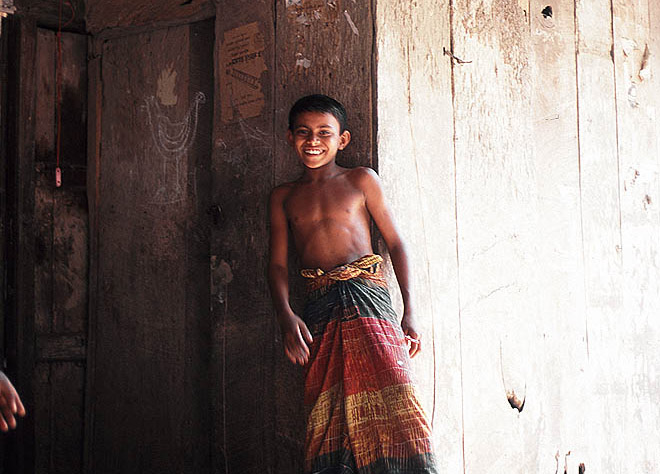 🇮🇳 India and 5 moreLungiলুঙ্গি
A cloth tube or sheet tied at the waist, worn across South and Southeast AsiaCotton · Batik · Checks and stripes
🇮🇳 India and 5 moreLungiলুঙ্গি
A cloth tube or sheet tied at the waist, worn across South and Southeast AsiaCotton · Batik · Checks and stripes
 🇮🇳 India and 5 moreResist dyeing
Cloth patterned by keeping dye off part of the fabric with wax, paste, ties or clampsIkat · Tie-dye
🇮🇳 India and 5 moreResist dyeing
Cloth patterned by keeping dye off part of the fabric with wax, paste, ties or clampsIkat · Tie-dye
 🇰🇪 Kenya and 5 moreKitenge
A printed African wrap cloth worn around the waist or chest and used as everyday dressBatik
🇰🇪 Kenya and 5 moreKitenge
A printed African wrap cloth worn around the waist or chest and used as everyday dressBatik
 🇮🇩 Indonesia and 2 moreKembenꦏꦼꦩ꧀ꦧꦼꦤ꧀
A shoulder-baring torso wrap from Java and Bali, wound from a length of kain clothBatik · Ikat
🇮🇩 Indonesia and 2 moreKembenꦏꦼꦩ꧀ꦧꦼꦤ꧀
A shoulder-baring torso wrap from Java and Bali, wound from a length of kain clothBatik · Ikat
Photo credits on this page
The small pictures above come from Wikimedia Commons under free licences. Some are cropped to fit.
- Batik Parang: Q100422095, Public domain, source
- Shantiniketan batik: Sumita Arup, CC BY-SA 4.0, source
- Sarong: Unknown author, CC BY-SA 3.0, source
- Longyi: Unknown author, Public domain, source
- Kebaya: Simon_sees, CC BY 2.0, source
- Lungi: Laportechicago at English Wikipedia (Paul La Porte)., CC BY 2.5, source
- Resist dyeing: Ardyansa Nugraha, CC BY-SA 4.0, source
- Kitenge: Fanny Schertzer, CC BY-SA 3.0, source
- Kemben: Unknown author, CC BY-SA 3.0, source