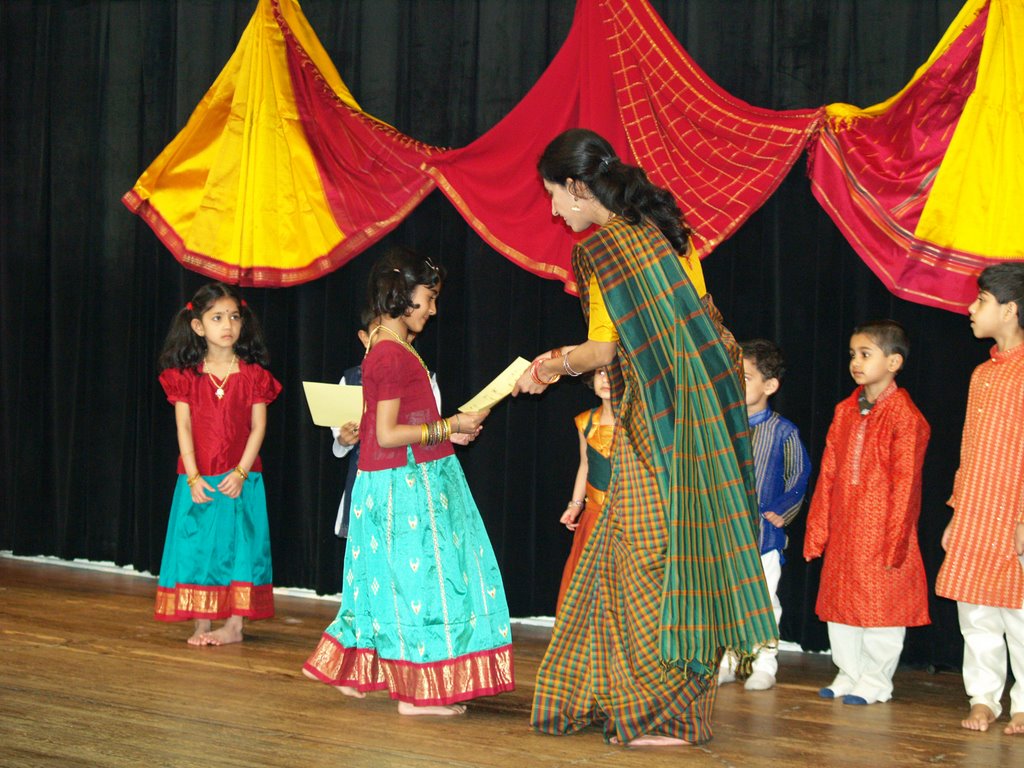
Langa voni
In its own language: లంగా వోణి
A two-piece half sari worn by girls in South India, a skirt with a short diagonal drape
The langa voni, also called the half sari or two-piece sari, is worn by girls in South India between puberty and marriage. A skirt tied with string pairs with a voni of two to two and a half metres, draped diagonally over a blouse, in cotton or silk.
- Worn by girls in South India between puberty and marriage
- The voni is about 2 to 2.5 metres long and needs no hand pleating
- The skirt, or langa, is tied at the waist with a string
- The modern lehenga-style sari takes its cue from the langa voni
- Black and grey, once thought inauspicious, now appear in newer pieces
What is Langa voni?
The langa voni is a two-piece garment worn by girls in South India between puberty and marriage, and it goes by several names: pavadai daavani in Tamil, langa davani in Kannada, and half sari or two-piece sari in everyday English. One part is a skirt, the langa or paavadai, tied at the waist with a string. The other is the voni, a length of cloth of about two to two and a half metres, draped diagonally over a choli, the close-fitting blouse. Cotton and silk are the usual cloths. Younger girls may also wear it on special days. Bright, contrasting colours are common, so the skirt and the drape set each other off.
Where does Langa voni come from?
The langa voni belongs to South India, and its shape grew out of the step a girl takes from childhood clothes to the sari. Before it, she wears a paavadai and sattai, a skirt and blouse. The half sari sits between that and the full sari, which is harder to drape. Across the subcontinent the same idea appears as the ghagra choli of the north, though the voni and the dupatta are draped in opposite directions. The sources give no date for its beginning. In modern times it fell out of daily use, pushed aside by the shalwar kameez and western dress, and then returned as occasional wear, helped by its influence on the lehenga-style sari.
How is Langa voni made?
The garment is woven, in cotton or silk as a rule. The sources do not describe the loom, the dyeing or the time a piece takes, so the detail stops there. Modern versions widen the choice of cloth: chiffon, georgette, crepe and nylon now join the older fibres. Some full saris are woven with a change built into them, so that the colour or the pattern shifts at the hip once the cloth is on, and the whole sari then reads as a langa voni. Plain pieces were once the norm, and today embroidery, mirror work and zari work are often added.
Langa voni, drawn
Colours, motifs and borders
Colour is where the outfit shows its character. The skirt and the drape are usually bright and set against each other, one strong shade answering another. Black and grey, once thought unlucky, now appear among the bolder choices. Decoration has grown heavier over time: embroidery, mirror work and zari are common on newer pieces, where older ones were plain. The sources name no particular motif, border or pallu for the langa voni, so those details are best judged piece by piece rather than by rule.
How Langa voni is worn
A langa voni has two parts on the body. The skirt is tied around the waist with a string. The voni, roughly two to two and a half metres long, is thrown diagonally across a choli. The line of the drape runs the way a southern sari does: tucked at the front of the skirt, taken round the waist, and brought over the opposite shoulder. It is shorter than a sari, though, and needs no pleating by hand. The wearer can move her legs freely.


When Langa voni is worn
Coming of age is the ceremony the garment is tied to in South India. When a girl reaches puberty, rites of passage are held, called langa voni in Telugu, pattu pavadai in Tamil and langa davani in Kannada. In the first half of the ceremony she receives the half sari from her mother's parents; a first sari from her father's parents follows in the second half, and the day marks her passage into womanhood. In some communities the gift begins early, at the naming ceremony and the first rice feeding, and ends with this last one. It is also worn now for special occasions and fashion.
Styles of Langa voni
The ghagra choli of North India is the nearest relative, different mainly in the direction the voni or dupatta is draped. Fabrics have multiplied beyond silk and cotton to include chiffon, georgette, crepe and nylon. Some full saris are woven so that colour or pattern changes at the hip when worn, giving the look of a langa voni. The sources do not separate handloom from powerloom pieces, so that distinction is not drawn here.
What Langa voni means
The langa voni marks a stage of life. The ceremony it belongs to is one of the rites that carry a girl from childhood to womanhood, and the two sets of grandparents take part, one giving the half sari and the other the first full sari. In some communities the giving starts at the naming ceremony and the first rice feeding. In recent years attention in media and fashion has brought the garment back, and it has shaped the lehenga-style sari worn across the subcontinent for special occasions.
Questions people ask about Langa voni
Where does the langa voni come from?
It is a South Indian garment, worn by girls between puberty and marriage. The names attached to it come from three languages of the region: langa voni in Telugu, pattu pavadai in Tamil and langa davani in Kannada. Its northern relative is the ghagra choli.
How is a langa voni made?
It is woven, usually in cotton or silk, in two parts. The skirt is tied with a string at the waist. The voni is a separate length of about two to two and a half metres. Newer pieces add chiffon, georgette, crepe or nylon, with embroidery, mirror work or zari.
How is it different from a sari?
The drape runs the same way as southern sari styles: tucked at the front of the skirt, round the waist, over the opposite shoulder. But the voni is shorter than a sari, no pleating by hand is needed, and the legs move more freely. It is a step between a child's skirt and blouse and the full sari.
When is it worn?
Coming of age rites are its main occasion in South India. In the first part of the ceremony a girl receives her half sari from her mother's parents, and a first sari from her father's parents in the second. She may wear one on other special days too, and fashion has brought it back as occasional wear.
What separates a langa voni from a ghagra choli?
They are close relatives with one clear difference: the direction in which the upper cloth is draped. The langa voni comes from South India, the ghagra choli from the north. The modern lehenga-style sari, worn for special occasions across the subcontinent, was inspired by the langa voni.
Good reading and sources
- Langa voni on WikipediaEncyclopedia
- More photos on Wikimedia CommonsPhotos and video
- Wikidata recordOpen data
The facts on this page come from the Wikipedia article "Langa voni", written by its contributors and used under the CC BY-SA 4.0 licence, and from its Wikidata record (CC0). EveryPallu rewrote the text in its own words, with AI assistance, and compares every page with the article to make sure no passage is copied. It may be reused under the same CC BY-SA 4.0 licence with a link back.
It may contain mistakes. Traditions, weaves and prices differ from one weaver, town or shop to the next, and it is not buying advice. If something is wrong, tell us. Last refreshed 2026-10-05.
More from India
All the sarees of India 🇮🇳 IndiaMundum neriyathumമുണ്ട് നേരിയത്
A two-piece white cotton cloth of Kerala, worn with a golden border called kasavuCotton · Zari work
🇮🇳 IndiaMundum neriyathumമുണ്ട് നേരിയത്
A two-piece white cotton cloth of Kerala, worn with a golden border called kasavuCotton · Zari work
Its cousins elsewhere
All silk sarees 🇵🇰 PakistanSindhi embroideryسنڌي ٿرت
Needlework and mirror embroidery crafted across the desert communities of SindhEmbroidery · Mirror work
🇵🇰 PakistanSindhi embroideryسنڌي ٿرت
Needlework and mirror embroidery crafted across the desert communities of SindhEmbroidery · Mirror work
 🇮🇳 IndiaChikankariचिकनकारी (Urdu: چکن کاری)
White thread hand embroidery from Lucknow, stitched on pale, sheer clothCotton · Embroidery · Block print
🇮🇳 IndiaChikankariचिकनकारी (Urdu: چکن کاری)
White thread hand embroidery from Lucknow, stitched on pale, sheer clothCotton · Embroidery · Block print
 🇮🇳 IndiaChanderi sari
A silk sari woven in Chanderi, Madhya Pradesh, with gold and silver zariSilk · Brocade · Zari work
🇮🇳 IndiaChanderi sari
A silk sari woven in Chanderi, Madhya Pradesh, with gold and silver zariSilk · Brocade · Zari work
 🇮🇳 IndiaGota patti
Rajasthani applique embroidery that stitches down ribbons of gold and silverGeorgette · Appliqué · Embroidery
🇮🇳 IndiaGota patti
Rajasthani applique embroidery that stitches down ribbons of gold and silverGeorgette · Appliqué · Embroidery