Regional drapes
The half saree (langa voni)
A three-piece South Indian outfit of skirt, blouse and a draped half-length cloth, worn by girls and young women before they take up the full saree.
Presented by ClearTrust Free for wearers, makers and the curious.
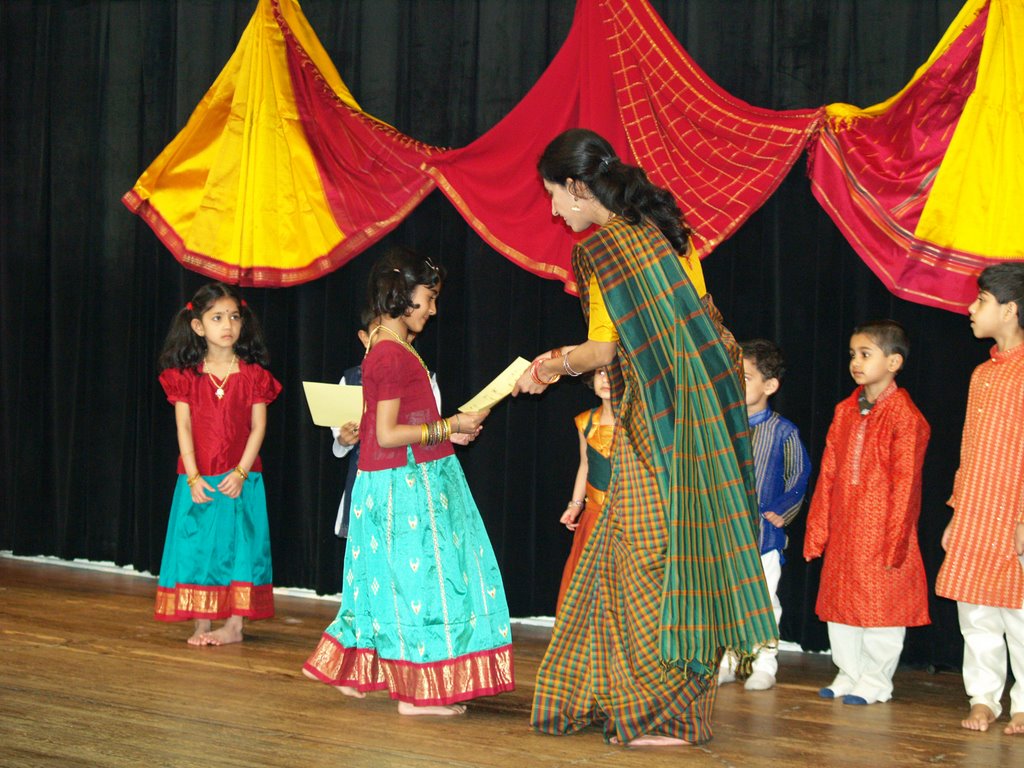
The half saree is a set of three pieces: a long skirt, a blouse, and a shorter cloth draped over the upper body like a pallu. It is called langa voni in Telugu, and pavadai davani in Tamil. It is worn by girls and young women in the south and often marks the step before the full saree.
Wrapped step by step
Each drawing shows the cloth so far, with the newest step outlined in gold. The figure is a front view; the wearer's left is on your right.
Step 1 Put on the fitted blouse and step into the long flared skirt, then tie the drawstring at the waist. Step 2 Tuck one end of the voni into the waist of the skirt at the right hip. Step 3 Take the cloth once round the waist, over the skirt. Step 4 Form a few pleats of the cloth at the front and tuck them into the waist. Step 5 Bring the free end across the chest and over the left shoulder. Step 6 Pin the cloth at the shoulder. Step 7 Let the end fall behind, and arrange the border so it shows. Finished The half saree (langa voni), seen from the front.
Where it comes from
The outfit is worn across South India under different names. In Telugu it is langa voni, also langa davani. In Tamil it is pavadai davani. In Kannada it is often called lehenga or langa davani, and in Malayalam it is paavada and thavani. The idea is old: a wrapped lower garment with a separate cloth over the chest and shoulder. Families in several communities mark a girl's coming of age with a function where she wears the half saree for the first time, and in Andhra and Telangana this is widely known as the half saree function.
How it looks
The skirt, the langa or pavadai, is stitched and flared, tied at the waist with a drawstring. The blouse is fitted. The voni or davani is a long cloth, much shorter than a full saree. One end is tucked at the waist, the cloth goes round the body, and the rest is brought across the chest and over the left shoulder, then pinned. Silk sets are woven or sewn with matching zari borders, and many girls wear contrast colours for the skirt and the cloth.
Who wears it and when
It is worn by girls from childhood to the early twenties, at festivals, in temples, at weddings and on school or college days. Classical dance students often wear a variant of it for practice. At the coming-of-age function the girl is dressed in a silk half saree and blessed by relatives. After this stage, many young women move on to the full saree, though the half saree remains a festive favourite. Details differ by family and locality. The cloth is chosen in colours that suit the occasion, and silk is usual for temple and wedding days. This guide gives the general form, and a maker, dresser or family may do it a little differently.
Good to know
- Keep the pin firm, since the cloth is short and has less weight to hold it.
Sarees worn this way

Sources and further reading
Original text and drawings by the EveryPallu desk, written with AI assistance and checked against the sources above. The drawings are simplified diagrams of the order of wrapping, not a lesson: how a drape is worn differs from family to family. If we have something wrong, tell us.
Photo credits on this page
The small pictures above come from Wikimedia Commons under free licences. Some are cropped to fit.
- Kanchipuram sari: McKay Savage, CC BY 2.0, source
- Langa voni: Kannadiga, CC BY-SA 3.0, source