Mirror work
Tiny mirrors held by stitches, from Kutch and Rajasthan.
Mirror work, or shisha, attaches small pieces of reflective glass to cloth with embroidery stitches that hold each piece in place. It is a craft of Gujarat, Rajasthan and Sindh, usually worked by women of pastoral and farming communities. Mirrors appear on borders, pallus and scattered motifs of festive sarees.
What it is
Mirror work, called shisha in Hindi and abhla bharat in Gujarati, uses small discs of reflective material fixed on cloth with thread. The mirror is held down by a framework of stitches that crosses over its edge, and a ring of buttonhole stitch finishes the border. Originally the discs were cut from thin blown glass or mica, and today they are often machine-cut glass or even plastic. The mirrors catch light as the wearer moves, which is part of the appeal. It is applied to blouses, skirts, bags and sarees, often together with other stitches such as herringbone, chain stitch and satin stitch.
How it is made, step by step
The embroiderer draws the layout on cloth, often freehand, and then places the first mirror on the cloth. She makes a square or cross-shaped frame of long stitches over the mirror, using a needle and strong thread, so that the mirror is held firmly. Then she works a ring of tight buttonhole or blanket stitch around the edge, going through the cloth and over the foundation threads, which locks the mirror in. Details like leaves, flowers and tiny dots are added by chain stitch around it. A saree may carry thousands of mirrors, and a single saree can take weeks. The cloth may be held in the lap or stretched on a frame.
The motifs and looks it is known for
Mirror work is usually arranged in circles and flower shapes, with a larger mirror at the centre and smaller ones around it. Common motifs are peacocks, parrots, elephants, flowers, and a thorny design called the chakla in Gujarat. Rabari work tends to use dense stitches in bright colour, with large mirrors, while Sindhi work often uses finer stitching. On sarees, mirrors often decorate the border and the pallu, with a few scattered across the body. A phulkari or a bandhani saree may also have mirrors added. The look is festive and bright, with sparkle that changes as the wearer moves.
Where it is made
Kutch in Gujarat is the best known centre, where communities such as the Rabari, Ahir, Mutwa and Jat make mirror embroidery, and Saurashtra has comparable work. In Rajasthan, mirror work is made in Barmer and Jaisalmer, and in Haryana and Punjab it appears on phulkari and bagh. Sindh in Pakistan has a strong tradition with the Sindhi and Baloch communities. Mirror embroidery is also used on cloth in Karnataka among the Lambani, or Banjara, women whose embroidery uses mirrors, coins and shells. Much of the work is done by women at home, and some sell through cooperatives and craft councils.
History in brief
Mirror work is often traced to Persia and the Mughal courts in the seventeenth century, when mirror inlay appeared in architecture, such as in the Sheesh Mahal. How the technique reached village embroidery is not fully documented, but it became established among pastoral groups of western India. Women in these communities embroider for their own dowries, and the designs show family and community identity. After the 1950s and 1960s, craft organisations helped bring these textiles to urban buyers. Today mirror embroidery is common in fashion, and some pieces are machine-made, with mirror substitutes glued on. Kutch embroidery as a group carries a Geographical Indication registration.
Buying and caring for it
On a genuine piece, each mirror is held by stitches around its edge, and you can feel the foundation threads under the buttonhole ring. Mirrors that are glued on, or sewn in only with a few weak stitches, may come off in washing. Machine-made versions use plastic sequins in neat rows. Check that the mirrors are firmly fixed and the stitching is tight and even. Hand wash gently inside out in cold water with a mild soap, avoiding scrubbing, and dry in shade. Dry clean heavily worked sarees. Do not wring or iron the mirrors directly, as heat can crack them. Store flat in cloth with tissue between layers.
Where to look
- Kutch mirror embroidery: Dense, bright shisha work of Gujarat made by Rabari and other communities.
- Rabari embroidery: Bold mirror and stitch work of the Rabari herders.
- Sindhi mirror work: Fine mirror embroidery of Sindh, found on both sides of the border.
- Lambani embroidery: Karnataka Banjara work with mirrors, coins and shells.
- Phulkari with mirrors: Punjabi flower embroidery sometimes decorated with mirrors.
- Sheesh Mahal inlay: Architectural mirror decoration that shares the name and look.
Care
- Hand wash gently inside out in cold water and dry in shade.
- Never iron directly over mirrors.
- Store flat with tissue between layers.
Sources and further reading
Original text by the EveryPallu desk, written with AI assistance and checked against the sources above. If we have something wrong, tell us.
Mirror work on EveryPallu
The sarees written up so far, newest and best known first.
 🇵🇰 PakistanSindhi embroideryسنڌي ٿرت
Needlework and mirror embroidery crafted across the desert communities of SindhEmbroidery · Mirror work
🇵🇰 PakistanSindhi embroideryسنڌي ٿرت
Needlework and mirror embroidery crafted across the desert communities of SindhEmbroidery · Mirror work
 🇮🇳 IndiaChikankariचिकनकारी (Urdu: چکن کاری)
White thread hand embroidery from Lucknow, stitched on pale, sheer clothCotton · Embroidery · Block print
🇮🇳 IndiaChikankariचिकनकारी (Urdu: چکن کاری)
White thread hand embroidery from Lucknow, stitched on pale, sheer clothCotton · Embroidery · Block print
 🇮🇳 IndiaLambada embroidery
Mirror-and-cowrie hand embroidery by Banjara women of Karnataka and TelanganaEmbroidery · Appliqué
🇮🇳 IndiaLambada embroidery
Mirror-and-cowrie hand embroidery by Banjara women of Karnataka and TelanganaEmbroidery · Appliqué
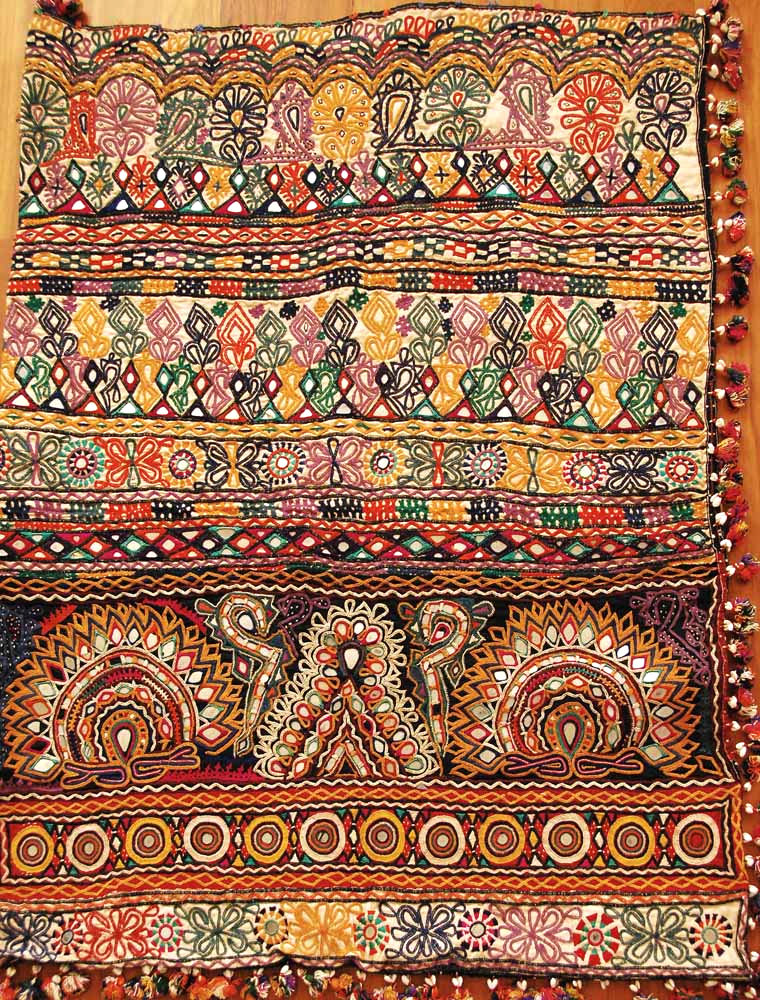 🇮🇳 IndiaKutch embroidery
Hand-stitched mirror work from Kutch, Gujarat, made by women of its tribal communitiesCotton · Embroidery · Mirror work
🇮🇳 IndiaPipili appliqué workଚାନ୍ଦୁଆ
A stitched-cloth craft from Pipili, Odisha, born to dress the chariots of JagannathCotton · Appliqué · Embroidery
🇮🇳 IndiaKutch embroidery
Hand-stitched mirror work from Kutch, Gujarat, made by women of its tribal communitiesCotton · Embroidery · Mirror work
🇮🇳 IndiaPipili appliqué workଚାନ୍ଦୁଆ
A stitched-cloth craft from Pipili, Odisha, born to dress the chariots of JagannathCotton · Appliqué · Embroidery
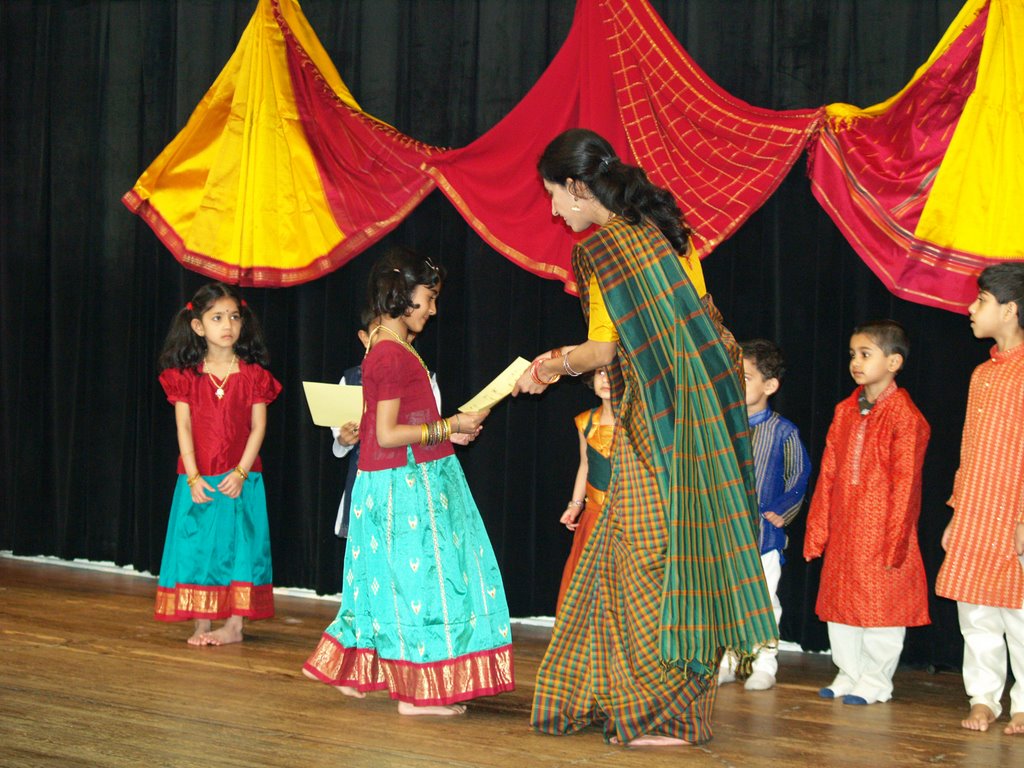 🇮🇳 IndiaLanga voniలంగా వోణి
A two-piece half sari worn by girls in South India, a skirt with a short diagonal drapeSilk · Embroidery · Zari work
🇮🇳 IndiaLanga voniలంగా వోణి
A two-piece half sari worn by girls in South India, a skirt with a short diagonal drapeSilk · Embroidery · Zari work
Photo credits on this page
The small pictures above come from Wikimedia Commons under free licences. Some are cropped to fit.
- Sindhi embroidery: Nasreen wafai, CC BY-SA 4.0, source
- Chikankari: Joey Berzowska, CC BY 2.0, source
- Lambada embroidery: Daderot, CC0, source
- Kutch embroidery: Jainamishra, CC BY 3.0, source
- Langa voni: Kannadiga, CC BY-SA 3.0, source