Temple border
The stepped, triangular border of the south, like the outline of a gopuram.
A temple border is a saree border woven in a stepped, triangular pattern that looks like the profile of a gopuram, the tower of a South Indian temple. The motif is common on Kanchipuram, Gadwal, Narayanpet and Mysore silk sarees. Each centre treats it a little differently in size, colour and weave.
What it is
The temple border is a design, not a single weave. It is made of repeated triangular or stepped shapes in a row, often with small diamonds, so that the edge of the saree resembles the rising tiers of a temple tower. In some versions it also includes small figures or the lamp and lotus. The border is typically woven in zari against a coloured ground, and the pallu may echo it. Temple borders are used on silk and cotton sarees across South India, and they are strongly associated with Tamil Nadu, Andhra Pradesh, Telangana and Karnataka. The border may be narrow or broad and sits on one or both sides of the saree.
How it is made, step by step
On a Kanchipuram saree the body and the border are woven separately and then joined by an interlocking technique known as petni, which can be seen as a zigzag lock at the join, strong enough to hold the heavy border. The weavers use pit looms, often with a jacquard. Each border pattern is set up through a card or a graph design, with zari wound on bobbins and thrown through for the triangles. Gadwal sarees use a different method, with cotton body and silk border, joined by a technique called kuttu, interlocking a pure silk border and pallu. A heavy temple border saree may take a week or more of work.
The motifs and looks it is known for
The central form is the stepped triangle, or the row of tiny gopuram shapes. Kanchipuram versions often combine it with a contrast border, such as a green body with a pink or red border, and add motifs like the mango, the lion called yali, the parrot or the lotus. Narayanpet cotton and silk sarees have a similar temple border, with a simpler zari line. Gadwal sarees may use it too, in zari with a contrast colour. Mysore silk typically has a fine zari border with small motifs, and the temple pattern appears in some designs. The overall effect is formal, geometric, and slightly architectural, and the saree is often called a temple saree.
Where it is made
Kanchipuram in Tamil Nadu is the leading home of the temple border, woven by weaving communities such as the Devanga and Saliyar, who traditionally claim a link with temple cloth. Gadwal in Jogulamba Gadwal district, Telangana, and Narayanpet in Narayanpet district weave cotton and silk sarees with temple borders. Dharmavaram in Andhra Pradesh makes heavy silk sarees with broad borders, and Mysore and Bengaluru in Karnataka produce silks with zari borders. Arni and Salem in Tamil Nadu also weave temple-border silks and cottons. The craft is based in family-run loom sheds, with cooperative societies in some towns, and the trade employs thousands of households.
History in brief
Kanchipuram silk is said by local tradition to be woven by descendants of Sage Markandeya, the weaver of the gods, and it has been tied to temple patronage for centuries. The stepped temple pattern appears in the weaving of the region at least in the later centuries, though precise dates for when it first appeared as a border are unclear. Under the Vijayanagara rulers and later patrons, weavers settled in Kanchipuram, and Gadwal and Narayanpet were developed in the princely era of Hyderabad state. Kanchipuram silk saree and Gadwal sarees both carry Geographical Indication registrations, and Narayanpet handloom is also recognised.
Buying and caring for it
On a Kanchipuram saree, look at the join between border and body. The zigzag interlock should be visible and the border should be woven, not stitched on. If the join shows a straight seam, the border may have been sewn. Check the zari for weight and shine and ask for a silk mark or a zari mark with silver and gold content. Gadwal sarees often come with a silk mark and a handloom mark. A true handloom shows slight variation, while powerloom pieces are even. Dry clean only, wrap in muslin, and refold now and then. Keep heavy borders from rubbing against rough surfaces, and avoid storing in plastic.
Where to look
- Kanchipuram temple border: Heavy zari gopuram border on pure silk, from Tamil Nadu.
- Gadwal temple border: Silk border on a cotton body, from Gadwal in Telangana.
- Narayanpet temple border: Cotton and silk sarees from Narayanpet with temple zari lines.
- Dharmavaram silk: Andhra silk sarees with broad temple-style borders.
- Mysore silk temple border: Crepe silk from Karnataka with fine zari borders.
- Arni silk: Lighter Tamil Nadu silk sarees often made with temple borders.
- Korvai: The Kanchipuram method of joining a contrast border to the body.
Care
- Dry clean only and store in muslin.
- Refold every few months along different lines.
- Avoid plastic storage and rough surfaces that snag the border.
Sources and further reading
Original text by the EveryPallu desk, written with AI assistance and checked against the sources above. If we have something wrong, tell us.
Temple border on EveryPallu
The sarees written up so far, newest and best known first.
 🇮🇳 IndiaKanchipuram sari
Heavy mulberry silk sari from Tamil Nadu, its contrast border woven in separatelySilk · Brocade · Zari work
🇮🇳 IndiaKanchipuram sari
Heavy mulberry silk sari from Tamil Nadu, its contrast border woven in separatelySilk · Brocade · Zari work
 🇮🇳 India and 1 moreHandloom sari
Saris woven by hand on pit looms in India and BangladeshSilk · Brocade · Zari work
🇮🇳 India and 1 moreHandloom sari
Saris woven by hand on pit looms in India and BangladeshSilk · Brocade · Zari work
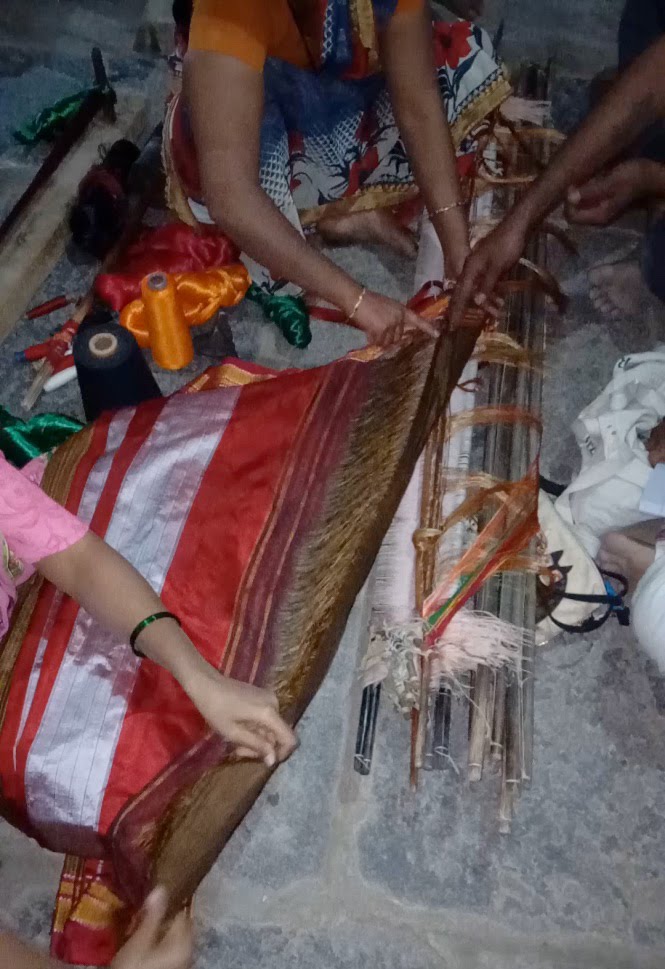 🇮🇳 IndiaIlkal sari
A cotton saree with a loop-joined silk pallu and broad red border, from Ilkal, KarnatakaCotton · Zari work · Embroidery
🇮🇳 IndiaBerhampur Patta
Odisha silk saree with a phoda kumbha temple border and zari edging, GI protectedSilk · Zari work · Temple border
🇮🇳 IndiaIlkal sari
A cotton saree with a loop-joined silk pallu and broad red border, from Ilkal, KarnatakaCotton · Zari work · Embroidery
🇮🇳 IndiaBerhampur Patta
Odisha silk saree with a phoda kumbha temple border and zari edging, GI protectedSilk · Zari work · Temple border