
Songket
In its own language: ᬲᭀᬂᬓᬾᬢ᭄
A hand-woven brocade cloth from Sumatra and the Malay world, with gold or silver thread
Songket is a hand-woven brocade cloth of silk or cotton, made in Indonesia, Malaysia and Brunei and worn as sarong, shoulder cloth or head tie. Weavers add gold or silver thread between the weft threads so the pattern stands out against the ground cloth.
- Hand-woven in silk or cotton, with gold or silver thread worked into the pattern.
- The metallic thread is added by supplementary weft, so the motif sits on the surface.
- UNESCO added songket, nominated by Malaysia, to its Representative List in 2021.
- Statues at the Bumiayu temple in South Sumatra suggest songket was worn in the 8th century.
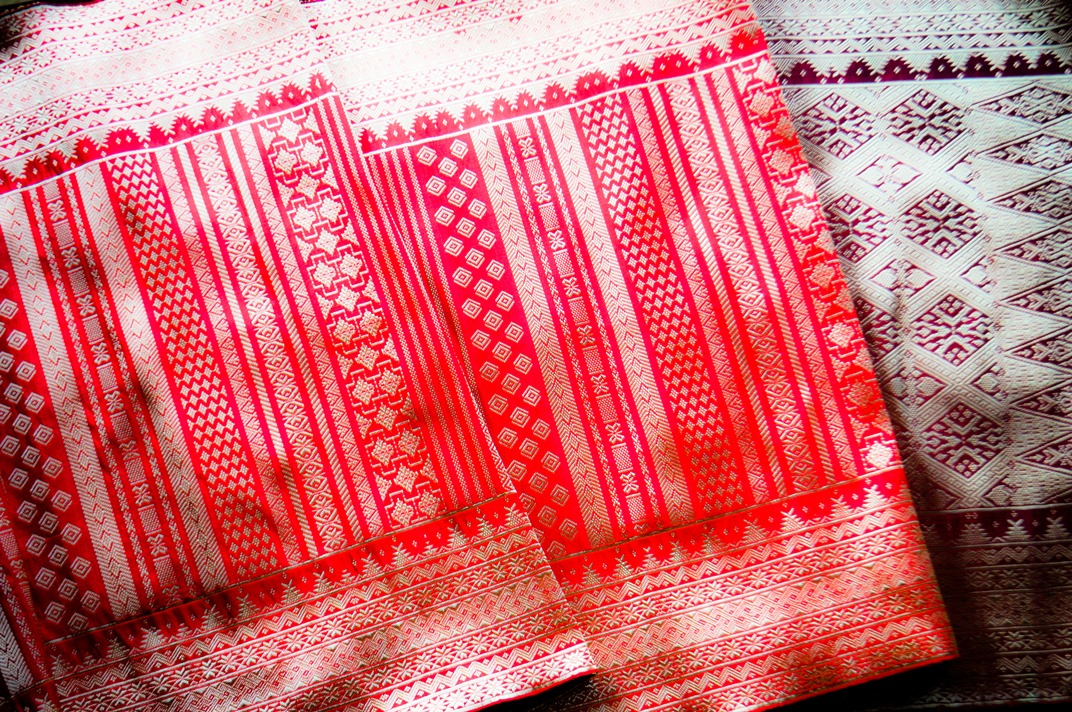
- Red is the traditional colour of songket.
What is Songket?
Songket is a hand-woven brocade cloth of silk or cotton, patterned with gold or silver thread. It belongs to Brunei, Indonesia and Malaysia, and is worn as a sarong, a shoulder cloth or a head tie. The metallic thread sits on the surface of the cloth, so the pattern looks raised and catches the light against the plainer ground. Weavers in Palembang, the Minangkabau highlands and other parts of Sumatra make it, as well as weavers in Malaysia and Bali. It was once reserved for nobles and is now a dress fabric for weddings and ceremonies.
Where does Songket come from?
Songket is usually linked to Srivijaya, the maritime empire that ran from roughly the 7th to the 13th century and was based in Sumatra. Carved figures at the Bumiayu temple in South Sumatra wear cloth with a lepus motif, which scholars read as a sign that songket was worn there in the 8th to 9th centuries. A Palembang folk account says Chinese traders brought silk thread and Indian or Middle Eastern traders brought gold thread, and the two were joined. Kelantan tradition holds that the technique reached the peninsula from the north, through Cambodia and Siam. It was once for royalty; after the sultanates fell, others took it up.
How is Songket made?
The cloth is woven by hand. Silk or cotton makes the ground, and the pattern is formed by supplementary weft: the weaver hooks and picks up a group of threads, then slips gold or silver thread in between the weft threads so it floats on the surface. Traditionally women wove songket, though men also weave today. Real gold leaf was once wound around the thread, and the cost of materials kept production close to royal courts. Nylon thread imitating gold is common now, while a few cloths are still made with true gold thread.
Songket, drawn
Colours, motifs and borders
Songket is known for its shine. Metallic thread forms the pattern and stands out from the background cloth. Named motifs include lepus, the star flower or bunga bintang, and a Minangkabau pattern read as bamboo sprouts. Red is the traditional colour for songket, with gold thread as the usual contrast. Some motifs once belonged to particular ranks: in the Palembang tradition the lepus was for nobles, and special shoulder cloths told people whether a widow was free to remarry.
How Songket is worn
Songket is not a single garment. It is made up as a sarong, a shoulder cloth or selendang, a head tie, or a tanjak, the folded headdress. Lengths differ with the use, so there is no one fixed shape. Pieces are worn for ceremonies and formal gatherings rather than for daily work. In Brunei, songket has formed part of the ceremonial court dress of royalty since the reign of Omar Ali Saifuddien III.



When Songket is worn
Songket is worn on special occasions, at religious festivals and at traditional social functions. Brides and grooms wear it in the wedding costumes of the Palembangese, Minangkabau and Balinese. It has long marked social standing, and in old Palembang a widow might wear a particular selendang to show her social and marital position. In the Malay courts of Sumatra and the peninsula it served as royal ceremonial dress. Rare gold-thread cloths are kept as pusaka, heirlooms handed down within a family.
Styles of Songket
The cloth goes by different names across the region: songke in Manggarai and Bima, jongkit among the Karo Batak, suje in Ternate, subbi' and arekare' among the Buginese, and pilih or pileh among the Iban Dayak. Bali knows it as songket or tenun cag cag. Palembang and Pandai Sikek in Minangkabau are counted the best known producers. Many pieces today use nylon in place of gold. Five Indonesian songket traditions are listed as national intangible heritage, and Malaysia's is on the UNESCO list.
What Songket means
Songket carries rank and identity. A motif could once say who you were, and the cloth still marks weddings, court ceremony and family standing across Sumatra, the Malay peninsula and Brunei. Malaysia recognised songket as intangible national heritage in 2012 through its ministry of tourism, arts and culture. Indonesia has listed five songket traditions as intangible cultural heritage, and in 2021 UNESCO added songket, nominated by Malaysia, to its Representative List. Because a real gold-thread cloth takes long to weave, families keep such pieces as pusaka.
Questions people ask about Songket
Where does songket come from?
It belongs to Brunei, Indonesia and Malaysia. The tradition is usually linked to the Srivijaya empire, which was based in Sumatra, and Palembang is counted its oldest and best known centre. Trade, the empire's reach and royal marriages carried the cloth across the Malay world.
How is songket made?
It is woven by hand on a loom. Silk or cotton makes the ground cloth, and the weaver hooks up groups of threads and slips gold or silver thread between the weft. This supplementary weft leaves the metallic pattern floating on the surface.
Who wears songket?
It is worn for weddings, religious festivals and traditional ceremonies. Brides and grooms wear it in Palembangese, Minangkabau and Balinese weddings, and it has long served as court dress for Malay royalty. Everyday wear is rare now.
How is songket different from ordinary cloth?
Songket is a brocade, so its pattern is woven in with extra metallic thread rather than printed or painted on. The gold or silver weft is inserted between the ground threads by hand, which gives the finished cloth a raised, shimmering pattern.
Is all songket made with real gold?
No. Most modern songket uses nylon thread made to look like gold. A few pieces are still woven with real gold thread, once wound from gold leaf, and these are rare and kept as heirlooms passed down in families.
Good reading and sources
- Songket on WikipediaEncyclopedia
- More photos on Wikimedia CommonsPhotos and video
- Wikidata recordOpen data
The facts on this page come from the Wikipedia article "Songket", written by its contributors and used under the CC BY-SA 4.0 licence, and from its Wikidata record (CC0). EveryPallu rewrote the text in its own words, with AI assistance, and compares every page with the article to make sure no passage is copied. It may be reused under the same CC BY-SA 4.0 licence with a link back.
It may contain mistakes. Traditions, weaves and prices differ from one weaver, town or shop to the next, and it is not buying advice. If something is wrong, tell us. Last refreshed 2026-10-03.
More from Indonesia
All the sarees of Indonesia 🇮🇩 Indonesia and 4 moreKebayaꦏꦼꦧꦪ
A front-opening blouse worn across Southeast Asia with a sarong or kainCotton · Embroidery · Batik
🇮🇩 Indonesia and 4 moreKebayaꦏꦼꦧꦪ
A front-opening blouse worn across Southeast Asia with a sarong or kainCotton · Embroidery · Batik
 🇮🇩 Indonesia and 5 moreBatikꦧꦛꦶꦏ꧀
A wax-resist way of dyeing cloth, most developed on the island of JavaSilk · Tie-dye · Block print
🇮🇩 Indonesia and 5 moreBatikꦧꦛꦶꦏ꧀
A wax-resist way of dyeing cloth, most developed on the island of JavaSilk · Tie-dye · Block print
 🇮🇩 Indonesia and 5 moreSarongꦱꦫꦸꦁ
A wrapped tube of cloth worn at the waist, from the Malay world to Kerala and SomaliaCotton · Batik · Ikat
🇮🇩 Indonesia and 5 moreSarongꦱꦫꦸꦁ
A wrapped tube of cloth worn at the waist, from the Malay world to Kerala and SomaliaCotton · Batik · Ikat
 🇮🇩 IndonesiaGeringsingᬕ᭄ᬭᬶᬂᬲᬶᬂ (gringsing)
A sacred double ikat cloth woven only in Tenganan, a Bali Aga village in BaliCotton · Ikat
🇮🇩 IndonesiaGeringsingᬕ᭄ᬭᬶᬂᬲᬶᬂ (gringsing)
A sacred double ikat cloth woven only in Tenganan, a Bali Aga village in BaliCotton · Ikat
Its cousins elsewhere
All silk sarees 🇮🇳 IndiaChanderi sari
A silk sari woven in Chanderi, Madhya Pradesh, with gold and silver zariSilk · Brocade · Zari work
🇮🇳 IndiaChanderi sari
A silk sari woven in Chanderi, Madhya Pradesh, with gold and silver zariSilk · Brocade · Zari work
 🇮🇳 IndiaGarad sariগরদ শাড়ি
A fine silk sari woven on pit looms in Murshidabad and Birbhum, worn at Durga PujaSilk · Zari work · Brocade
🇮🇳 IndiaGarad sariগরদ শাড়ি
A fine silk sari woven on pit looms in Murshidabad and Birbhum, worn at Durga PujaSilk · Zari work · Brocade
 🇮🇳 IndiaKanchipuram sari
A silk sari from Kanchipuram with a separate contrast border locked onto the bodySilk · Zari work · Brocade
🇮🇳 IndiaKanchipuram sari
A silk sari from Kanchipuram with a separate contrast border locked onto the bodySilk · Zari work · Brocade