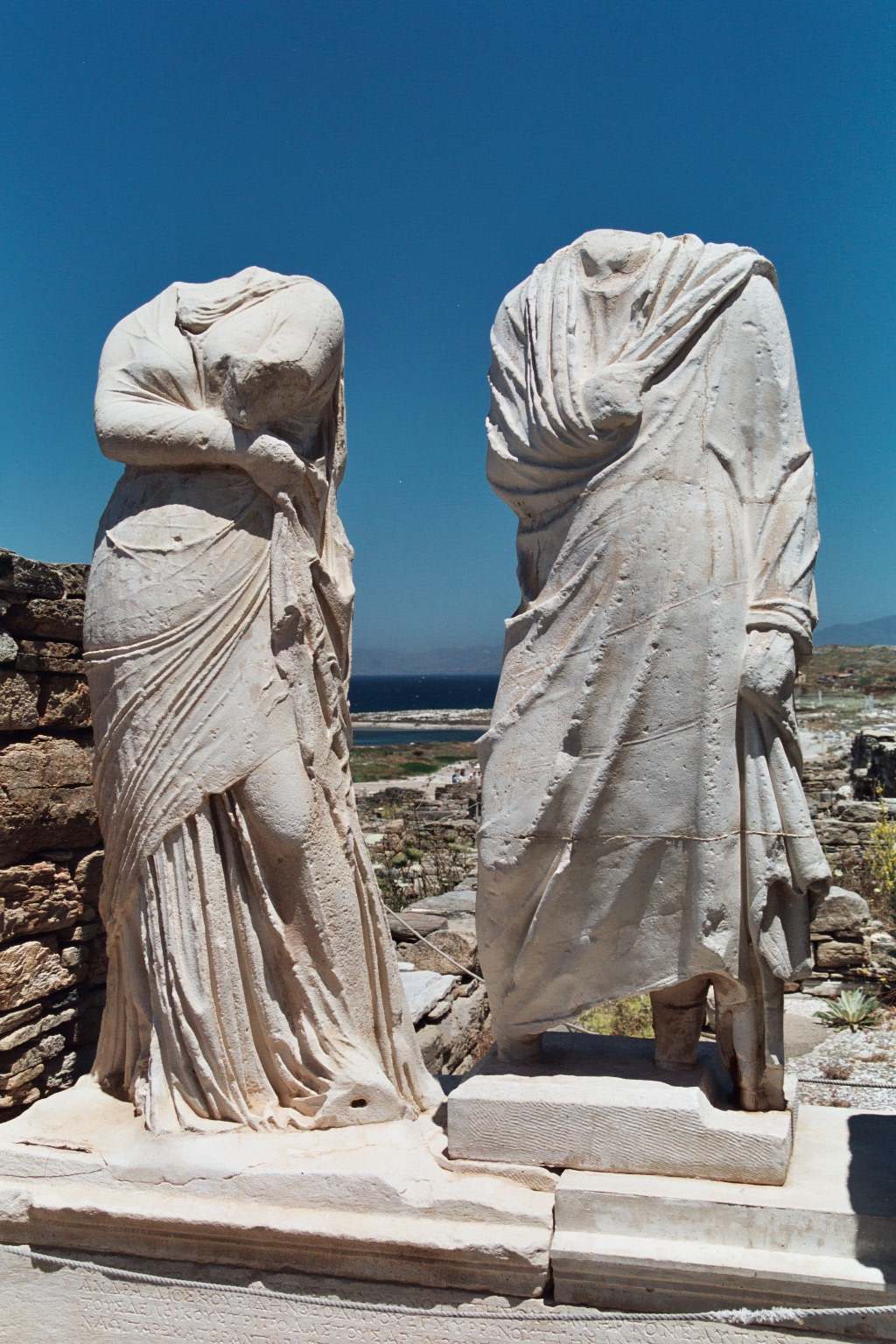
Himation
In its own language: ἱμάτιον
An ancient Greek draped mantle of woven wool or linen, worn without pins
A rectangular draped mantle from ancient Greece, worn by men and women over tunics or on its own. Spun and woven by hand from wool or linen, it was arranged without pins to signal social standing, modesty, and personal style.
- Worn in ancient Greece from around 750 BC to 30 BC by both men and women across all social classes.
- Spun and woven at home by women using wool or linen, creating a large seamless rectangular wrap.
- Held in place entirely through folding and wrapping, without using pins or fasteners.
- Served as an everyday cloak, a formal garment for judges, and a veil for women in public.
What is Himation?
A himation is a large rectangular mantle from ancient Greece, worn wrapped around the body by both women and men. It was usually layered over lighter undergarments such as the chiton or peplos, functioning as a warm cloak or shawl. In some cases, people wore it by itself as a single complete covering. Compared to the wide, heavy folds of the Roman toga, it had a much lighter and simpler volume. Woven out of wool or linen, the fabric was thick enough to provide structure and warmth. It remained a central piece of clothing from the Archaic era through the Hellenistic age, and artists later preserved its likeness in Byzantine religious paintings.
Where does Himation come from?
Although no surviving pieces of cloth have lasted to modern times, statues, painted vases, and written records confirm the himation was in regular use by the sixth century BCE. It emerged during the Greek Archaic period and stayed in continuous use through Hellenistic times, roughly between 750 BC and 30 BC. The wrap became so widespread across daily life that its name was sometimes applied broadly to different outer wraps. Its popularity eventually crossed borders into ancient Rome, where Roman society took up the drape for their own use, including aristocratic pupils learning under Greek schoolmasters.
How is Himation made?
Making a himation began with spinning raw wool or flax fibres into yarn. Women produced most of these textiles inside their households, weaving the threads into broad rectangular lengths on simple looms. Along with domestic production, skilled professional weavers and dyers also crafted pieces for sale. Linen was a costly material, meaning higher grades of linen cloth remained limited to wealthy households. The base cloth was typically a solid white, but makers also introduced decorative interest by weaving intricate designs directly into the thick yarn, painting ornamental details onto the surface, or adding needle embroidery.
Himation, drawn
Colours, motifs and borders
Most himatia appeared in plain white, relying on the clean fall of wool or linen for their look. When decorated, the cloth showcased striking colours and intricate ornamental work. Artisans created these patterns in several ways: by interlacing coloured threads into the heavy weave, by hand-painting motifs straight onto the finished fabric, or by stitching needlework into the ground. Women also styled the cloth in varied ways to present their personal taste and display their place in society.
How Himation is worn
Unlike many other Greek outer wraps, the himation stayed in place without pins or brooches. Men typically threw one end over the left shoulder and swathed the rest around the body, keeping the right arm unhindered. Exposing the left shoulder was seen as crude. Women enjoyed more freedom in how they draped, freeing either arm as desired. In public, women wore it over thin tunics and could pull the upper folds across the face as a veil before strangers. Older youths generally wrapped their whole torso and limbs completely.
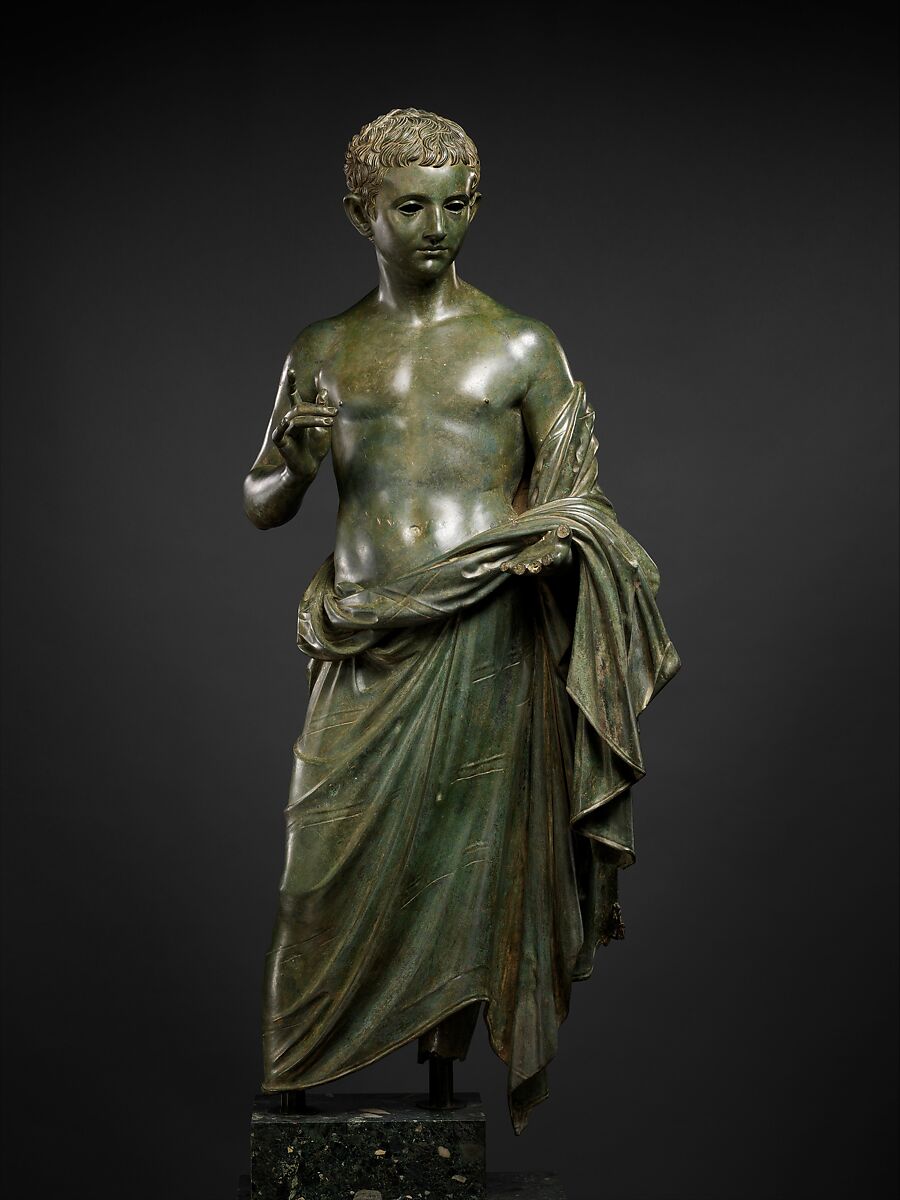


When Himation is worn
People of all classes wore the himation for everyday life and formal duties alike. Historical pottery shows judges wearing it while presiding over legal matters, as well as musicians wrapped in the cloth while playing the kithara. Women relied on it as an outer cloak when stepping out in public. It was also used during courtship, where a neat or intentionally loosened drape sent quiet signals between individuals.
Styles of Himation
The wrap changed depending on who wore it and how it was arranged. Women adopted it around 500 BCE, layering it loosely over thin Ionic chitons. Men kept to stricter drape rules, avoiding hems that dragged past the ankles. Youths wore fully enclosing wraps. Beyond everyday mortals, Greek art depicted deities like Dionysos and the goddess Athena draped in himatia, while Byzantine painters later rendered Christ, Mary, and biblical figures in the same classic mantle.
What Himation means
In ancient Greece, how one arranged a himation served as a clear test of character and social standing. A neat, orderly wrap conveyed refinement and elite standing, while careless folds or letting the cloth hike up past the knees while seated invited criticism from philosophers like Theophrastus. Draped mantles also carried meaning into art, clothing divine figures in classical sculpture and later enduring in Byzantine icon painting as an established artistic dress for biblical subjects.
Questions people ask about Himation
Where does the himation come from?
The himation originates in ancient Greece, where it was worn from the Archaic period through the Hellenistic era, between roughly 750 BC and 30 BC. It was later adopted across ancient Rome as well.
How was the himation made?
Women traditionally spun wool or linen yarn at home and hand-wove it into large rectangular pieces of cloth. Professional weavers and dyers also produced them. Designs were woven in, embroidered, or painted by hand onto the fabric.
How was the himation worn?
It was wrapped around the body without pins. Men generally draped it over the left shoulder, freeing the right arm, while women could leave either arm free and often pulled the fabric over their heads as a veil.
What role did the himation play in ancient Greek society?
Beyond providing warmth, the wrap communicated status and personal character. A neat drape showed elite standing, while sloppy folds or exposing the left shoulder were judged harshly by peers and philosophers.
Good reading and sources
- Himation on WikipediaEncyclopedia
- More photos on Wikimedia CommonsPhotos and video
- Wikidata recordOpen data
The facts on this page come from the Wikipedia article "Himation", written by its contributors and used under the CC BY-SA 4.0 licence, and from its Wikidata record (CC0). Pallu rewrote the text in its own words, with AI assistance, and compares every page with the article to make sure no passage is copied. It may be reused under the same CC BY-SA 4.0 licence with a link back.
It may contain mistakes. Traditions, weaves and prices differ from one weaver, town or shop to the next, and it is not buying advice. If something is wrong, tell us. Last refreshed 2026-10-04.

Its cousins elsewhere
All wool and pashmina 🇮🇳 India and 1 moreTant sari
A light, near-transparent cotton sari woven in Bengal, suited to hot, humid weatherCotton · Jamdani · Embroidery
🇮🇳 India and 1 moreTant sari
A light, near-transparent cotton sari woven in Bengal, suited to hot, humid weatherCotton · Jamdani · Embroidery
 🇮🇳 India and 4 moreSariसाड़ी
A single unstitched length of cloth, tucked at the waist and slung over one shoulderSilk · Brocade · Ikat
🇮🇳 India and 4 moreSariसाड़ी
A single unstitched length of cloth, tucked at the waist and slung over one shoulderSilk · Brocade · Ikat
 🇮🇳 IndiaChanderi sari
A silk sari woven in Chanderi, Madhya Pradesh, with gold and silver zariSilk · Brocade · Zari work
🇮🇳 IndiaChanderi sari
A silk sari woven in Chanderi, Madhya Pradesh, with gold and silver zariSilk · Brocade · Zari work
 🇮🇳 IndiaKasuti
Counted-thread folk embroidery from Karnataka, stitched on Ilkal and Mysore silk sareesCotton · Embroidery
🇮🇳 IndiaKasuti
Counted-thread folk embroidery from Karnataka, stitched on Ilkal and Mysore silk sareesCotton · Embroidery