
Chlamys
In its own language: χλαμύς
An ancient Greek and Byzantine draped cloak made from a single rectangular cloth
The chlamys was an ancient Greek and Byzantine draped cloak made from a seamless rectangle of cloth, fastened at the shoulder with a brooch. Worn by soldiers, messengers and later emperors, it served as both protective outerwear and ceremonial state dress.
- Originated in ancient Greece as a seamless woollen cloak pinned at the right shoulder.
- Soldiers could wrap the rectangular cloth around their forearm to act as a combat shield.
- Became the official ceremonial state dress of Byzantine emperors and senior magistrates.
- Emperors wore purple silk with gold panels, while court officials wore white with purple.
- Presented to Byzantine empresses as part of their formal coronation ceremony.
What is Chlamys?
The chlamys is an ancient draped mantle formed from a single rectangular piece of fabric. In ancient Greece, men wore it as an outer wrap or as a standalone garment during military service and travel. Wearers fastened the cloth over the right shoulder with a pin called a fibula. In the Byzantine era, it transformed into a long, stately robe reaching almost to the ground. Emperors wore purple mantles accented with gold decorative patches, while senior officials wore white versions with purple accents. It stood as a symbol of civil power, imperial law, and administrative leadership.
Where does Chlamys come from?
The chlamys originated in ancient Greece, where it functioned as standard attire for soldiers and hunters from the fifth to the third century BC. Greek art frequently portrayed messengers and the god Hermes draped in this mantle. Early wearers wrapped the cloth around the hips as a loincloth before shifting it higher onto the arms. Over the centuries, the mantle evolved from battlefield gear into Byzantine court attire. By imperial times, monarchs and high-ranking dignitaries wore it during formal state assemblies and crownings. The style persisted through the twelfth century, lingering on coinage and among senior officials even longer.
How is Chlamys made?
The garment began as an uncut rectangle of woven wool roughly the dimensions of a bed covering. It was crafted without seams and finished with an edging along its perimeter. In the Byzantine period, craftsmen shifted toward richly patterned silk weaves. Makers decorated the fabric with inset panels known as tablia positioned near the edges, which contrasted with the main body. Embroiderers embellished both these panels and the outer borders, sewing ornate designs and affixing precious stones across the surface.
Chlamys, drawn
Colours, motifs and borders
Early Greek versions featured simple bordered edges on plain woollen cloth. In the Byzantine era, the mantle acquired striking decorative details. The most prominent feature was the tablion, a rectangular patch of contrasting coloured cloth placed along the sides from the armpit to the waistline. Imperial rulers reserved rich purple cloth with gold panels, while government dignitaries were permitted white fabric with purple patches. During the Middle Byzantine era, weavers incorporated bright patterned silks, while artisans encrusted the borders and inset panels with detailed embroidery and precious jewels.
How Chlamys is worn
Wearers draped the cloth around the body and secured it over the right shoulder using a clasp or fibula brooch. In classical times, soldiers sometimes wound the fabric around an arm to serve as an improvised defensive shield. Byzantine wearers arranged the mantle sideways so that it draped down toward the ankles at both the front and back. Monarchs often wore the cloak open on one side to draw a sword easily, whereas imperial administrators closed the opening over the middle of the torso.

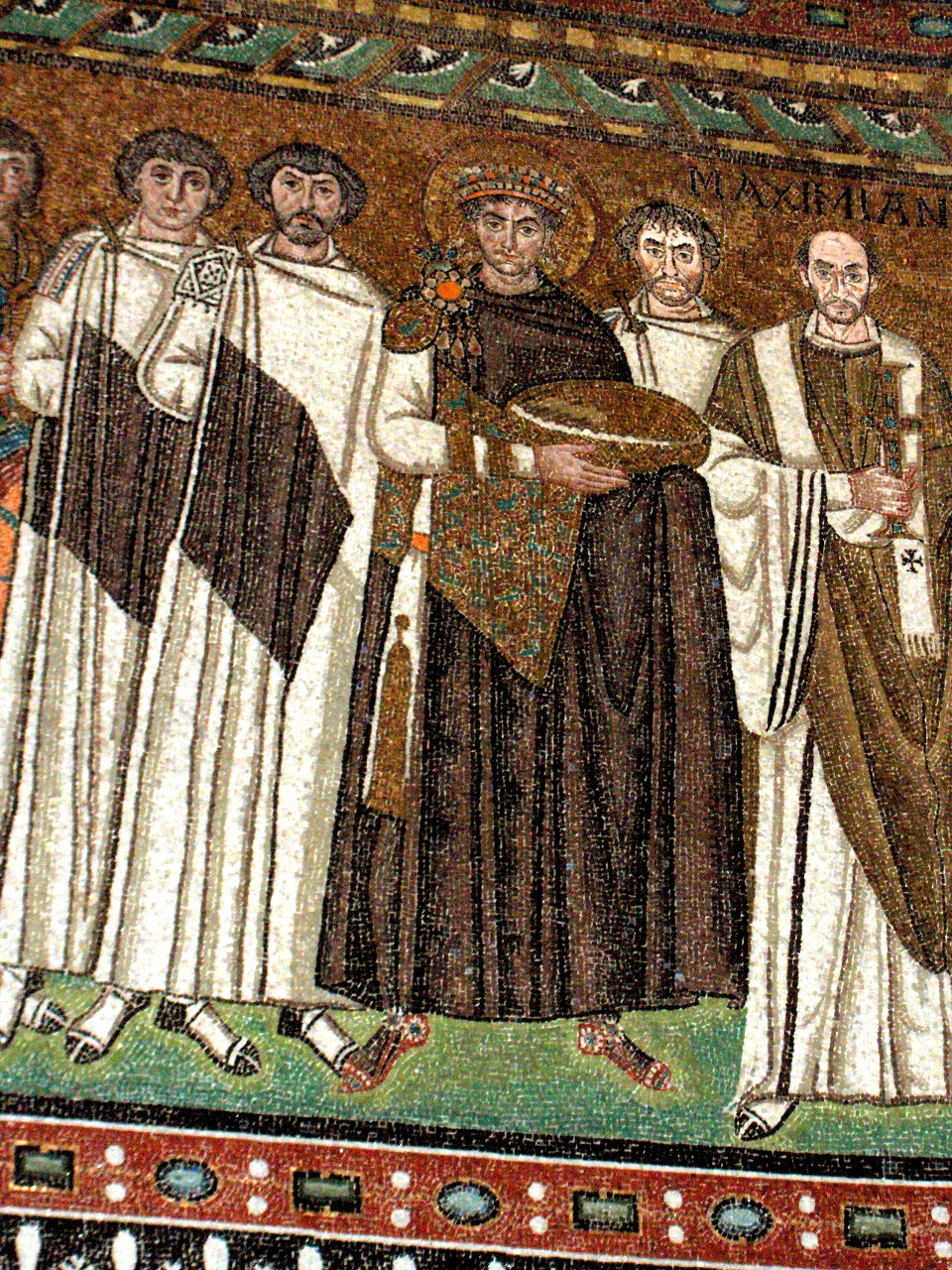
When Chlamys is worn
In classical antiquity, men wore the mantle for hunting, military campaigns, and messenger duties. By the Byzantine period, it had become formal ceremonial attire for dignitaries and emperors. Rulers donned the cloak for secular governance, administering justice, and state occasions. Empresses received the garment during their formal coronation ceremonies, though they wore it far less frequently in public portraiture than religious vestments.
Styles of Chlamys
Foot soldiers in ancient Greece wore a closely related garment known as the ephaptis. Over time, the cloak transitioned from a short woollen field wrap into a floor-length silk court robe. Byzantine versions varied according to rank: only the reigning monarch could wear purple cloth with gold panels, whereas court officials wore white mantles with purple panels. While the emperor wore his mantle with a side slit, court officers wore theirs fastened at the centre.
What Chlamys means
In Greek mythology and art, the chlamys served as the defining emblem of Hermes, the messenger god. During the Byzantine era, the garment carried distinct political meaning. While the jewelled loros sash represented the emperor's sacred spiritual role, the chlamys signified secular authority. It marked the ruler as the supreme head of government, leader of the civil administration, and dispenser of justice throughout the realm.
Questions people ask about Chlamys
Where does the chlamys come from?
The chlamys comes from ancient Greece, where it was worn by soldiers and hunters from the fifth to the third century BC. It later became prominent in the Byzantine Empire as high-level court and imperial attire.
How was the chlamys made?
Originally, it was crafted from a seamless rectangle of woollen cloth with a border. In the Byzantine period, it was typically made of patterned silk, decorated with contrasting fabric panels called tablia, and embellished with embroidery and jewels.
How was the chlamys fastened and draped?
The wearer secured the cloak at the right shoulder with a pin or fibula brooch. Byzantine figures wore it draped sideways so the cloth reached near the ground, leaving an opening at the side or centre.
Who was allowed to wear the chlamys in the Byzantine Empire?
The chlamys was reserved for emperors, empresses during coronation, and high-ranking state officials on formal occasions. Purple cloth with gold panels was strictly restricted to the reigning emperor alone.
Good reading and sources
- Chlamys on WikipediaEncyclopedia
- More photos on Wikimedia CommonsPhotos and video
- Wikidata recordOpen data
The facts on this page come from the Wikipedia article "Chlamys", written by its contributors and used under the CC BY-SA 4.0 licence, and from its Wikidata record (CC0). EveryPallu rewrote the text in its own words, with AI assistance, and compares every page with the article to make sure no passage is copied. It may be reused under the same CC BY-SA 4.0 licence with a link back.
It may contain mistakes. Traditions, weaves and prices differ from one weaver, town or shop to the next, and it is not buying advice. If something is wrong, tell us. Last refreshed 2026-10-04.
Its cousins elsewhere
All wool and pashmina 🇮🇳 India and 4 moreSariसाड़ी
A single unstitched length of cloth, tucked at the waist and slung over one shoulderSilk · Brocade · Ikat
🇮🇳 India and 4 moreSariसाड़ी
A single unstitched length of cloth, tucked at the waist and slung over one shoulderSilk · Brocade · Ikat
 🇮🇳 India and 2 moreMadras
A light handwoven cotton cloth of bright checks, named after the city of ChennaiCotton · Checks and stripes · Embroidery
🇮🇳 India and 2 moreMadras
A light handwoven cotton cloth of bright checks, named after the city of ChennaiCotton · Checks and stripes · Embroidery
 🇮🇳 IndiaChanderi sari
A silk sari woven in Chanderi, Madhya Pradesh, with gold and silver zariSilk · Brocade · Zari work
🇮🇳 IndiaChanderi sari
A silk sari woven in Chanderi, Madhya Pradesh, with gold and silver zariSilk · Brocade · Zari work
 🇮🇳 India and 1 moreMundumuṇṭŭ
A cotton cloth wrapped at the waist, edged with the thicker woven line called the karaCotton · Embroidery
🇮🇳 India and 1 moreMundumuṇṭŭ
A cotton cloth wrapped at the waist, edged with the thicker woven line called the karaCotton · Embroidery