
Sinh
In its own language: ສິ້ນ
A handwoven tube skirt of Laos and northern Thailand, its hem telling where it was made
The sinh is a handmade tube skirt of silk or cotton, worn by women in Laos and in northern and northeastern Thailand. Its pattern and its carefully woven hem can show which region the wearer and the weaver come from.
- A tube skirt, not a draped length: no open end and no pallu
- Made of silk or handwoven cotton, largely in rural areas
- Three parts: hidden waistband, plain body, detailed hem
- The hem and pattern can show which region the wearer is from
- Ordinary wear in Laos; in Thailand it is saved for occasions
What is Sinh?
The sinh is a tube skirt worn by women in Laos and in the north and northeast of Thailand. It is made by hand, usually of silk or of cotton woven on a handloom, and a good deal of the work happens in rural places rather than factories. A finished sinh is built in three parts: a waistband that is folded in and hidden, a plain body in one or two colours, and a hem where the weaving turns busy and detailed. The pattern of the cloth, and the way that hem is worked, can point to the region the wearer comes from.
Where does Sinh come from?
Lao women and Thai women both wear the sinh, and the sources give no founding story or date for it. It belongs to Laos and to northern and northeastern Thailand, and it carries two names: sinh in Lao, pha sin in Thai. Much of the weaving is done in rural areas, and the regional differences are real enough that a cloth can mark where its wearer is from. How often it is worn has changed. In Laos it remains ordinary wear. In Thailand it has moved to occasions.
How is Sinh made?
Two fibres are used: silk, and cotton that is spun and woven by hand. A sinh comes together in three sections. The hua sinh is the waistband, folded inwards so it does not show. The phuen sinh, called tua sinh in Thai, is the body, kept plain and usually limited to one or two colours. The tin sinh is the hem, and it is here that the weaver puts her detail. Fine silk cloth from a recognised weaver is the most prized kind; plainer cotton serves for everyday. Much of this work is done in rural places.
Sinh, drawn
Colours, motifs and borders
The body of a sinh is deliberately quiet: one or two colours, little or no pattern. The interest sits at the hem, where the weaving grows dense and complicated, and the particular arrangement of that detail is a clue to where the piece was made. Read together with the overall pattern, the cloth tells a viewer which region the wearer belongs to. The sources name no individual motifs or colours, so what any given hem contains varies from one weaving place to the next.
How Sinh is worn
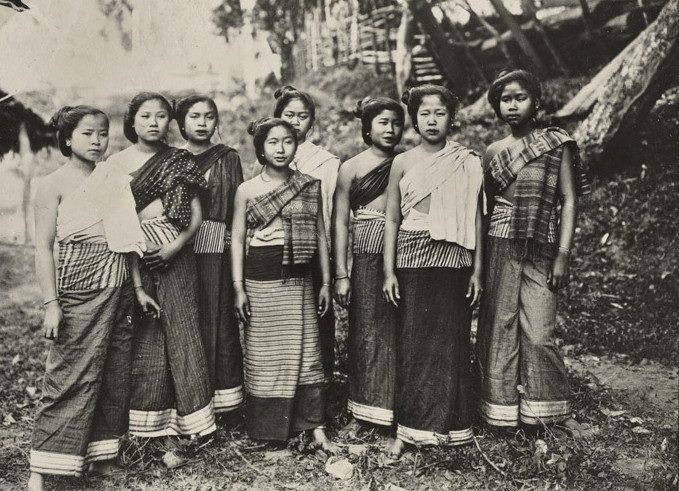
A sinh is a tube, so there is no open end to drape and no pallu. A woman steps into it and folds the top edge over at the waist; the waistband section, the hua sinh, is tucked in and stays out of sight. Women in Laos wear it, and so do women in northern and northeastern Thailand. The sources describe no blouse, no petticoat and no fastened length, so the skirt itself is the whole of what is recorded.


When Sinh is worn
The two countries treat the sinh differently. In Laos it is what women put on for an ordinary day, not a garment kept aside. Across the border in Thailand, the pha sin has become something for celebrations and formal gatherings. The sources do not attach it to any named festival, ritual or religious practice.
Styles of Sinh
Texture and design differ from place to place, and those differences show in the cloth. At the top end there is fine silk, sometimes the work of a weaver with a reputation, and such pieces are the most costly. Handwoven cotton, plainer and less expensive, fills the everyday role. Because the hem carries the identifying detail, two sinhs of the same general shape can look quite unlike each other. The sources do not discuss powerloom versions or modern adaptations.
What Sinh means
The sinh carries place in it. A pattern, and the way a hem is finished, tells people where the wearer and the weaver come from, so the cloth works as a quiet marker of regional identity. It is shared between Laos and Thailand, with a Lao name and a Thai name for the same garment. Its weight in daily life differs between the two countries: ordinary in Laos, occasional in Thailand. Weaving it is rural work, mostly done by hand.
Questions people ask about Sinh
Where does the sinh come from?
It is worn in Laos and in Thailand, particularly by women in the northern and northeastern parts of Thailand. The two languages of the region give it its two names, sinh and pha sin. The sources record no single place of origin for it.
How is a sinh made?
By hand, in silk or in handwoven cotton, mostly in rural areas. Three sections make it up: a waistband folded out of sight, a plain body kept to one or two colours, and a hem that is woven with a great deal of detail.
Is the sinh the same as a sari?
No. A sari is a length of cloth that is draped and tucked, while the sinh is a tube with no open end and no pallu. It belongs to Laos and Thailand rather than to India, though both are garments worn by women.
What do the patterns on a sinh mean?
A pattern can show which region the wearer comes from, and the hem in particular can indicate where the piece was made. The sources do not name individual motifs or colours, so the meaning of a specific design is not recorded there.
When is a sinh worn?
In Laos it remains part of ordinary dress. In Thailand it has become clothing for celebrations and formal gatherings. The sources do not tie it to any particular festival, ritual or religion.
Good reading and sources
- Sinh (clothing) on WikipediaEncyclopedia
- More photos on Wikimedia CommonsPhotos and video
- Wikidata recordOpen data
The facts on this page come from the Wikipedia article "Sinh (clothing)", written by its contributors and used under the CC BY-SA 4.0 licence, and from its Wikidata record (CC0). EveryPallu rewrote the text in its own words, with AI assistance, and compares every page with the article to make sure no passage is copied. It may be reused under the same CC BY-SA 4.0 licence with a link back.
It may contain mistakes. Traditions, weaves and prices differ from one weaver, town or shop to the next, and it is not buying advice. If something is wrong, tell us. Last refreshed 2026-10-03.

Its cousins elsewhere
All silk sarees 🇮🇳 India and 4 moreSariसाड़ी
A single unstitched length of cloth, tucked at the waist and slung over one shoulderSilk · Brocade · Ikat
🇮🇳 India and 4 moreSariसाड़ी
A single unstitched length of cloth, tucked at the waist and slung over one shoulderSilk · Brocade · Ikat
 🇮🇳 India and 1 moreBandhani
Tie-dyed cloth dotted with small tied knots, made in Gujarat and RajasthanSilk · Tie-dye
🇮🇳 India and 1 moreBandhani
Tie-dyed cloth dotted with small tied knots, made in Gujarat and RajasthanSilk · Tie-dye
 🇮🇳 IndiaMundum neriyathumമുണ്ട് നേരിയത്
A two-piece white cotton cloth of Kerala, worn with a golden border called kasavuCotton · Zari work
🇮🇳 IndiaKhandua
An Odisha ikat silk saree woven with temple verses and auspicious motifsSilk · Ikat
🇮🇳 IndiaMundum neriyathumമുണ്ട് നേരിയത്
A two-piece white cotton cloth of Kerala, worn with a golden border called kasavuCotton · Zari work
🇮🇳 IndiaKhandua
An Odisha ikat silk saree woven with temple verses and auspicious motifsSilk · Ikat