
Rogan painting
In its own language: रङ्गन्
Castor-oil paint drawn with a metal stylus to form mirrored patterns on fabric
Rogan painting is an Indian and Afghan textile craft where thick paint made from boiled oil is drawn onto dark fabric with a stylus. Practiced in Gujarat by Khatri and Kansara artisans, it creates mirrored floral and folk motifs for wedding lehengas and sarees.
- Made using thick paint derived from castor oil boiled continuously for about two days.
- Patterns are guided across dark fabric using a metal stylus called a tulika.
- Half of the design is often folded while wet to print a mirror image onto the other side.
- Protected under Geographical Indication status for the Kutch district of Gujarat.
What is Rogan painting?
Rogan painting is an art of decorating textiles with thick, lustrous paint made from boiled seed oil and vegetable pigments. Practiced in India and Afghanistan, the artisan uses a thin metal rod known as a tulika to trail strands of paint across the fabric surface. Historically nurtured by Hindu Khatri artisans in Gujarat, the finished cloth was bought by local women to adorn celebratory attire. The luminous paint stands out sharply against dark backgrounds. Today, artisans make sarees, lehengas, and decorative wall hangings using these detailed freehand patterns.
Where does Rogan painting come from?
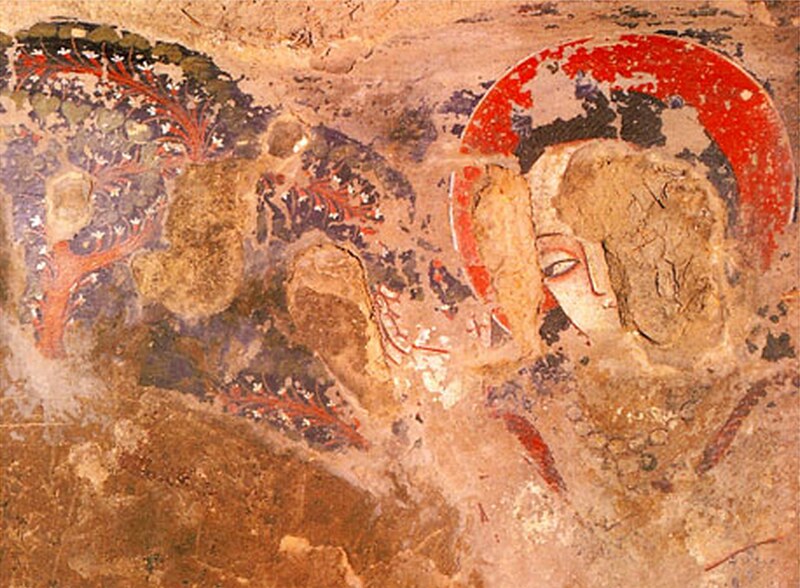
Historical roots of the craft reach from Patliputra in Bihar through Bamiyan to western India. A 2008 study by UNESCO traced Buddhist rogan work back to the fifth or sixth century. The craft name traces to the Sanskrit root rangan, which denotes adding colour or dyeing. In Gujarat, the work took hold across locations including Ahmadabad, Patan, Deesa, Palanpur, Mahesana, and Kutch. It was traditionally a seasonal craft carried out ahead of wedding months, after which artisans turned to farming. Machine-printed textiles in the late twentieth century caused a steep decline in practicing workshops.
How is Rogan painting made?
The paint base requires boiling castor oil over roughly two days until it thickens into a glossy paste, though linseed, poppy seed, or walnut oils can also serve as alternatives. The paste is mixed with natural colour pigments and binding agents. To create a pattern, the artist works freehand, pulling fine threads of paste from the tip of a stylus without piercing the cloth. Often, one half of the layout is painted before the cloth is pressed together along the middle, transferring an identical mirror print to the opposite side. In block printing styles, carved brass molds known as biba stamp the motifs.
Rogan painting, drawn
Colours, motifs and borders
Traditional rogan art uses a palette of five core shades: white, yellow, orange, blue, and green. These bright pigments contrast against deep, dark base fabrics. Designs feature nature-inspired imagery such as floral spreads, animal figures, and local folk art. The tree of life remains the primary signature pattern of the tradition. Embellished styles build on a single-colour base by adding brush-painted colours, mica flakes, or glitter for a sparkling finish.
How Rogan painting is worn
Rogan fabric is fashioned into ceremonial garments including wedding lehengas and sarees worn for major family occasions and festivals. The decorated cloth is also used to construct contemporary accessories like purses, bags, pillow slips, table linens, and framed display art.



When Rogan painting is worn
The craft was historically tied to the seasonal marriage calendar, when women commissioned decorated skirts and cloths for their wedding ceremonies. Today, rogan sarees and garments are chosen for festive gatherings, formal functions, and weddings, while painted panels serve as ceremonial presentation gifts.
Styles of Rogan painting
The craft exists in three forms. Freehand rogan art relies on stylus work and fabric folding for mirror symmetry. Nirmika rogan uses carved brass biba blocks to stamp repeatable prints. Varnika rogan begins with a freehand base line in one shade, followed by brushwork to fill in additional colours and optional mica or glitter.
What Rogan painting means
The rogan craft of Kutch holds Geographical Indication status. Following the 2001 Gujarat earthquake, improved transport and infrastructure boosted regional tourism, helping artisans sell directly to visitors and urban markets. National honors and state awards further elevated the craft, highlighted when Prime Minister Narendra Modi gifted a tree of life painting by Abdul Gafur Khatri to President Barack Obama. In 2026, practitioner Ashish Shantilal Kansara received an honorary doctorate from AKTU Lucknow. To sustain the craft against rising demand, workshops run by the Khatri and Kansara families began training women artisans from outside the family circle.
Questions people ask about Rogan painting
Where does Rogan painting come from?
Rogan painting has ancient roots tracing across Patliputra in Bihar, Bamiyan, and Gujarat. Today, it is practiced mainly in the Kutch district of Gujarat, India, as well as parts of Afghanistan.
How is Rogan paint prepared and applied to cloth?
Artisans boil castor oil for about two days, mixing it with vegetable pigments and binding agents. The thick paint is trailed onto dark fabric using a metal stylus, often folded in half to create a mirror image.
What garments and motifs are typical of Rogan craft?
The craft is renowned for bridal lehengas and sarees featuring floral motifs, animals, and the tree of life. It is also applied to modern accessories and wall hangings.
Good reading and sources
- Rogan painting on WikipediaEncyclopedia
- More photos on Wikimedia CommonsPhotos and video
- Wikidata recordOpen data
The facts on this page come from the Wikipedia article "Rogan painting", written by its contributors and used under the CC BY-SA 4.0 licence, and from its Wikidata record (CC0). EveryPallu rewrote the text in its own words, with AI assistance, and compares every page with the article to make sure no passage is copied. It may be reused under the same CC BY-SA 4.0 licence with a link back.
It may contain mistakes. Traditions, weaves and prices differ from one weaver, town or shop to the next, and it is not buying advice. If something is wrong, tell us. Last refreshed 2026-10-04.
More from India
All the sarees of India 🇮🇳 India and 1 moreBandhani
Tie-dyed cloth dotted with small tied knots, made in Gujarat and RajasthanSilk · Tie-dye
🇮🇳 India and 1 moreBandhani
Tie-dyed cloth dotted with small tied knots, made in Gujarat and RajasthanSilk · Tie-dye
Its cousins elsewhere
 🇮🇩 Indonesia and 5 moreBatikꦧꦛꦶꦏ꧀
A wax-resist way of dyeing cloth, most developed on the island of JavaSilk · Tie-dye · Block print
🇮🇩 Indonesia and 5 moreBatikꦧꦛꦶꦏ꧀
A wax-resist way of dyeing cloth, most developed on the island of JavaSilk · Tie-dye · Block print
 🇮🇳 India and 2 moreChintzछींट
A painted or woodblock-printed floral cotton cloth originating in GolcondaCotton · Block print · Hand painting
🇮🇳 India and 2 moreChintzछींट
A painted or woodblock-printed floral cotton cloth originating in GolcondaCotton · Block print · Hand painting
 🇮🇳 IndiaKalamkariVraata Pani
Cloth art from Andhra Pradesh, drawn with a pen or blocks and dyed with plant coloursCotton · Kalamkari · Hand painting
🇮🇳 IndiaKalamkariVraata Pani
Cloth art from Andhra Pradesh, drawn with a pen or blocks and dyed with plant coloursCotton · Kalamkari · Hand painting
 🇹🇿 Tanzania and 4 moreKanga
A light cotton wrap from East Africa framed with printed borders and Swahili proverbsCotton · Block print · Hand painting
🇹🇿 Tanzania and 4 moreKanga
A light cotton wrap from East Africa framed with printed borders and Swahili proverbsCotton · Block print · Hand painting